
Peasant Life in China: Complete Chapter-by-Chapter Summary

Welcome to our deep dive into Fei Xiaotong's groundbreaking work, *Peasant Life in China*. Today's slide sets the stage for everything we're about to explore: the Jiangcun Economy.
Fei Xiaotong offers us a rare, anthropological look inside a Chinese village navigating a massive collision between traditional agrarian life and the modern global economy. Think of this book not just as history, but as a survival guide for a community caught in the crossfire of industrialization.
The image you see captures the essence of this struggle. We are looking at a water village, where life revolves around the canals, bridges, and boats. This isn't just scenery; it's the engine of the economy. The text highlights that this is a study of a specific village, Kaixiangqiao, located in the rich, water-dense Yangtze Delta. Its geography—warm, wet, and connected by water—made it one of China's most prosperous regions, with a nearby town serving as a hub for collecting local goods and distributing industrial products to Shanghai.
But prosperity didn't last. The core of Fei's analysis lies in the clash of two worlds. On one side, you have the traditional family-based economy, where farming and sericulture were the backbone. On the other, the relentless force of the modern global market. The slide mentions the "collision," and that's exactly what happened. When modern industrial techniques arrived, they destroyed the local family silk industry. Prices for raw silk plummeted, traditional handicrafts collapsed, and the village's financial foundation cracked under the weight of world economic depression.
Fei argues that to understand this, we can't just look at the village in isolation. We must see how local traditions interact with global forces. The village wasn't just a passive victim; it tried to adapt through cooperative silk factories and reforms, yet the gap between local production and global demand remained too wide.
This book is a vital lesson for anyone studying development. It shows us that economic change isn't a simple switch from old to new. It's a complex dance where geography, social structure, and global markets all play a role. By studying this specific village, Fei provides a microcosm that explains the macro challenges facing all of rural China.
So, as we move forward, keep this image in mind: a resilient community trying to stay afloat in rising waters, balancing the weight of tradition against the tide of modernity.

A Milestone in Anthropology: How Fei Xiaotong Changed the Game
Look at this slide. It captures a massive shift in how we understand human societies. On the left, you see "Traditional Anthropology," which focused on isolated, exotic tribes—like that island village depicted. It was about observing "others" from afar. But the arrow points us to "Modern Anthropology": studying advanced, economically vital nations like China.
The quote from Bronisław Malinowski is the heart of this transformation. He predicted that Fei Xiaotong's *Peasant Life in China* would be a landmark not because it studied a foreign land, but because it was a citizen observing his own people. This was revolutionary. Instead of treating rural China as an exotic curiosity, Fei treated it as a complex, modernizing society facing real-world crises.
The key insight at the bottom explains it perfectly: Fei transformed anthropology from a study of strange customs into an applied science of social engineering. He didn't just describe the silk farmers in Kaiqianggong Village; he diagnosed their existential crisis. When global markets crashed and silk prices plummeted, traditional family industries collapsed. Fei analyzed how these economic shocks interacted with local culture, kinship, and land rights. He showed that solving China's problems required understanding the whole system—from the water-logged fields and the cooperative silk factories to the intricate balance between tradition and modernization.
This book proved that anthropology could offer practical solutions for a nation in transition, moving us from studying the "other" to understanding the "us" right in front of us.
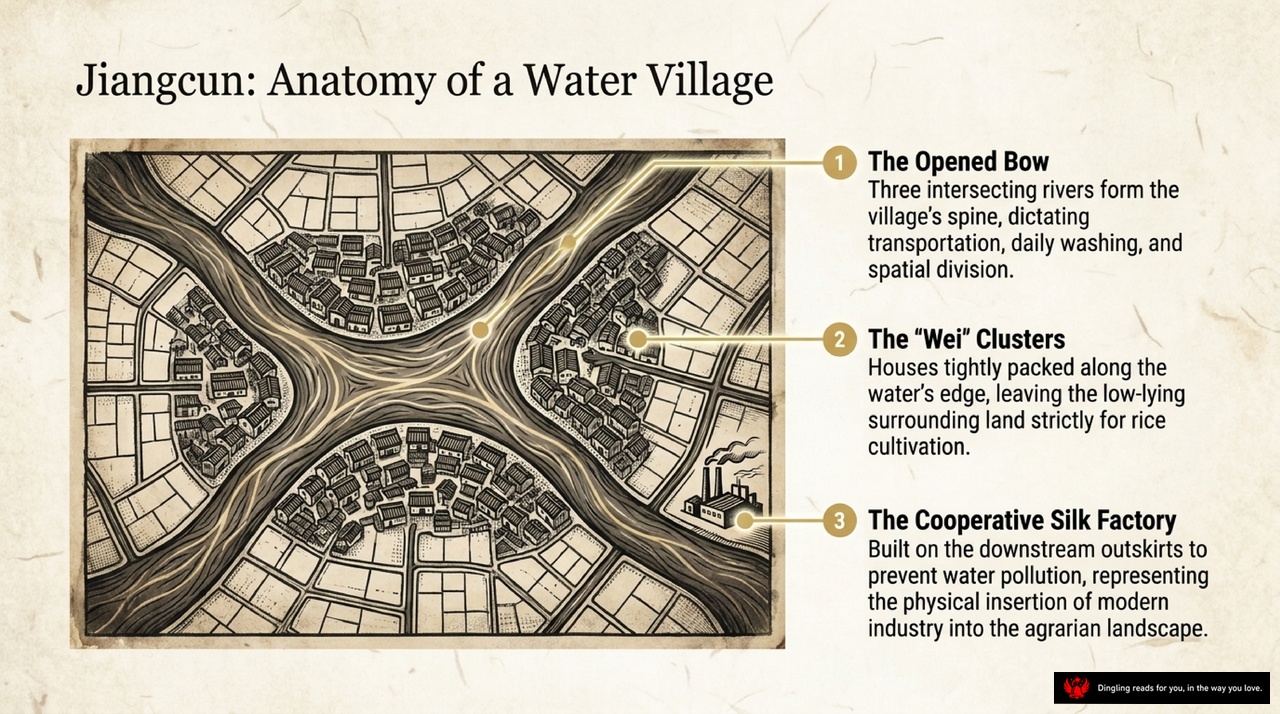
Let's dive into the physical soul of Kaiqianggong Village. As the slide illustrates, this isn't just a random cluster of houses; it's a carefully engineered water village where the river dictates every aspect of life.
First, look at what they call "The Opened Bow." You see those three intersecting rivers? They form the village's very spine. This wasn't just for show; it was the backbone of transportation, daily washing, and how the space was divided. The water defined the boundaries and the flow of daily life.
Then, notice how the houses are packed tightly along the water's edge. These are the "Wei" clusters. By building right on the banks, the villagers left the low-lying land strictly for rice cultivation, maximizing the use of their limited arable space. It's a perfect adaptation to the wet, marshy environment of the Taihu Lake region.
Finally, take a look at the downstream outskirts where you see that factory. This is the Cooperative Silk Factory. Notice its placement? It was deliberately built away from the residential core to prevent water pollution, representing a rare and physical insertion of modern industry directly into the agrarian landscape. This factory was the result of a major reform, shifting production from individual homes to a collective enterprise, and it remains a central pillar of the village's economy today.
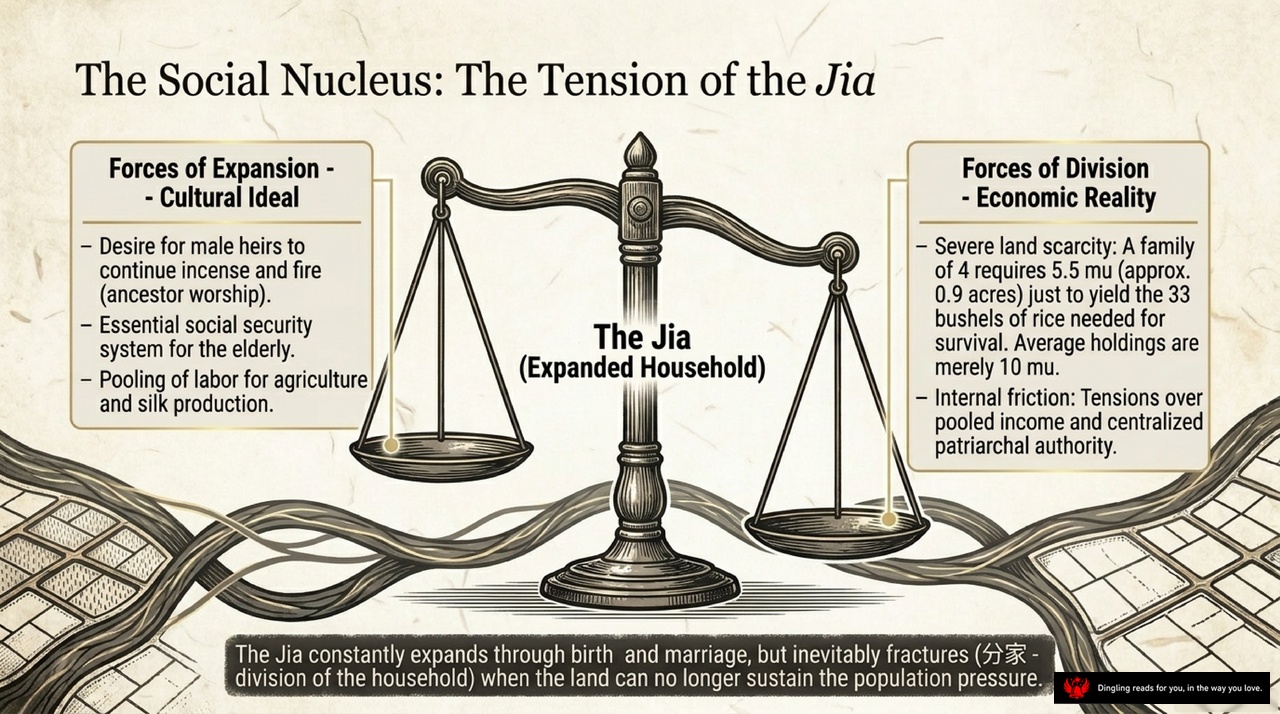
Today's slide captures the central tension that has haunted the Chinese countryside for centuries: the struggle of the *Jia*, or the extended household. On the left, we see the "Forces of Expansion"—the powerful cultural ideals driving the family to grow. There is a deep-seated desire for male heirs to continue the ancestral line, a need for the family to act as a social security net for the elderly, and the practical necessity of pooling labor for farming and silk production. These are the dreams and traditions that pull the family together.
However, on the right side of the scale, we see the harsh "Forces of Division"—the economic reality that threatens to pull it apart. The system faces severe land scarcity; a family of four needs about 0.9 acres just to produce the rice required for survival, yet the average holding is a mere 0.15 acres. This pressure creates internal friction, leading to conflicts over pooled income and the struggle against centralized patriarchal authority.
The image illustrates a perfect balance that is constantly tipping. The *Jia* constantly expands through birth and marriage, but as the land can no longer sustain the population pressure, it inevitably fractures. This cycle of expansion and division, driven by the clash between cultural ideals and economic limits, is the engine of social change in traditional China.
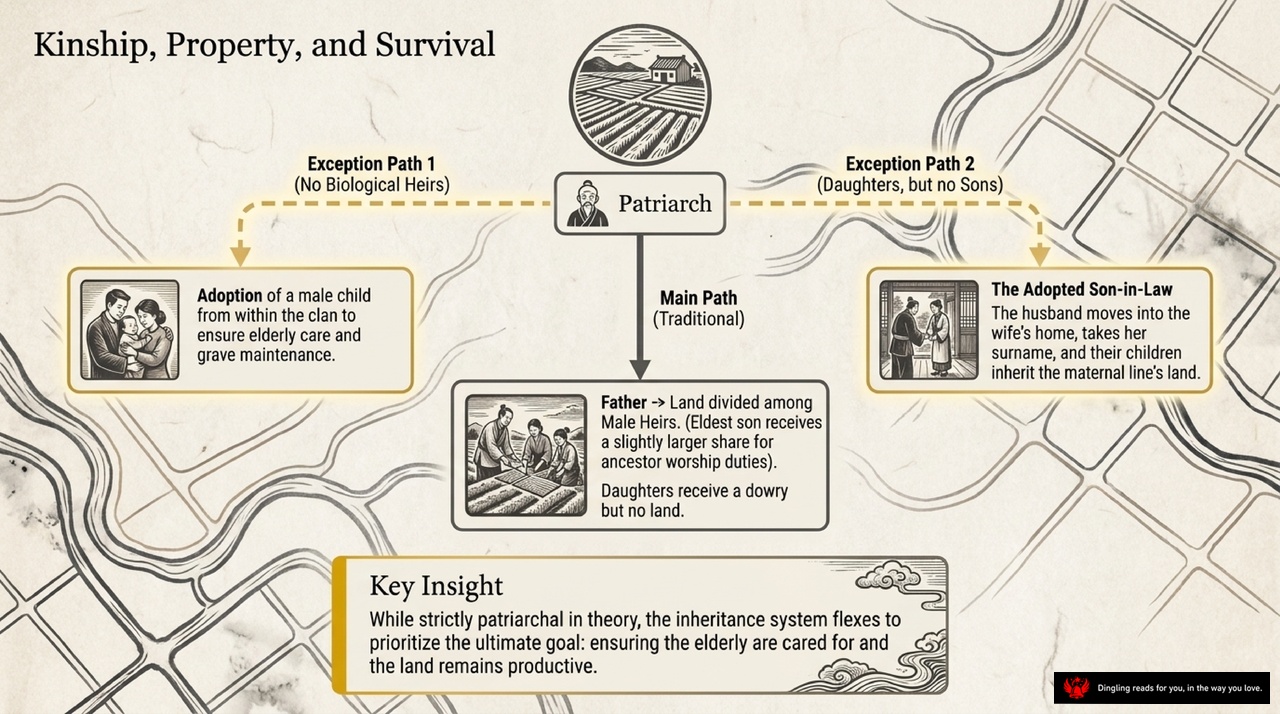
Kinship, Property, and Survival: How Tradition Flexed for Survival
In this system, the patriarch sits at the center, but the path to inheritance isn't always a straight line. When a family has no biological heirs, they turn to Exception Path 1: adopting a male child from within the clan. This isn't just about blood; it's a strategic move to ensure the elderly are cared for and the family's grave is maintained. If there are daughters but no sons, Exception Path 2 kicks in. The husband moves into the wife's home, takes her surname, and their children inherit the maternal line's land. This is known as the adopted son-in-law.
However, the traditional main path remains the ideal. Here, the father divides the land among male heirs, with the eldest son getting a slightly larger share to handle ancestor worship duties. Daughters receive a dowry but no land. Yet, look closely at the bottom of this diagram. The key insight is that while the system is strictly patriarchal in theory, it actually flexes. The ultimate goal isn't just following rigid rules; it's ensuring the elderly are cared for and the land remains productive. This adaptability allowed the community to survive even when faced with the loss of sons, proving that the inheritance system was designed for survival, not just tradition.
Imagine a world where the rhythm of life isn't dictated by a factory clock, but by the turning of the sun and the rising of the tides. In Kaiqianggong Village, time isn't just a measurement; it's the very fabric that holds the community together. While the new schools and the cooperative silk factory have adopted the Western calendar to stay connected with the outside world, the heart of the village still beats to the traditional lunar calendar. It marks birthdays, death anniversaries, and those sacred days for worshipping the Kitchen God, reminding everyone of their place in a spiritual and social order.
But for the farmers, there's another clock that matters most: the solar terms. This ancient system divides the year into 24 stages, guiding every move from planting rice in June to harvesting in October. It's a practical guide to nature's rhythm, ensuring they know exactly when to sow, irrigate, and harvest. Yet, even with this deep knowledge, nature remains a formidable force. When droughts strike or locusts swarm, human effort feels powerless. Here, science and superstition walk hand in hand. While the government tries to ban "superstition," farmers still turn to rituals and even the local magistrate, who once acted as a spiritual healer, to appease the heavens.
This unique relationship with time shapes their labor. Agriculture is overwhelmingly a man's domain, while women, once busy with silk reeling, now find themselves with less work on the land. However, when it comes to the critical task of irrigation and draining the paddy fields, everyone must pull together. The village is divided into drainage units, where labor is shared based on land ownership. This collective responsibility makes it incredibly difficult to introduce modern pumps, as every single family in the unit must agree. It's a perfect example of how their deep-rooted social structure and traditional ways of organizing time and work create both their resilience and their limitations in the face of modern challenges.
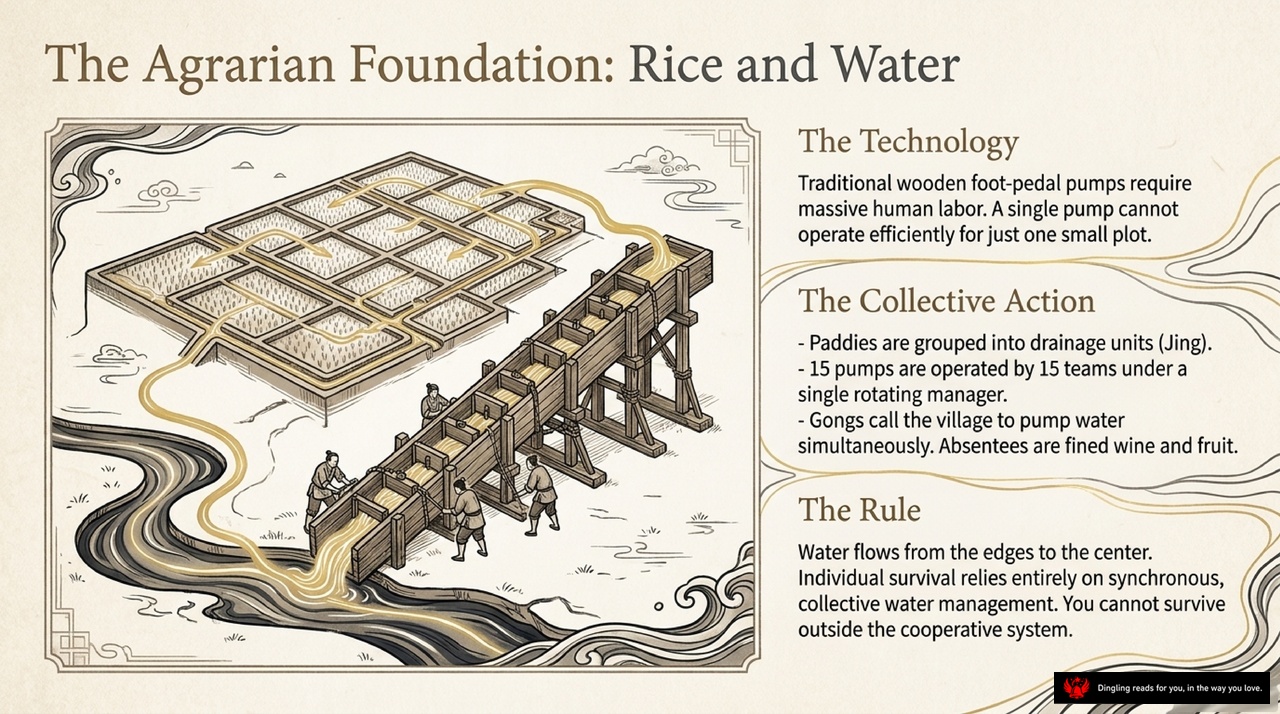
Look at this illustration of the "Agrarian Foundation: Rice and Water." It perfectly captures the delicate, high-stakes dance between farming and hydrology in this village.
The image highlights a massive wooden foot-pedal pump system. You can see the water flowing from the river, up the canal, and into the rice paddies. But here's the catch: traditional technology demands massive human labor. A single pump just can't handle even a small plot efficiently.
That's why we see this incredible "collective action." The paddies are grouped into drainage units called "Jing." In this system, 15 pumps are operated by 15 teams, all under a single rotating manager. You'll notice the gongs in the scene; they call the entire village to pump water simultaneously. It's a synchronized effort where absentees are fined with wine and fruit. No one gets left behind.
This brings us to the core rule illustrated here: water flows from the edges to the center. Individual survival relies entirely on this synchronous, collective water management. You literally cannot survive outside this cooperative system. If one team fails, the whole field dries up. This rigid interdependence is what makes the village's agricultural foundation so strong, yet so vulnerable to any disruption in that human-powered chain.
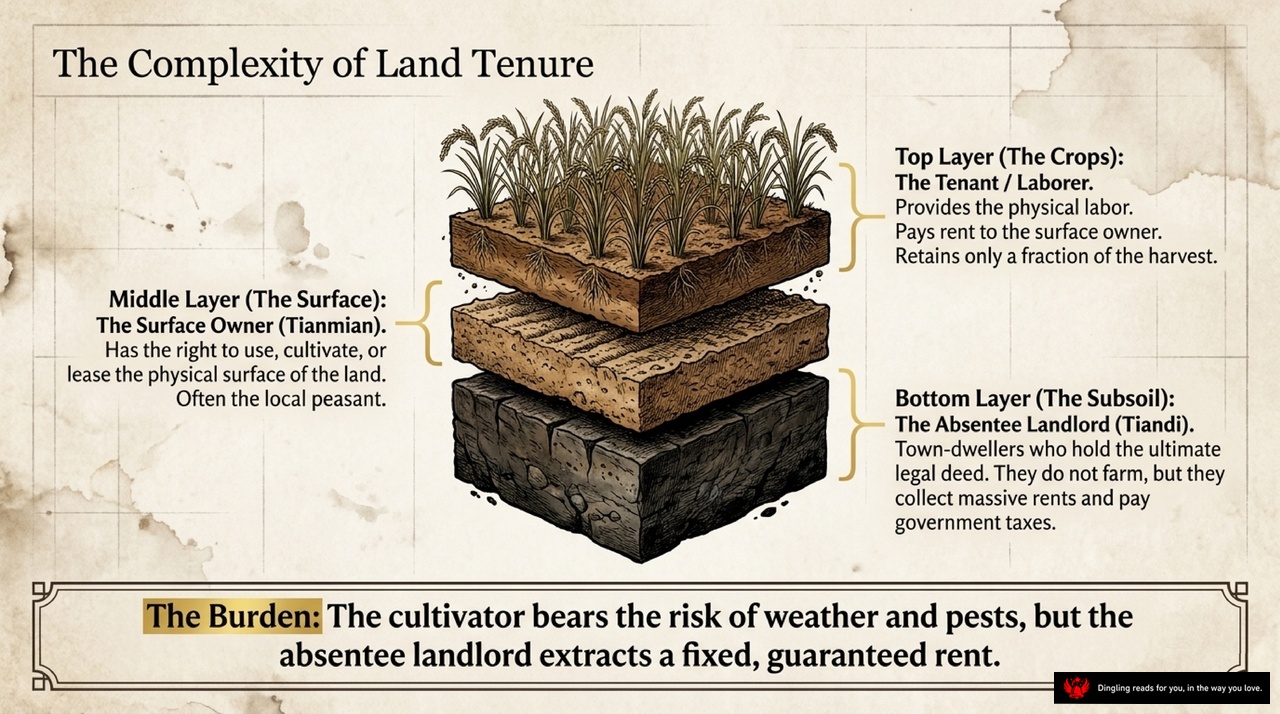
Look at this layered diagram of land tenure. It perfectly illustrates a rigid, three-tiered system that has long defined rural life. At the very top, you see the crops—the physical labor provided by the tenant or laborer. This person works the land but only keeps a fraction of the harvest, paying rent to the layer below.
That middle layer is the surface owner, the *Tianmian*. Often a local peasant, they hold the right to use and lease the physical surface of the land. They act as the bridge between the worker and the ultimate owner.
Beneath it all lies the bottom layer, the subsoil, held by the absentee landlord, the *Tiandi*. These are often town-dwellers who hold the ultimate legal deed. They don't farm a single acre, yet they collect massive rents and pay government taxes.
This structure creates a profound imbalance. As the text emphasizes, the burden is entirely on the cultivator at the top. They bear all the risks of unpredictable weather and pests, yet the absentee landlord at the bottom extracts a fixed, guaranteed rent regardless of the harvest. This disconnect between risk and reward is the core tension driving the economic struggles in the village.

Welcome back. Today, we're diving into the turning point that shattered the village's economic stability: the collapse of the silk industry.
Look at this chart, titled "The Catalyst of Change: The Silk Collapse." It illustrates a dramatic 66% plunge in value between 1930 and 1934. This wasn't just a market fluctuation; it was a total system failure.
On the left, you see two distinct cycles. Men spent six months of heavy field labor growing rice, which formed the core of their survival. Meanwhile, women engaged in intensive, highly skilled indoor labor raising silkworms and reeling silk. For decades, this dual economy kept the household balanced. But then came the global shock. Traditional household silk could no longer meet the standardized quality demanded by modern, mechanized Western looms. As the graph shows, prices plummeted, and the village's primary source of cash income evaporated overnight.
The impact was devastating. With the silk trade gone, households plunged into severe deficit. The men's rice cycle alone was no longer enough to cover the family's needs, exposing the fragility of a system that relied too heavily on a single global commodity. This collapse forced the community to confront the harsh reality that their traditional way of life was no longer sustainable in a changing world.
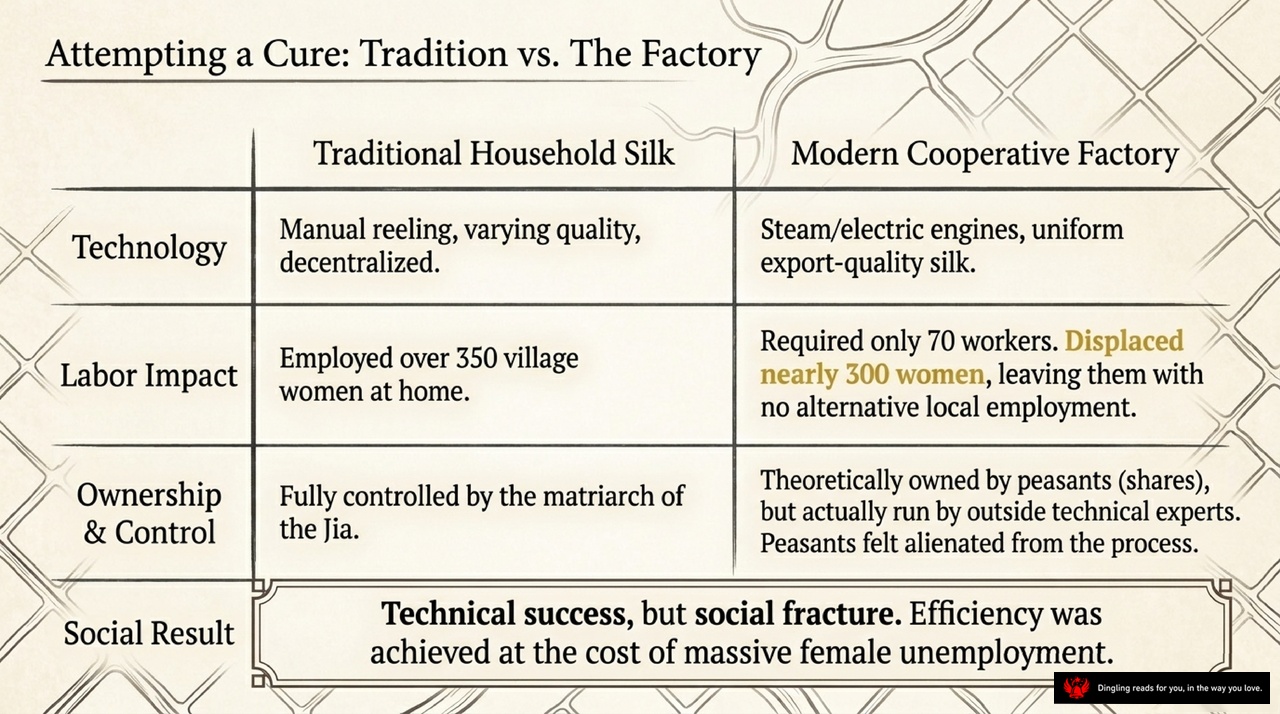
Looking at this slide, we see a stark comparison between the old way of making silk and the new factory model. On the left, we have the traditional household silk production. It relied on manual reeling, which meant quality varied from batch to batch, and the work was decentralized across hundreds of homes. This system employed over 350 village women, keeping them productive right in their own homes.
On the right, we see the modern cooperative factory. By introducing steam and electric engines, the factory could produce uniform, high-quality silk that met export standards. However, this efficiency came at a steep human cost. The factory required only 70 workers to do the work of hundreds, displacing nearly 300 women who suddenly had no local employment options.
Furthermore, the ownership structure changed drastically. While the factory was theoretically owned by the peasant shareholders, it was actually run by outside technical experts, leaving the local farmers feeling alienated and disconnected from the process they helped fund.
The bottom line, as summarized in the red text, is a tragic paradox: the reform achieved technical success and efficiency, but it caused a deep social fracture. We gained better silk, but we lost the livelihoods of hundreds of women, creating a generation of unemployment where there was once work.
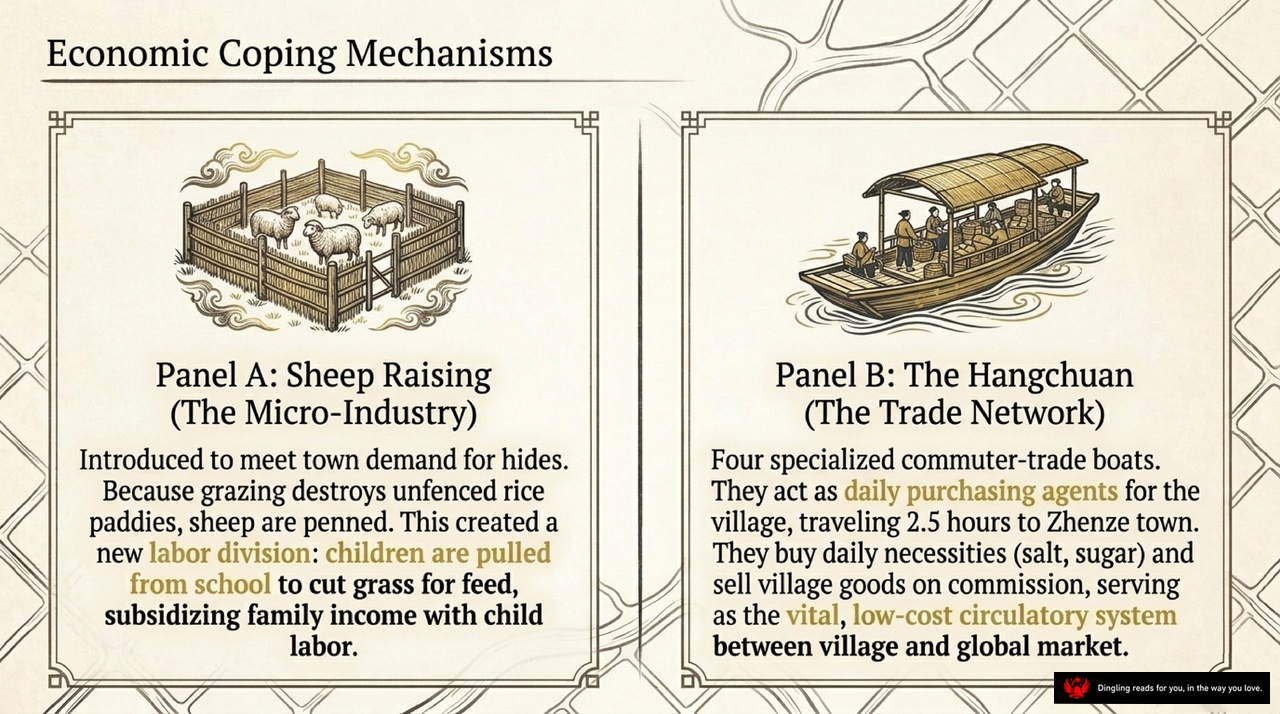
Look at this slide titled "Economic Coping Mechanisms." It breaks down how this village survived economic hardship through two specific strategies: a micro-industry on the left and a trade network on the right.
First, let's look at Panel A, the Sheep Raising. This was a clever adaptation to meet the town's demand for hides. But here's the challenge: grazing sheep freely would destroy the unfenced rice paddies. So, the villagers built pens to keep the sheep safe. This created a new labor division that actually changed the family dynamic. You see the text says children were pulled from school to cut grass for feed. This wasn't just about feeding animals; it was a survival strategy where child labor subsidized the family income.
Now, move to Panel B, The Hangchuan. This represents the trade network. These four specialized commuter-trade boats acted as daily purchasing agents. They traveled 2.5 hours to Zhenze town to buy daily necessities like salt and sugar, then returned to sell village goods on commission. This system served as a vital, low-cost circulatory system between the village and the global market. Without these boats, the village would be cut off from the world.
So, the village didn't just wait for help; they built a micro-industry to generate cash and a dedicated trade network to move goods. These two mechanisms worked together to keep the community stable despite the pressures of the changing global economy.

Imagine a leaking bucket trying to stay full. That's the reality for the farmers in Kaixiangqiao. Money pours in from rice harvests, silk sales, and trade, but it drains out just as fast. You see, a massive 4,800 bushels of rice are siphoned off every year as absentee rent, flowing straight to distant landlords. At the same time, the pressure to maintain social standing forces families to spend 200 to 400 yuan on weddings alone. Add to that the crushing weight of global deflation, which has plummeted the value of their raw materials, and you have a structural deficit. With income consistently falling short of expenses, the community is forced into a desperate "band-aid" strategy. They rely on high-interest loans and traditional mutual aid societies, where neighbors pool about 40 yuan annually to survive. But this isn't a solution; it's just a temporary fix for a broken system, leaving the village drowning in debt with no way to plug the holes in their bucket.

Synthesis: The Dual Forces of Transformation. Look at this image. We are witnessing a massive geological shift in rural China, driven by the collision of two tectonic plates. On the left, we have Plate 1: the Traditional Agrarian Equilibrium. This was a stable world built on strict land tenure, patriarchal family structures, and a delicate balance where manual labor directly translated into rice survival. It was a self-contained system. But then, on the right, comes Plate 2: Global Industrialization. This force is defined by volatile global market pricing, mechanized factories, and the relentless demand for standardized export goods.
The result? A violent fault line right in the middle. As these two worlds collide, they don't just merge; they mutate society in bizarre ways. The cooperative factories displace traditional women's labor, pushing them out of the home. Economic depression forces the adoption of "cheap" marriages, like taking in sons-in-law to reduce costs. Even children are pulled from school to raise sheep for global hide markets. This isn't just an economic shift; it's a total social reordering. The old balance is shattered, and a new, often harsh reality is emerging, where local traditions are being rewritten by the pressures of the global market.
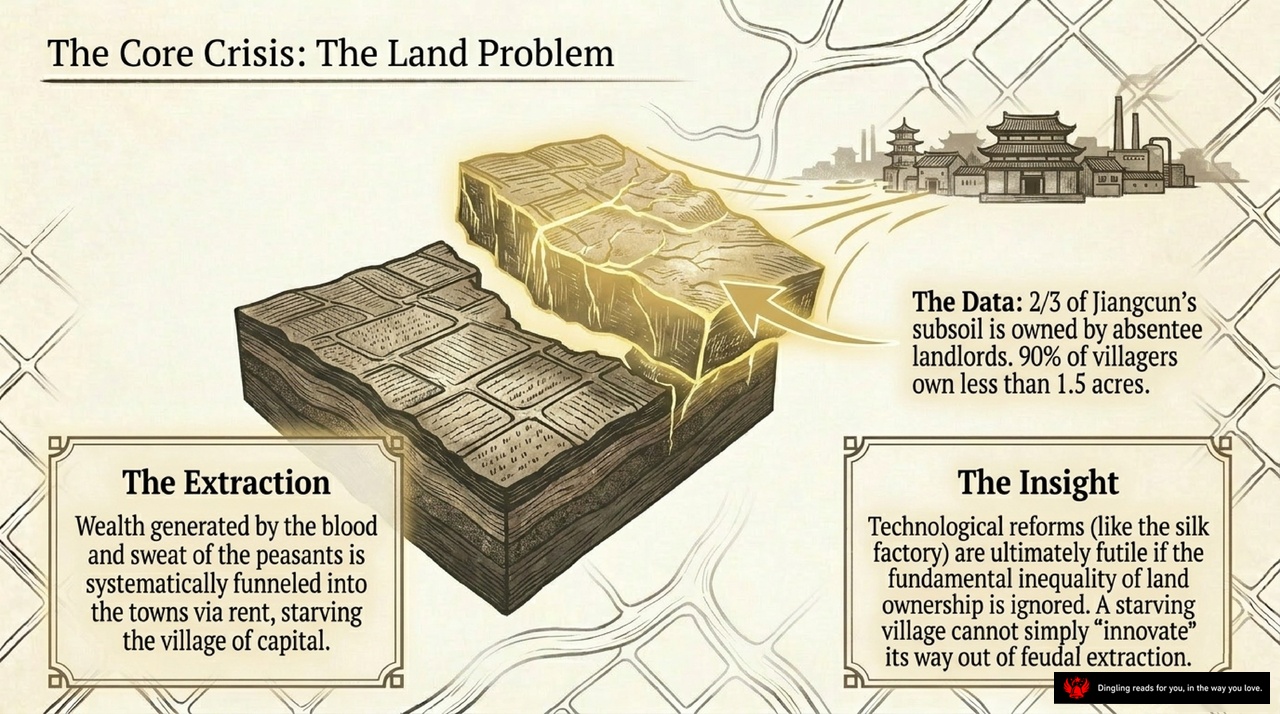
Look at this cracked earth. This isn't just a metaphor; it's the reality of Jiangcun. Two-thirds of the land here belongs to absentee landlords, while 90% of the villagers own less than 1.5 acres. This is the core crisis: the land problem.
Imagine the wealth generated by the peasants' blood and sweat. Instead of staying in the village to build capital, it gets systematically funneled into the towns via rent. The village is literally being starved of the resources it needs to grow.
Now, here is the hard truth: you cannot simply innovate your way out of this. The slide highlights a crucial insight: technological reforms, like the silk factory, are ultimately futile if you ignore this fundamental inequality in land ownership. A starving village cannot simply "innovate" its way out of feudal extraction. If you fix the technology but leave the land distribution untouched, you are just trying to speed up the process of draining the village dry. Without solving the land problem first, no amount of industrial progress will save the community.

Look at this solitary figure standing by the canal in Jiangcun. He represents the quiet desperation of a nation caught between the weight of the past and the relentless demands of the future. The slide reminds us that technological reform and industrialization here proved futile without addressing the fundamental inequalities of land ownership. It wasn't just about new machines; it was about who actually owned the land.
This village's struggle is a microcosm of a nation trapped between feudal tradition and the global market. We see this clearly in the slide's question: If technological advancement only displaces labor without redistributing wealth, can modernization ever truly save a society, or does it merely redesign its poverty?
In Jiangcun, the introduction of modern silk factories did displace thousands of rural women who had once earned their livelihoods spinning thread at home. Yet, without fixing the land system, where these displaced workers could go was limited. The wealth generated by the new industry flowed away, while the original laborers faced a hollowed-out existence. The slide asks us to consider the deeper cost of progress. When we talk about "modernization," are we building a ladder out of poverty, or are we just changing the shape of the cage people live in? True development requires not just better tools, but a fairer distribution of the resources those tools create.