
Primal Leadership: Complete Chapter-by-Chapter Summary
Welcome, everyone. Today, we're diving into *Primal Leadership* by Daniel Goleman, Richard Boyatzis, and Annie McKee. If you think leadership is just about IQ or strategy, this book will challenge that view. As you can see on the screen, the core message is simple yet powerful: "Great leadership works through the emotions, transforming intellect into resonance to drive outstanding organizational performance." In other words, true influence isn't about commanding from above. It's about connecting. When leaders tap into emotional intelligence, they turn raw intelligence into something deeper—resonance. This isn't just theory; it's the difference between a good team and a great one. Over the next hour, we'll explore how to harness this power. Let's get started.
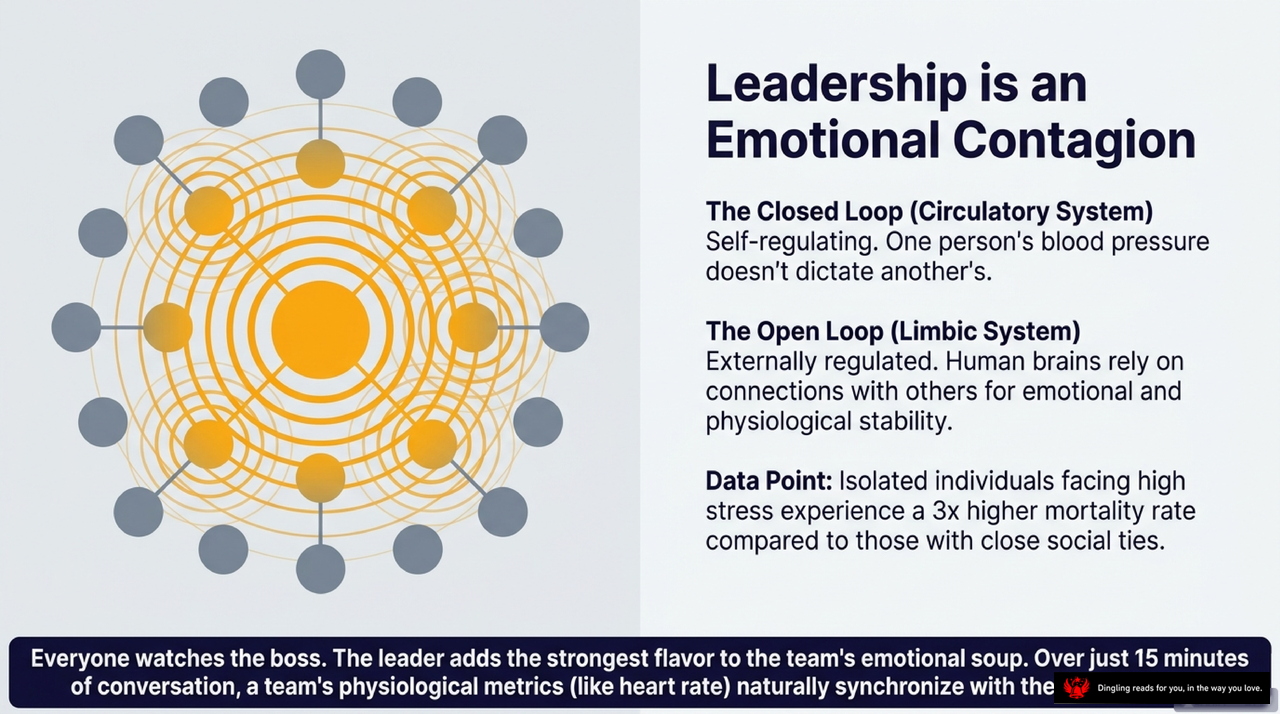
Let's look at the science behind leadership. The slide highlights a crucial distinction between two systems. First, the "Closed Loop," like your circulatory system, is self-regulating. Your blood pressure doesn't change just because someone else's does. But the second system, the "Open Loop" or Limbic System, is externally regulated. Our brains rely on connections with others for stability.
This is why leadership is an emotional contagion. Emotions spread like viruses. The slide notes a stark data point: isolated individuals facing high stress experience a 3x higher mortality rate compared to those with close social ties. This proves the biological cost of isolation versus connection.
Now, look at the leader's role. The text reminds us that "Everyone watches the boss." The leader adds the strongest flavor to the team's emotional soup. It's not just about what you say, but what your body does. Over just 15 minutes of conversation, a team's physiological metrics, like heart rate, naturally synchronize with the leader.
If you are calm, the team stabilizes. If you are stressed, the team panics. Because the Limbic System is open, your state dictates theirs. Understanding this open loop is the first step to mastering the emotional environment you create. You aren't just managing tasks; you are managing the emotional reality of your team.
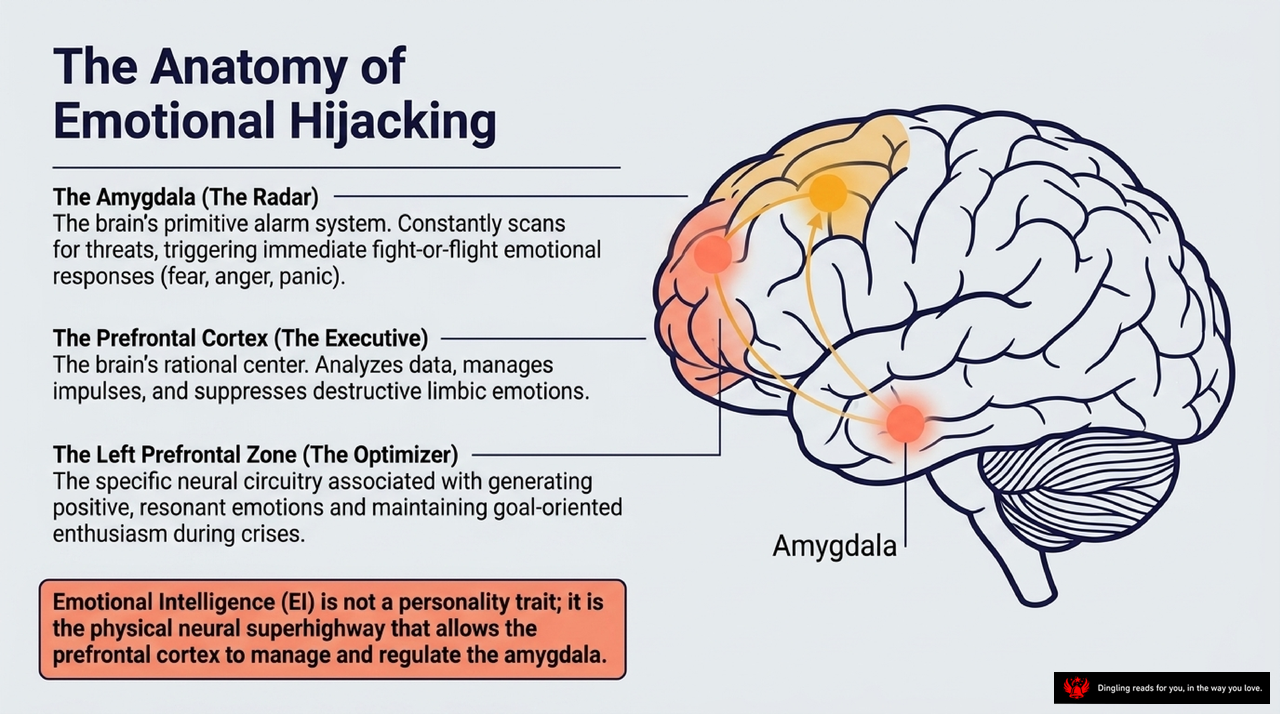
So, let's dig into the biology behind why we lose our cool. It's not just about "feeling" angry or stressed; it's about what's actually happening in your brain. This slide breaks down the anatomy of emotional hijacking.
First, look at the Amygdala. The slide calls it "The Radar." It's your brain's primitive alarm system. It's constantly scanning for threats, and when it spots danger, it triggers an immediate fight-or-flight response. You feel fear, anger, or panic instantly. This is that primitive limbic system we talked about—it operates fast, often faster than you can think.
Next, we have the Prefrontal Cortex, labeled here as "The Executive." This is your brain's rational center. It analyzes data, manages impulses, and tries to suppress those destructive limbic emotions. It's the part of you that wants to think before acting.
And lastly, there's the Left Prefrontal Zone, or "The Optimizer." This is the specific neural circuitry associated with generating positive, resonant emotions and maintaining goal-oriented enthusiasm, even during a crisis. This is what helps you stay focused when things get tough.
But here is the most important part, right at the bottom of the slide. It states that Emotional Intelligence is not a personality trait. It is the physical neural superhighway that allows the prefrontal cortex to manage and regulate the amygdala.
This means EI is literally a physical connection in your brain. When that superhighway is strong, your Executive can calm down your Radar. But when it's weak or blocked, your Amygdala takes over, and you get hijacked. You lose your rational judgment, your focus disperses, and you might make impulsive decisions that you regret later.
As we've discussed, negative emotions like anger or anxiety can hijack your brain's information processing. They make it hard to be rational. So, building Emotional Intelligence is about strengthening that neural connection. It's about training your Prefrontal Cortex to stay in control when your Amygdala screams for a reaction. Whether you're leading a team or managing your own stress, understanding this anatomy gives you the power to regulate your response, not just be a victim of it. It's the difference between reacting and responding.
Remember, the brain is plastic. You can actually strengthen this superhighway through practice. Every time you pause and choose a rational response over an emotional one, you are reinforcing that neural pathway. Over time, that superhighway gets wider and faster, making it easier to manage your emotions. That's the science behind why self-management works.
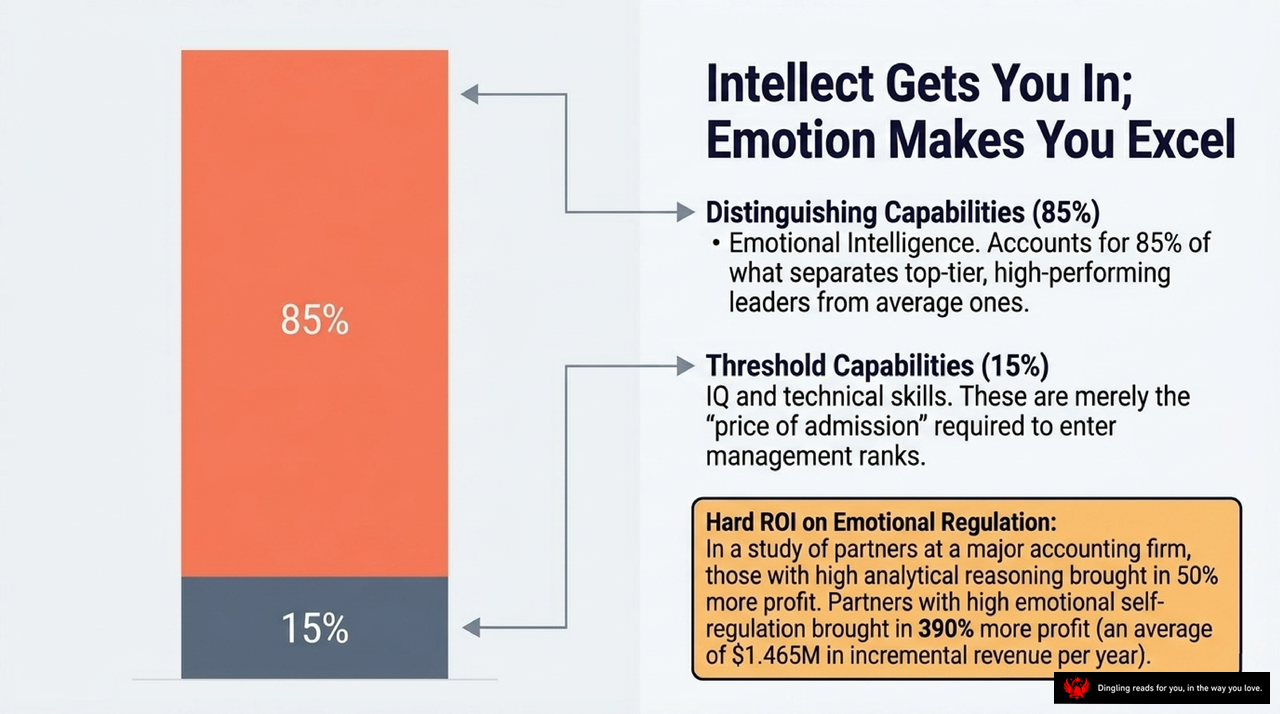
Let's talk about what actually separates a good leader from a great one. You might think it's about IQ or technical expertise, but the data tells a different story. Look at this breakdown: Intellect gets you in the door, but emotion makes you excel.
Here's the hard truth. Eighty-five percent of what separates top-tier, high-performing leaders from the average ones is actually Emotional Intelligence. That's what we call Distinguishing Capabilities. The other fifteen percent? That's Threshold Capabilities—your IQ and technical skills. Think of that 15% as the price of admission. You need it to get into management ranks, but it doesn't make you a star. It just gets you the interview. Without it, you're stuck at the threshold.
Why does this matter? Because the ROI on emotional regulation is massive. A study of partners at a major accounting firm shows that while high analytical reasoning brought in 50% more profit, partners with high emotional self-regulation brought in 390% more profit. That's an average of 1.465 million dollars in incremental revenue per year. That is a huge difference between a good year and a great year.
This isn't just about soft skills. As we discussed earlier, emotional capability is the core lever for leaders to unlock team efficiency and achieve organizational goals. It impacts performance far more than simple business skills. Research shows the essential gap between leaders isn't IQ or professional ability, but the ability to perceive and regulate emotions to build trust and drive teams. Johnson & Johnson's study of 358 executives confirmed that potential leaders with empathy and resonance outperformed the control group. Lyle Spencer's model for industrial control companies showed that training these capabilities doubled department profits compared to the control group. Without it, even the best strategy can fail because you can't rally the team or navigate conflict. We see this time and time again.
So, don't underestimate the power of your emotional side. It's not just about feeling; it's about performance. It's the difference between getting hired and getting promoted, between being a manager and being a leader. If you want to excel, you need to focus on that 85%. You need to master the emotional game, because that's where the real value is created. It's not about suppressing your feelings, it's about using them to drive results. That's the real secret to leadership success.
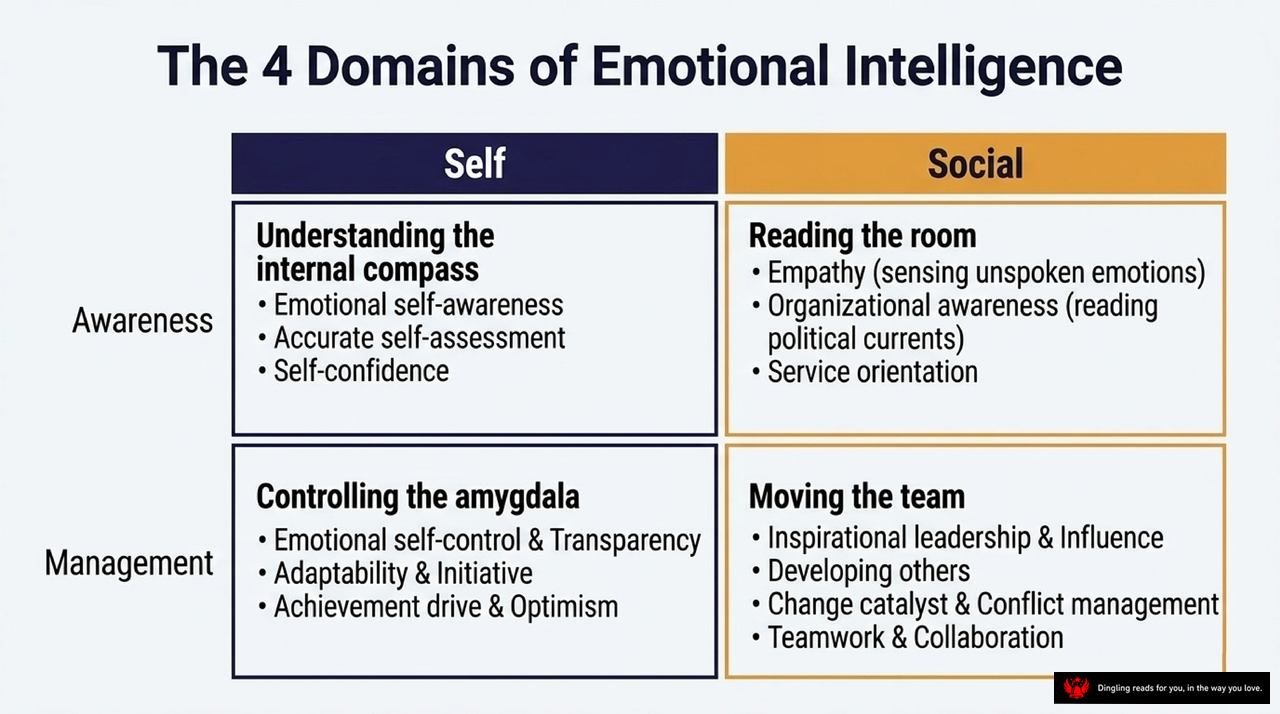
Okay, let's break down the framework on this slide. This model simplifies emotional intelligence into four core domains that define a truly effective leader.
On the left, we have the Self domain. This is your internal foundation.
At the top, under Awareness, it's about understanding your internal compass. Think of it as knowing your own emotional baseline. You need accurate self-assessment and confidence. Without this, you're flying blind.
Below that, we have Management. The text calls it "Controlling the amygdala." This is about emotional self-control and transparency. It's not just about suppressing anger; it's about adaptability, initiative, and keeping that achievement drive and optimism alive even when the pressure is on.
Now, look at the right side, the Social domain. This is where you interact with the world.
The top section is Awareness, specifically "Reading the room." This goes beyond just seeing people; it's about empathy—sensing unspoken emotions—and organizational awareness, understanding the political currents at play. It's also about service orientation.
The bottom section is Management, labeled "Moving the team." This is where you translate your internal state into action. It involves inspirational leadership and influence, developing others, acting as a change catalyst, managing conflict, and fostering true teamwork and collaboration.
Notice the flow here. Self-awareness is the foundation. You can't manage your emotions if you don't know them. Then, self-management builds on that. Similarly, social awareness feeds into relationship management. You can't move a team if you can't read the room.
Think of it this way: The Self domain is about managing your own engine, while the Social domain is about steering the vehicle. If you have a powerful engine but can't steer, you crash. If you can steer but the engine is broken, you stall.
The research shows that leaders who master all four domains—Self Awareness, Self Management, Social Awareness, and Relationship Management—are significantly more effective. They build trust, navigate complexity, and drive performance. It's not about being nice; it's about being effective. By integrating these four domains, you move from just managing tasks to truly leading people. This matrix gives you a clear roadmap to diagnose where you might be struggling and where you need to grow.
Ultimately, this isn't just a chart. It's a practical toolkit. When you understand the connection between your internal state and your external impact, you stop reacting to situations and start leading through them. That's the difference between a manager who just gets things done and a leader who inspires people to do great work.
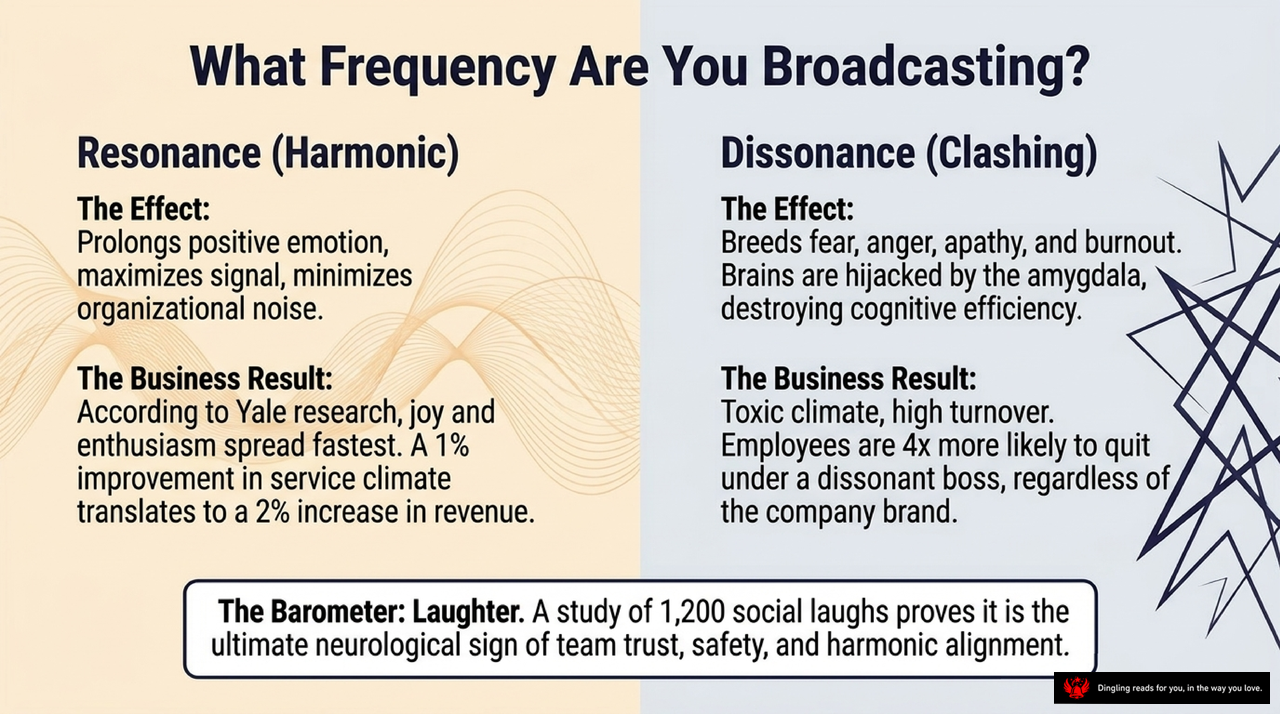
Let's talk about the frequency you're broadcasting. Are you resonating or clashing? Think of your leadership style as a radio signal. When you broadcast resonance, it's harmonic. It prolongs positive emotions, maximizes your signal, and minimizes the organizational noise that distracts your team. Yale research shows this has a direct financial impact. A mere 1% improvement in the service climate can translate to a 2% increase in revenue. Joy and enthusiasm spread fastest, creating a virtuous cycle.
On the other side, you have dissonance. This is clashing. It breeds fear, anger, apathy, and burnout. Biologically, it hijacks the brain's amygdala, destroying cognitive efficiency. The business result is a toxic climate and high turnover. Employees are four times more likely to quit under a dissonant boss, regardless of the company brand. This isn't just about personality; it's about the emotional reality of the workplace.
But how do you know which frequency you're on? Look at the barometer. It's laughter. A study of 1,200 social laughs proves it is the ultimate neurological sign of team trust, safety, and harmonic alignment.
In the book, we see that emotional contagion works like a virus. The leader's state is the 'anchor.' If you're resonating, you create a safe space where people feel understood. If you're dissonating, you trigger the 'fight or flight' response. The text highlights that leaders who lack emotional resonance often face a 'dissonant' environment where trust evaporates.
So, ask yourself: Is your team laughing? Is the amygdala being hijacked, or is the prefrontal cortex leading? Your choice of frequency determines whether you build a high-performance team or a high-turnover culture. Choose resonance.
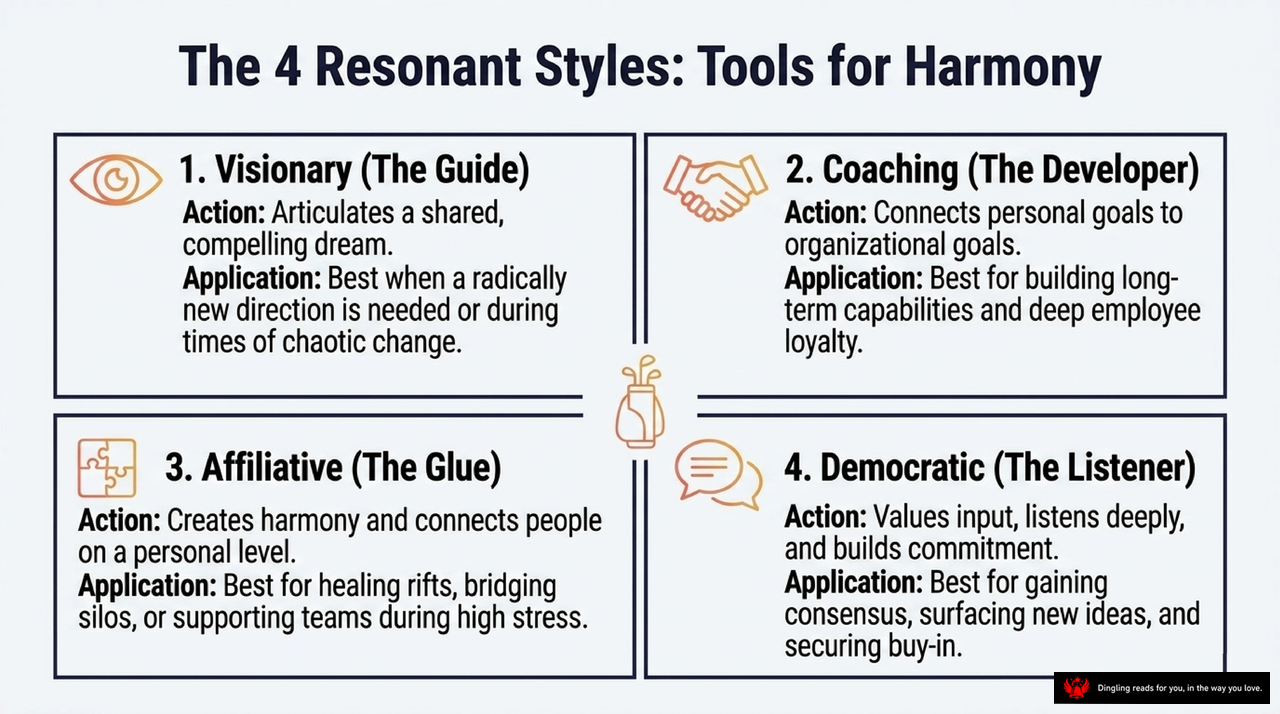
Let's dive into the four resonant styles—these are our core tools for creating harmony within a team. Think of them as different instruments in your leadership orchestra, each playing a specific role depending on the situation.
First, the Visionary, or The Guide. This leader articulates a shared, compelling dream. This style is best when you need a radically new direction or are navigating chaotic change. It's about painting a picture of the future that everyone can rally behind. It gives the team a sense of purpose when the path ahead is unclear.
Second, Coaching, or The Developer. This leader connects personal goals to organizational goals. The focus here is on growth. It's best for building long-term capabilities and deep employee loyalty. You're helping them see how their individual success ties into the company's success. It turns employees into partners in their own development.
Third, Affiliative, The Glue. This leader creates harmony and connects people on a personal level. This is your go-to for healing rifts, bridging silos, or supporting teams during high stress. It builds the emotional safety net that allows people to perform. When the pressure is high, connection becomes more important than productivity.
Finally, Democratic, The Listener. This leader values input, listens deeply, and builds commitment. This is the best style for gaining consensus, surfacing new ideas, and securing buy-in. It makes everyone feel like an owner of the outcome. When you want your team to take ownership, you listen first.
Notice how each style has a specific action and a specific application. The Visionary acts by dreaming, applied during change. The Coach acts by connecting, applied for growth. The Affiliative acts by harmonizing, applied during stress. The Democratic acts by listening, applied for consensus.
Remember, these aren't mutually exclusive. A great leader knows when to switch gears. Maybe you need a Visionary to start a new project, then switch to Coaching to develop your team, or use Affiliative to smooth over tensions. By mastering these four styles, you stop trying to force a single mold onto every situation, and instead, you lead with emotional intelligence and adaptability. This flexibility is what transforms a group of individuals into a high-performing team.
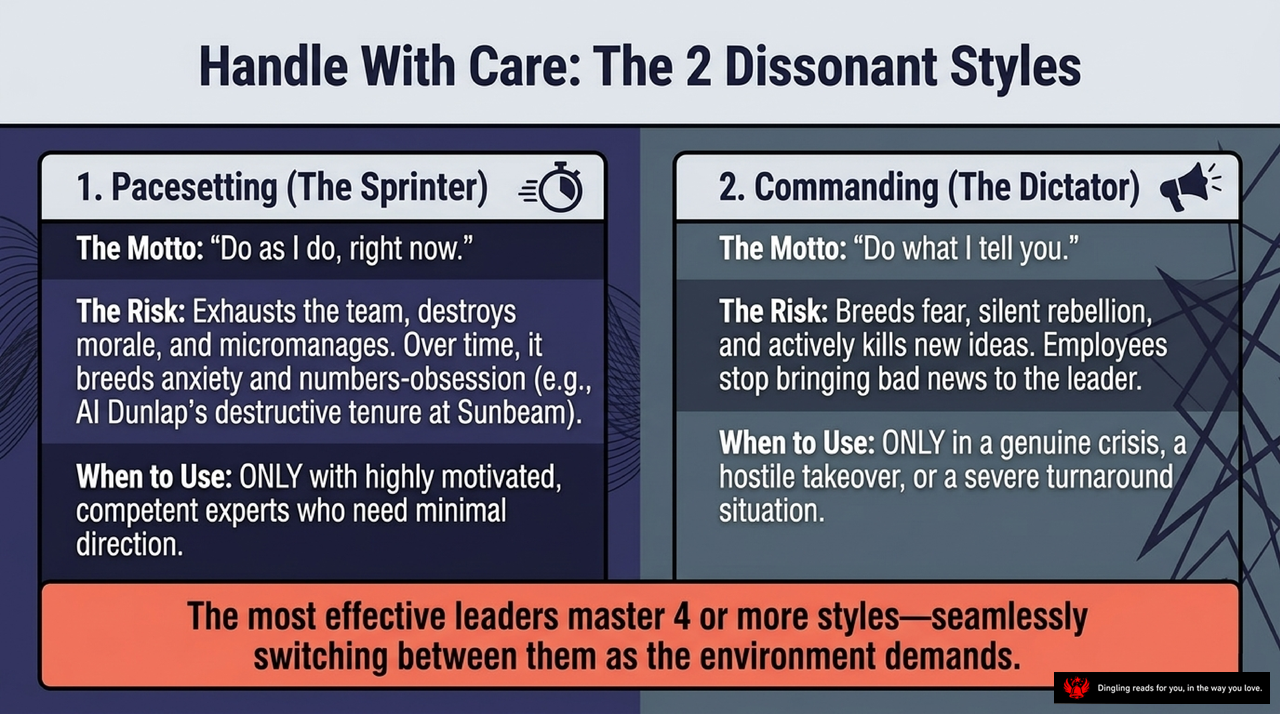
Let's be honest, not all leadership styles are created equal. Today, we're focusing on the two dissonant styles that require careful handling. If you misuse them, they can tear a team apart.
First, look at Pacesetting, or 'The Sprinter.' The motto is simple: 'Do as I do, right now.' It sounds motivating, but the risk is that it exhausts the team and destroys morale. It leads to micromanagement and breeds anxiety, making everyone obsessed with numbers rather than real value. Over time, this style creates a toxic environment where people just chase targets. The book even cites a destructive tenure at Sunbeam as a warning. This style only works when you have highly motivated, competent experts who need minimal direction. If your team lacks that drive or skill, this style will backfire.
Then, on the other side, we have Commanding, or 'The Dictator.' The motto is blunt: 'Do what I tell you.' This approach breeds fear and silent rebellion. It actively kills new ideas because employees learn to hide bad news from the leader. The risk here is high; it creates a culture where no one speaks up. However, the book clarifies when to use this: ONLY in a genuine crisis, a hostile takeover, or a severe turnaround situation. Outside of those extreme moments, this style is the least efficient.
So, what's the takeaway? The slide reminds us that the most effective leaders master four or more styles. They don't just pick one and stick with it. They seamlessly switch between them as the environment demands. You might use Commanding to stop a bleeding ship, but you need to switch to something more collaborative once the crisis passes. If you rely too heavily on these dissonant styles, you'll lose your talent and your trust. The goal isn't to be one style, but to be adaptable enough to know which style fits the moment. Remember, flexibility is the key to sustainable leadership.
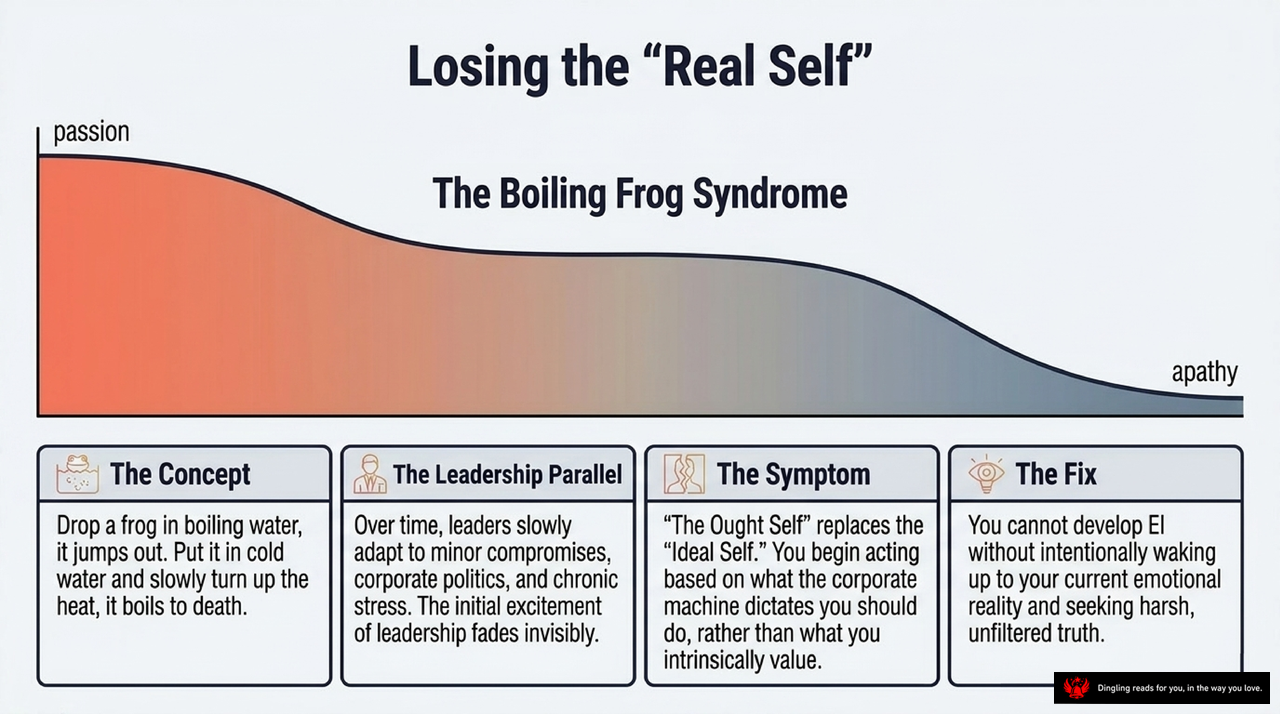
Let's talk about losing the Real Self. Look at this graph. It illustrates the Boiling Frog Syndrome. We start with passion, but slowly slide into apathy. It's like a frog in cold water that gets boiled without noticing.
In leadership, this happens when we slowly adapt to minor compromises, corporate politics, and chronic stress. The initial excitement of leadership fades invisibly. This is the concept.
The book dives deeper into this. It distinguishes between the Ideal Self and the Real Self. The Ideal Self is the image we want to be, while the Real Self is our current state. The gap between them is the core motivation for growth. But over time, The Ought Self replaces the Ideal Self. You start acting based on what the corporate machine dictates you should do, rather than what you intrinsically value. This is the symptom. You lose your authentic self.
Why does this happen? Because we often suffer from self-deception. We live in a Hopeful Self bubble, hiding from the truth. We tell ourselves things are fine, but our emotional reality is different. The text warns us: we need to break this self-deception.
Many leaders fall into a fixed mindset, believing their leadership style cannot change. They surround themselves with people who won't give negative feedback. This creates a vicious cycle, keeping them stuck in mediocrity. But the book says growth comes from wanting to break out of this. We need to distinguish between the Hopeful Self and the Real Self.
So, what is the fix? You cannot develop emotional intelligence without intentionally waking up to your current emotional reality and seeking harsh, unfiltered truth. You need to find the gap between your Ideal Self and your Real Self.
Think about it. Are you living in a bubble? Or are you facing the reality? The text suggests using 360-degree feedback to see the truth. It's not about being perfect, it's about being real. We need to ask ourselves: Am I still excited? Am I still finding joy? If not, we are drifting. We need to actively seek feedback from peers, colleagues, and even customers to build a complete picture of ourselves.
Leaders who lose their Real Self become just another cog in the machine. But those who wake up, who seek the truth, they regain their passion. They stop boiling slowly and start leading with authenticity. Don't let your passion fade into apathy. Wake up to your emotional reality today.
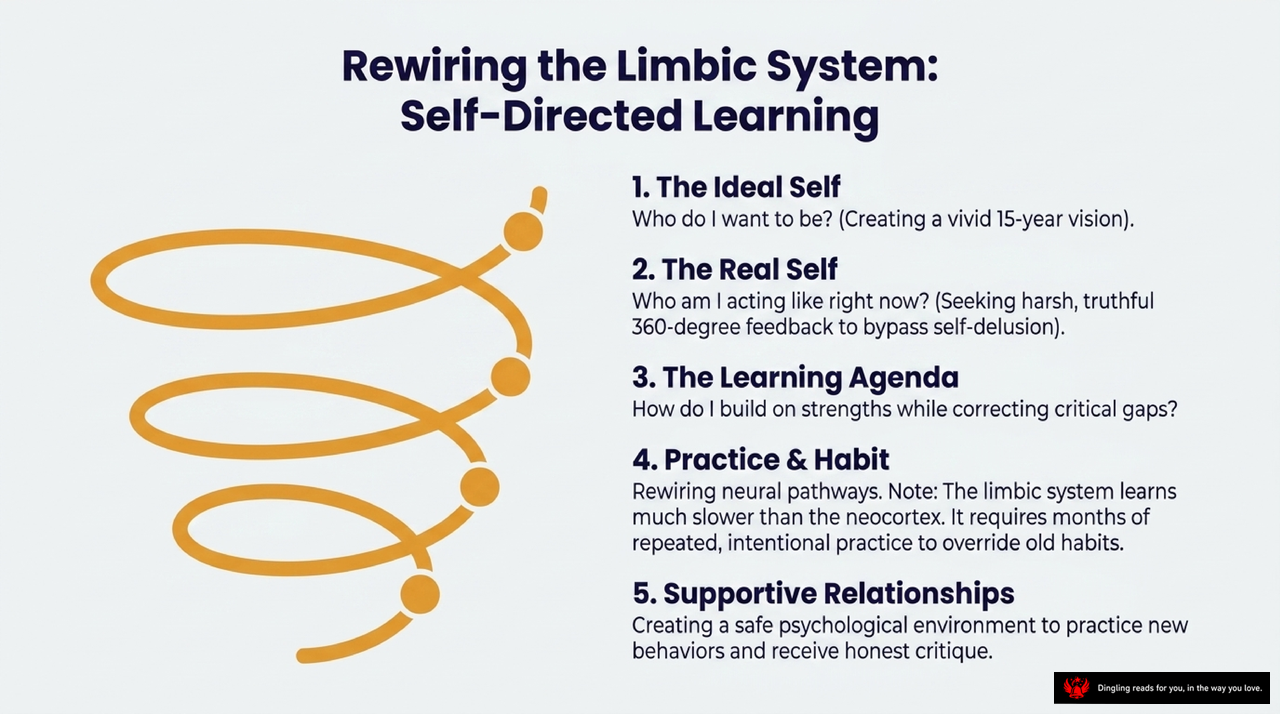
So, let's dive into how we actually change. It's not just about willpower; it's about rewiring the limbic system through self-directed learning. Think of it as upgrading your brain's operating system.
First, you have to define The Ideal Self. Who do you want to be? Don't just think about your job title. Create a vivid 15-year vision. Imagine the person you want to become. This gives you a target and a reason to keep going.
But vision alone is a trap. You need to face The Real Self. Who are you acting like right now? It's uncomfortable, but you need to seek harsh, truthful 360-degree feedback. You have to bypass self-delusion to see the actual gap between where you are and where you want to be. Without this honesty, you're just spinning your wheels.
Once you see that gap, you build The Learning Agenda. Ask yourself: How do I build on strengths while correcting critical gaps? Don't try to fix everything at once. Leverage what you're already good at to tackle the hard stuff.
Here's where most people fail. It's Practice and Habit. Rewiring neural pathways takes time. The limbic system learns much slower than the neocortex. It's not about willpower; it's about repetition. It requires months of intentional practice to override old habits. If you want to change your emotional responses, you have to practice them until they become automatic. Think of it like building a new muscle.
Finally, you can't do this alone. You need Supportive Relationships. Creating a safe psychological environment is non-negotiable. You need a circle of people where you can practice new behaviors and receive honest critique without fear of judgment. This safety net is what allows you to take the risks necessary for growth.
So, start with the vision, face the truth, plan your path, practice relentlessly, and surround yourself with support. That's how you truly transform.
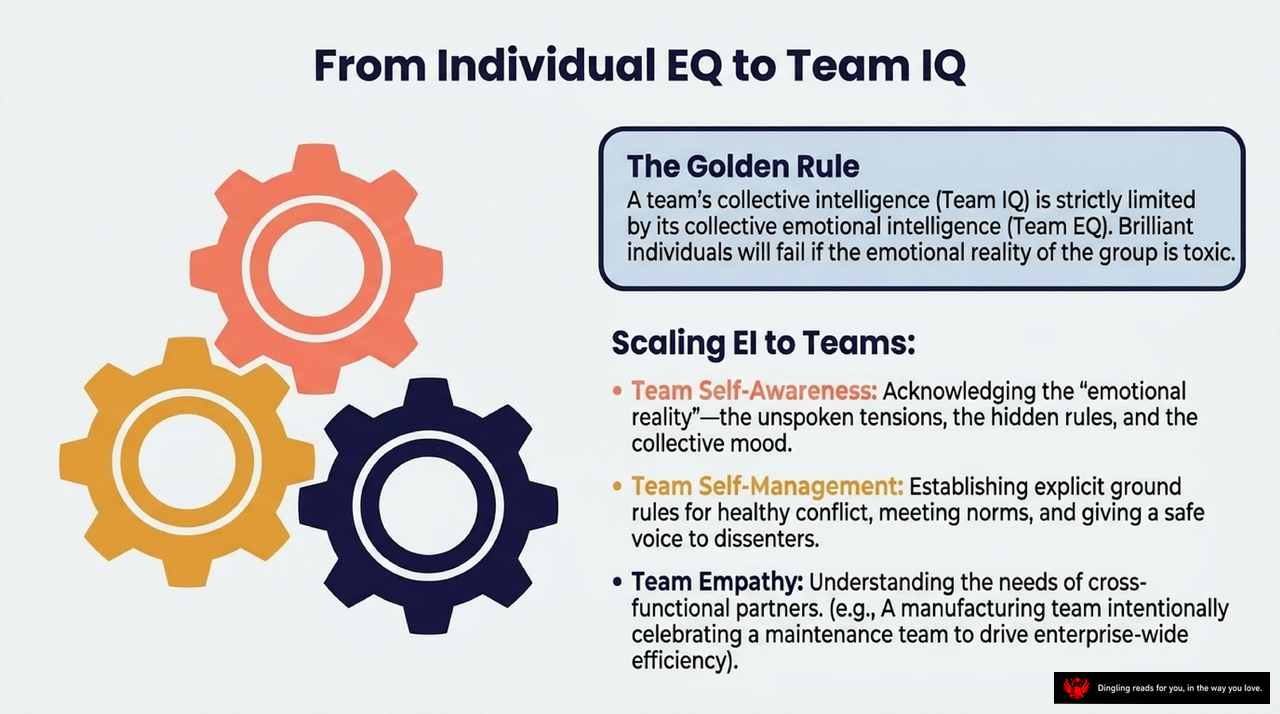
So, let's take a step back and look at how we shift from individual emotional intelligence to team intelligence. This slide highlights a critical concept: moving from Individual EQ to Team IQ.
On the right, you see what we call The Golden Rule. It states that a team's collective intelligence, or Team IQ, is strictly limited by its collective emotional intelligence, or Team EQ. Think about that. Even if you have brilliant individuals on your team, they will fail if the emotional reality of the group is toxic. The vibe matters just as much as the talent. If the emotional climate is hostile, no amount of individual skill can save the project. We've seen this time and time again. When trust evaporates, productivity plummets.
So, how do we scale emotional intelligence from the individual level to the team level? The slide breaks this down into three key pillars. First, Team Self-Awareness. This means acknowledging the emotional reality of the team—the unspoken tensions, the hidden rules, and the collective mood. You can't manage what you don't see. Leaders need to be aware of the emotional undercurrents that might be driving conflict or disengagement.
Second is Team Self-Management. This involves establishing explicit ground rules for healthy conflict, setting meeting norms, and crucially, giving a safe voice to dissenters. It's about creating a container where people feel safe to speak up without fear. When we establish these norms, we prevent the toxicity that kills innovation. It's about psychological safety.
Third is Team Empathy. This is about understanding the needs of cross-functional partners. For example, a manufacturing team might intentionally celebrate a maintenance team to drive enterprise-wide efficiency. It's about seeing how your success connects to others. It's moving beyond silos to understand the broader ecosystem.
Look at those gears on the left. They represent the interconnected parts of the team. Just like those gears meshing together, our team members need to interlock. When we align these three elements—awareness, management, and empathy—we unlock the potential of the group. We move from a collection of individuals to a cohesive unit where the whole is greater than the sum of its parts.
This transition is vital. As we move forward, remember that building Team IQ isn't just about adding more people. It's about building the emotional infrastructure that allows those people to perform at their best together. It requires intentionality and practice. Let's keep that Golden Rule in mind as we explore how to build these capabilities in practice.
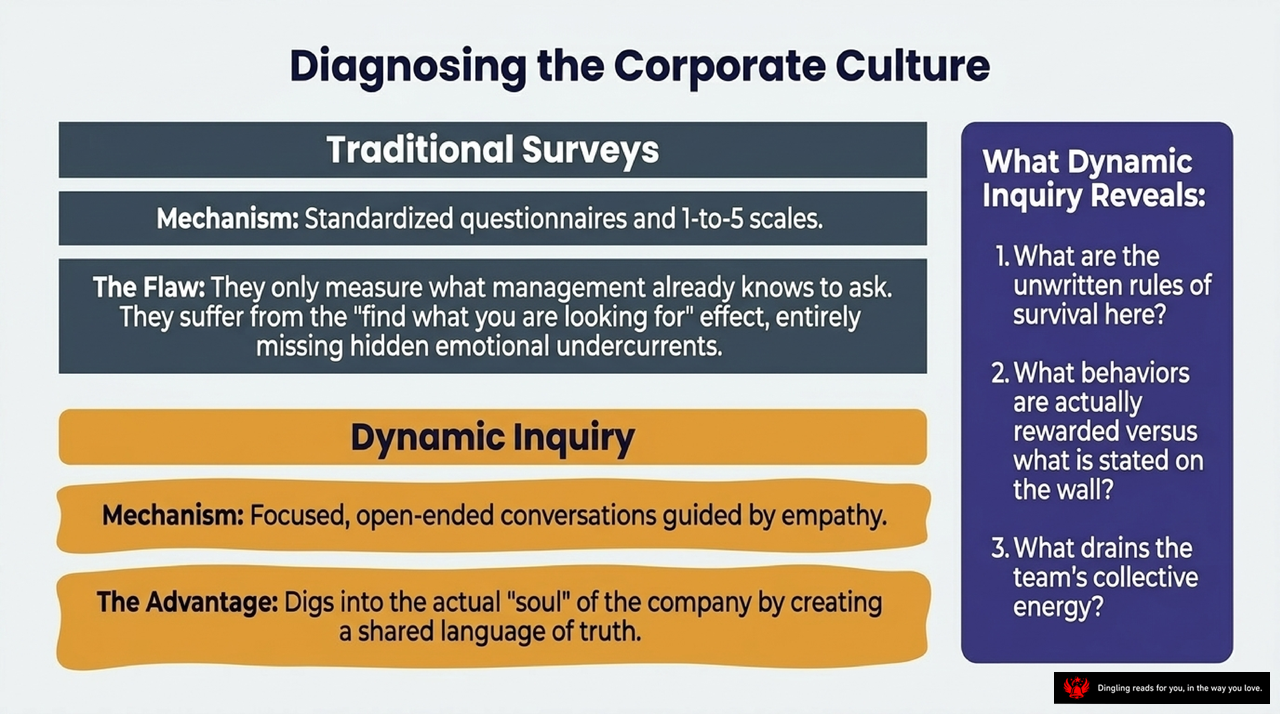
Welcome back. Today we're tackling a critical question: How do we really diagnose our corporate culture?
Look at the left side of the screen. We call this Traditional Surveys. We've all been there. You get a link, you fill out a standardized questionnaire, rating things on a scale of one to five. It feels objective, doesn't it? But let's be honest, it's often a blind spot.
The flaw is fundamental. These surveys only measure what management *already knows* to ask. They suffer from what we call the 'find what you're looking for' effect. You can't ask people about the hidden emotional undercurrents if you don't know what they are. It's like trying to find a needle in a haystack with a magnet that only sticks to iron. You end up with data that confirms your biases rather than revealing the truth.
So, what's the better alternative? It's called Dynamic Inquiry.
This isn't a form to fill out. It's a method developed by Ann MacKee and Cecilia McMeel. Instead of asking for ratings, it uses focused, open-ended conversations guided by empathy. Think of it as digging into the actual 'soul' of the company. It's about creating a shared language of truth.
The process usually starts with one-on-one talks with key leaders and core employees. You ask about their feelings, their expectations, and their reality. Then, you bring these themes into small group discussions to spark honest dialogue. This helps everyone form a shared understanding of the organization's problems.
For organizations stuck in a development bottleneck or with rigid culture, Dynamic Inquiry is the key step to opening up change. It breaks the surface harmony to touch the real emotional reality.
When we use Dynamic Inquiry, we stop asking what the culture *says* it is, and start asking what it *actually* does. It reveals three critical things that surveys completely miss.
First, it uncovers the unwritten rules of survival. What behaviors are actually rewarded versus what is stated on the wall? This exposes the gap between policy and practice.
Second, it identifies what drains the team's collective energy. We often ignore the things that kill morale. It helps us pinpoint the specific stressors.
Finally, it helps leaders see the true operating state of the organization, breaking through surface harmony to find the root causes of dysfunction.
This approach allows us to dig out deep problems and potential drivers affecting organizational effectiveness. It's not just about fixing a process; it's about understanding the human dynamics that drive performance. By creating this shared language of truth, we can align the team's actual experience with the company's vision.
So, next time you're thinking about how to measure culture, ask yourself: Are we just measuring what we know, or are we uncovering what we don't know? That's the power of Dynamic Inquiry.
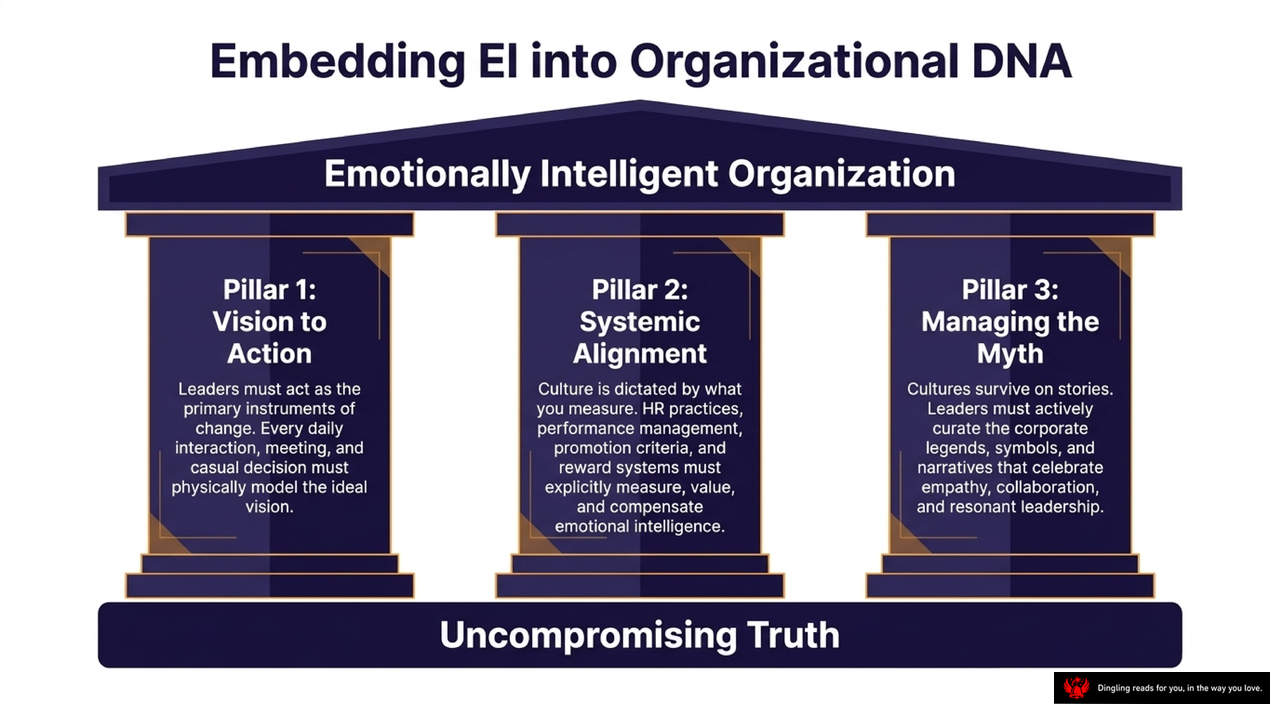
So, the big question is: how do we actually make emotional intelligence stick? It's not enough to have a workshop; we need to embed it into our organizational DNA. Imagine building an Emotionally Intelligent Organization. It rests on three critical pillars, all supported by a foundation of Uncompromising Truth.
Let's start with the first pillar: Vision to Action. Leaders aren't just strategists sitting in a boardroom; they are the primary instruments of change. If you want a culture of empathy, you can't just talk about it in meetings. Every daily interaction, every decision, and even the casual way you speak must physically model that ideal vision. You have to walk the talk, because your team watches you closely. Your emotional state sets the tone for the entire room. If leaders are inconsistent, the vision becomes just another slogan.
Next, we have Systemic Alignment. Here's the hard truth: culture is dictated by what you measure. If your HR practices, performance management, promotion criteria, and reward systems ignore emotional intelligence, your culture will inevitably reflect that. We need to explicitly measure, value, and compensate for EI. If we don't align our systems with our values, employees will do exactly what gets rewarded, regardless of what we say. It's about creating an environment where doing the right thing is the easy thing.
The third pillar is Managing the Myth. Cultures survive on stories. Leaders must actively curate the corporate legends, symbols, and narratives that celebrate empathy, collaboration, and resonant leadership. If the stories we tell don't match the behavior we want, we lose credibility and trust. We need to make sure the narrative supports the emotional reality we want to create, so everyone knows what success looks like. Leaders need to be the architects of these stories.
But all of this rests on a foundation of Uncompromising Truth. We can't build this on lies or wishful thinking. We need to face the organization's emotional reality. Through honest inquiry, we uncover the hidden norms and feelings that are actually driving us, not just the ones on paper. This means we need to ask tough questions about our current state. Only when we ground ourselves in truth can we build a sustainable, high-performance culture that actually works for everyone. This requires courage to admit where we are, but it's the only path forward.
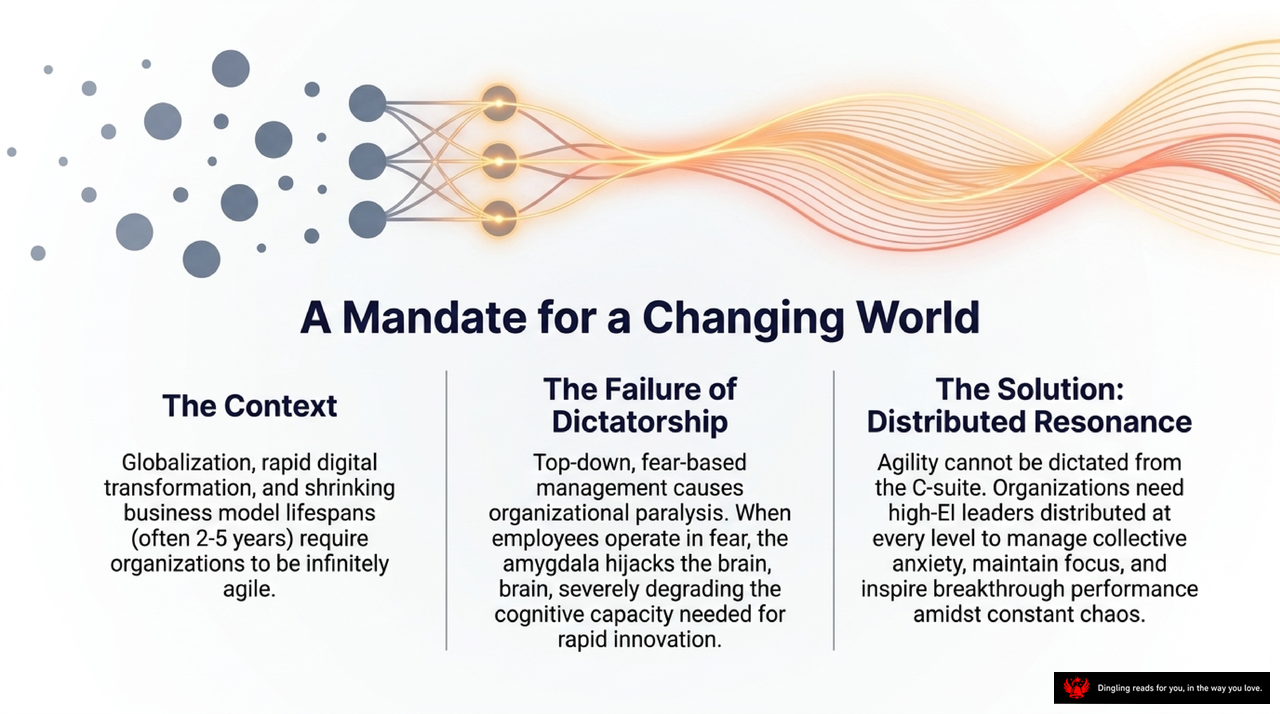
Welcome back. Today we're looking at a critical slide titled "A Mandate for a Changing World." This isn't just a presentation; it's a reality check for modern leadership.
Let's start with the context. We are living in an era of rapid digital transformation. Business model lifespans are shrinking—often down to just two or five years. This volatility demands one thing above all: infinite agility. You cannot manage this kind of speed with the old playbook.
So, what happens when we try to use the old playbook? We see the failure of dictatorship. Many leaders still rely on top-down, fear-based management. But here is the hard science: when employees operate in fear, their amygdala hijacks the brain. This biological response severely degrades the cognitive capacity needed for rapid innovation. If your team is too scared to think, you can't innovate. You can't survive.
So, if the old way breaks, what is the solution? The slide proposes "Distributed Resonance." This is a powerful concept. It tells us that agility cannot be dictated from the C-suite. You cannot command innovation from the top floor. Instead, organizations need high-EI leaders distributed at every level. We need emotional intelligence to be a muscle used by everyone, not just the bosses.
Why does this work? Because these distributed leaders can manage collective anxiety, maintain focus, and inspire breakthrough performance amidst constant chaos. When everyone is empowered to lead with empathy and awareness, the organization becomes resilient. It stops being a machine that breaks under pressure and starts being a network that adapts.
The bottom line is this: In a changing world, you don't need more control. You need more resonance. You need to move from a culture of fear to a culture of connection. That is the mandate. That is how we win.
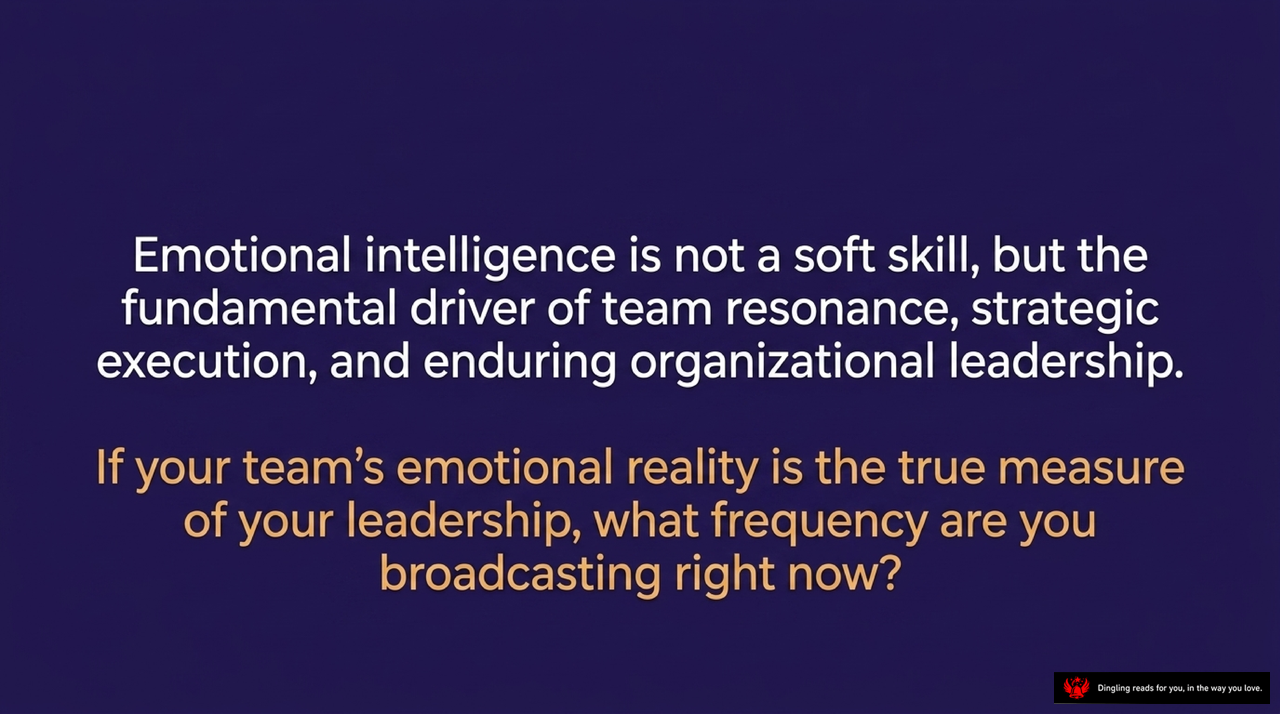
We often hear people call emotional intelligence a "soft skill." They treat it like something optional, something nice to have if you have the right technical skills. But here's the truth: it's not a soft skill at all. It's the fundamental driver of how your team actually resonates, how strategy gets executed, and how leadership endures over time. In fact, emotional capability is the core pivot for unlocking team effectiveness, far exceeding pure business skills. It's not just about feelings; it's a hard indicator of success.
Think about this: if your team's emotional reality is the true measure of your leadership, then ask yourself, what frequency are you broadcasting right now?
Leadership isn't just about giving orders. It's about setting the emotional tone. Research shows that a leader's emotional state is the "anchor" for the team's atmosphere. Just like a radio signal, your emotions broadcast out. If you're anxious or angry, that frequency spreads instantly. If you're calm and optimistic, that becomes the new normal. This is what we call emotional contagion.
This isn't just theory. It's biology. The human brain's limbic system has an open-loop characteristic, meaning emotions spread like viruses. When you're stressed, your team gets stressed. When you're disconnected, trust erodes. When you're empathetic, people feel safe to take risks and innovate. That's why high-performing leaders aren't necessarily the smartest in the room, but they are the ones who master this emotional capability.
Companies that cultivate this see better collaboration, higher retention, and real financial results. But it requires work. You have to be aware of your own triggers. You have to manage your reactions. And you have to be authentic. Without this, even the best strategy becomes empty talk.
So, look at your team. Look at the energy in the room. Are they energized or drained? Are they trusting or guarded? That tells you everything about the leader standing at the front. Your team's emotional reality is the true measure of your leadership.
So, take a moment. What frequency are you broadcasting right now? Is it one that builds them up, or one that tears them down? Because the team is listening, and they're feeling it. The question is, are you listening to yourself enough to change the signal? Remember, the leader's emotional state determines the team's work status and performance. So, tune in.