
Two Thousand Years: Complete Chapter-by-Chapter Summary
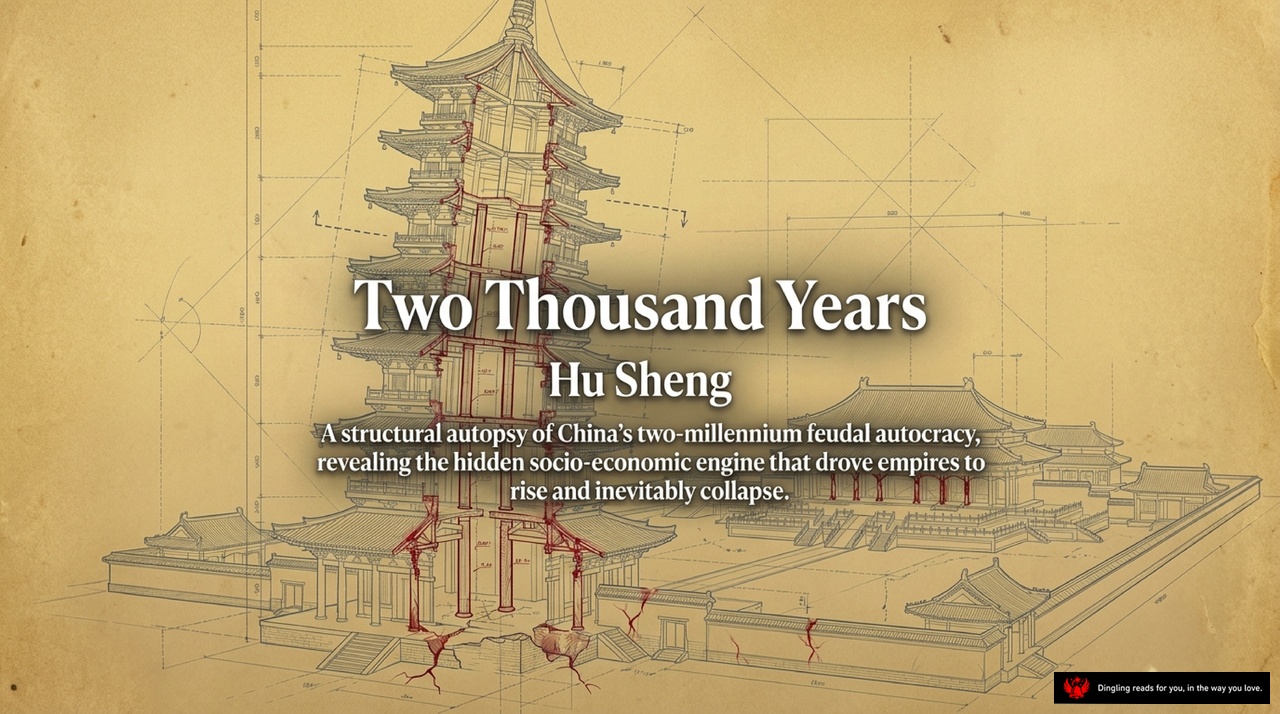
Welcome to the structural autopsy of China's two millennia. Today, we're peeling back the layers of a 2,000-year-old feudal autocracy to reveal the hidden socio-economic engine that drove empires to rise and inevitably collapse.
Look at this blueprint behind the title. It's not just an architectural drawing; it's a diagnosis of a system that lasted over two thousand years. From the Shang Dynasty around 1600 BC to the modern era, China's history wasn't a series of disconnected dynasties. Instead, it was one continuous story of feudal autocracy. Whether it was the Qin, Tang, or Ming, the core logic remained the same: a centralized imperial power built on small-scale farming, supported by a landlord class, and enforced by a rigid bureaucratic system.
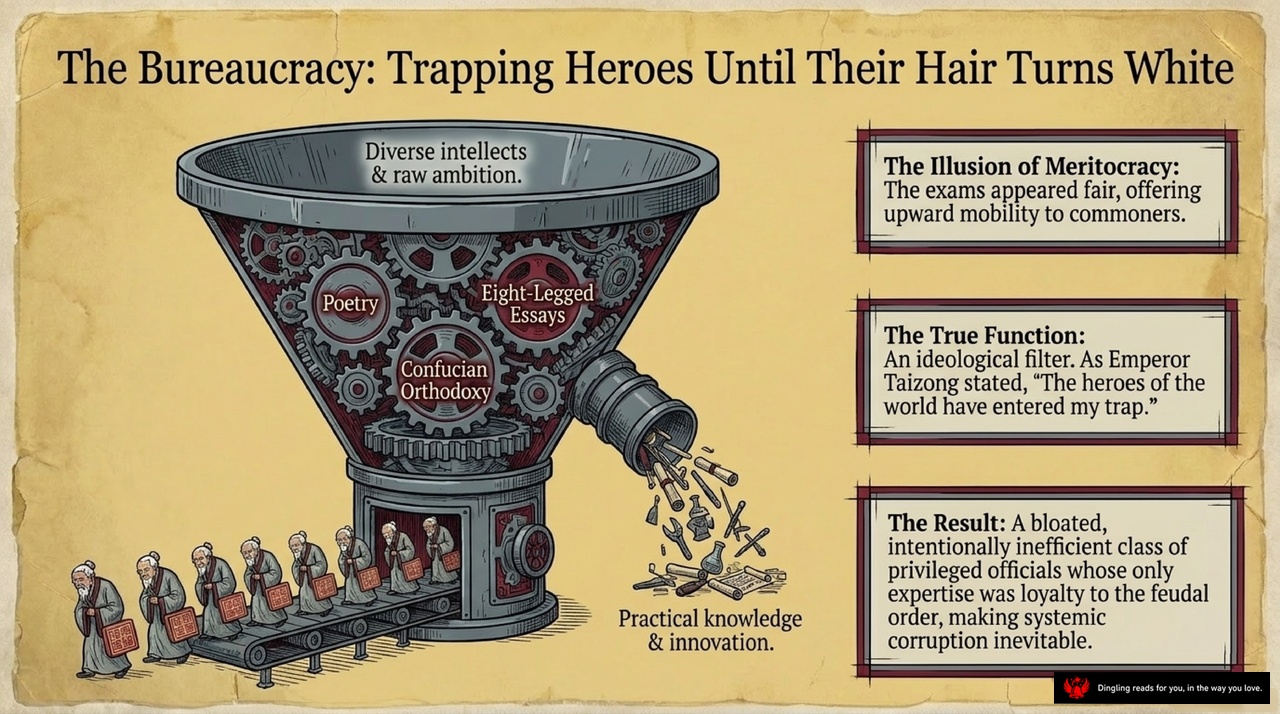
This book adopts a vertical perspective, looking at the long-term trends rather than just the events of a single era. We see how the "hidden engine" worked. The emperor, often portrayed as a divine figure, was actually the largest landlord, representing the interests of the entire ruling class. To maintain control, the state relied on two tools: a unified bureaucracy and a standing army. But this system had a fatal flaw. It trapped the vast majority of the population in a cycle of exploitation. The small peasant economy, while resilient, was constantly squeezed by heavy taxes, forced labor, and the relentless drive of land consolidation by the elite.
As time passed, this system became rigid and corrupt. The bureaucracy, meant to serve the state, slowly turned into a self-serving class that drained the resources of the people. The constant cycle of rebellion and restoration became the rhythm of history. Every dynasty rose on the blood of the peasants and eventually fell under their weight. This wasn't just a story of war and politics; it was a profound struggle over land, power, and survival that shaped the very soul of Chinese civilization.

Imagine history not as a simple line of rising and falling dynasties, but as a deep, unchanging machine buried beneath the surface. On the left, we see the traditional view: a timeline marked by names like Han, Tang, Song, Ming, and Qing. It focuses on the rise and fall of individual rulers, treating history like a series of snapshots. But look at the right side. This is the structural perspective. Instead of a timeline, we see a cross-section of a machine.
For over two thousand years, the names of the emperors changed, and the dynasties shifted, but the core machinery remained exactly the same. The Emperor sits at the top, controlling the Bureaucracy and the Military, all built upon the foundation of the Peasantry. Whether it was the Han, Tang, or Qing, the socio-economic machinery that drove this empire never truly changed. The system was designed to last, outlasting every single dynasty that tried to replace it. So, while the titles and faces changed, the fundamental logic of this ancient machine stayed rigidly in place.
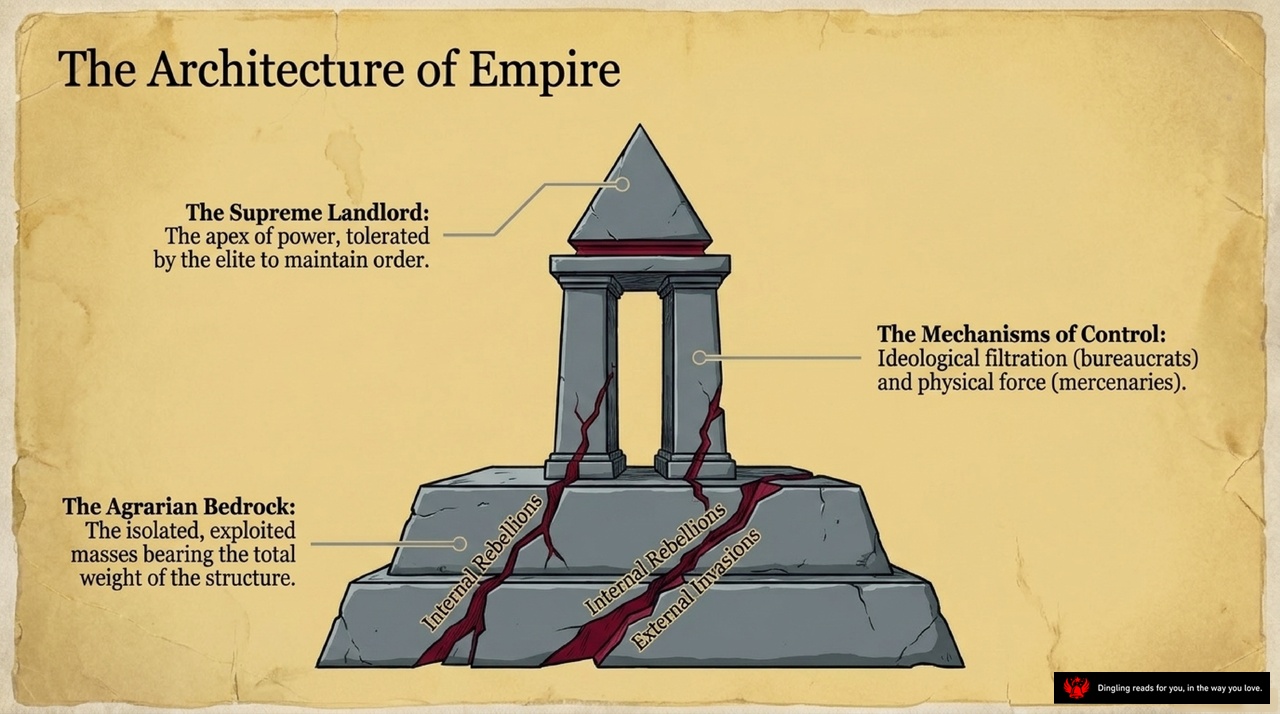
Look at this diagram: "The Architecture of Empire." It breaks down the two-thousand-year structure of Chinese feudalism into three critical layers. At the very top sits "The Supreme Landlord," the apex of power tolerated by the elite simply to maintain order. Below that, the "Mechanisms of Control" rely on ideological filtration through bureaucrats and brute physical force via mercenaries. And at the foundation lies "The Agrarian Bedrock"—isolated, exploited masses bearing the total weight of the entire structure.
But notice the cracks running through the base. These aren't just random fractures; they represent the inevitable pressure points of the system: internal rebellions and external invasions. This image perfectly captures the fatal flaw of this empire. The rulers at the top were detached from reality, often indulging in myths of divine mandate while the foundation beneath them was crumbling under the weight of exploitation. As the text explains, the emperor was essentially the largest landlord, representing the interests of the entire landlord class against the peasantry. When the bedrock could no longer support the load, the cracks widened into chasms, leading to the repeated cycles of rebellion and collapse that defined this era. The architecture was stable only as long as the people at the bottom remained silent; once they spoke, the whole structure began to fall.

The Emperor wasn't a god; he was simply the nation's biggest landlord.
Look at the throne in the center. The text calls it "The Apex: Supreme Landlord, Not Divine Right." This is the core truth. For two thousand years, the ruling class didn't believe in divine right. They knew the truth: the Emperor was just the ultimate guarantor of the landlord class's property and power.
But how did they keep this secret? That's where the "Illusion" comes in. As the slide explains, they engineered myths like dragons, divine omens, and the "Son of Heaven" story. They built a fantasy to legitimize a reality that was purely about economics and class.
Now, look at the balance scale on the right. It shows the terrifying trade-off. If you had a "Mad/Incompetent Heir," the result was "Class Civil War." The elite couldn't risk a weak leader, so they developed a strange tolerance for incompetence. They would put up with child emperors or idiots—like Emperor Hui of Jin—because strict hereditary succession was the only way to prevent the landlords from fighting each other to the death.
Finally, look at the bottom. The throne sits directly on top of mountains of gold, scrolls, and ingots. This visualizes the reality: the entire system was built on land and wealth. The Emperor ruled not because he was special, but because he owned the most land and needed the support of the rest of the landlord class to keep the peace. It was a business, not a religion.
Chapter 4: Another Special Profession—Being a Soldier.
Look at this slide. It contrasts the romanticized "300-round battles" in novels with the brutal reality of history. The core truth is simple: victory is always built on the bones of countless anonymous soldiers, not the duels of generals.
The slide highlights a critical shift from the Spring and Autumn period to the Warring States. Back then, war was a privilege for nobles, fought with chariots on open plains. But as society changed, ordinary people were forced into the army. Warfare evolved from chariot-based to flexible infantry and cavalry tactics, allowing for massive mobilizations of hundreds of thousands. This shift was driven by the needs of a centralized, autocratic state that required a large, professional military to control vast territories.
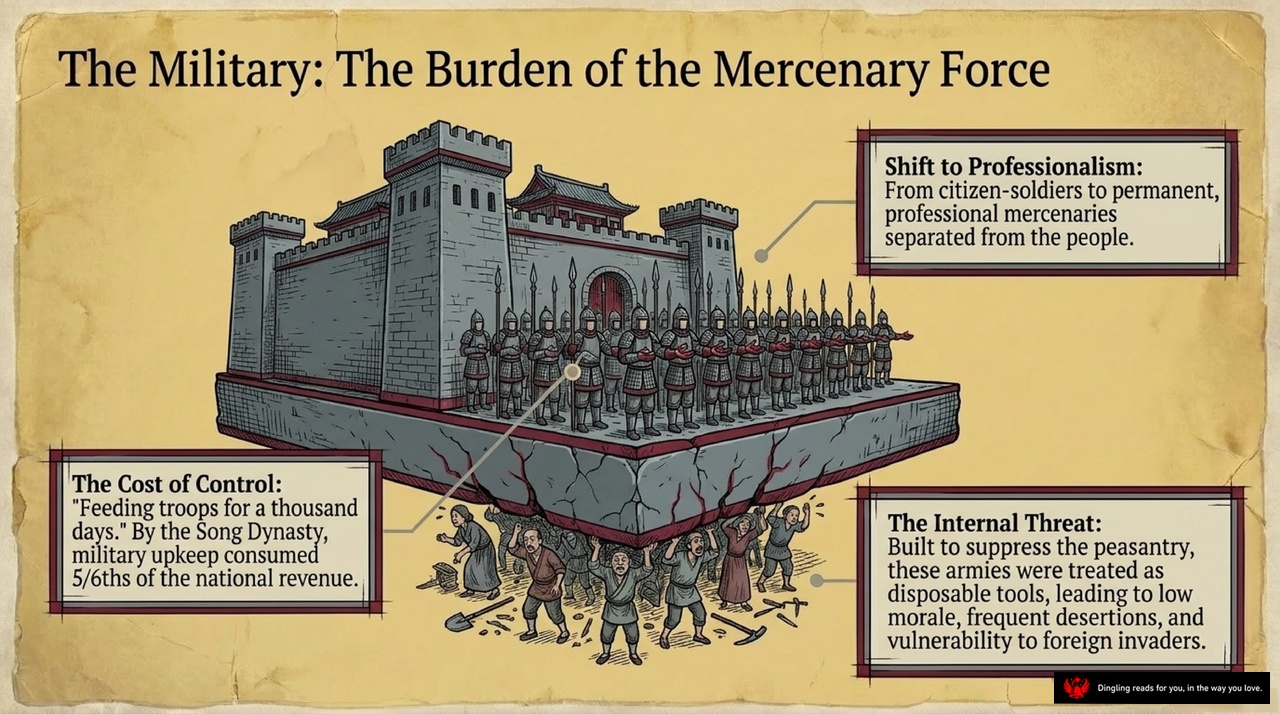
The graphic also points out the tragic reality of the "special profession" of soldiering. Unlike true conscription in democratic societies, feudal China relied on a system where soldiers became a permanent, distinct social class. Whether through the Han "Geng Fu" system, the Tang "Fubing" system, or later mercenary armies, soldiers were often drawn from the poor or even criminals. The saying "Good iron is not used for nails; good men do not become soldiers" reflects how the profession was stigmatized.
Furthermore, the slide illustrates the vicious cycle of this system. Because soldiers were treated as disposable tools, they couldn't return to farming after war. They became lifelong soldiers, often passing their status to their children, creating hereditary military clans. This led to a massive financial burden for the state, where the cost of maintaining the army consumed up to five-sixths of government revenue in the Song Dynasty.
Ultimately, this professional soldier system created a deep contradiction. To prevent generals from becoming warlords, the central court separated command from control, making it impossible for soldiers and officers to fight effectively together. This structural flaw, combined with the constant need to feed a bloated army, drained the people and fueled the very rebellions the army was meant to suppress. The slide reminds us that while empires rose and fell, the cost was always paid by the common foot soldier.
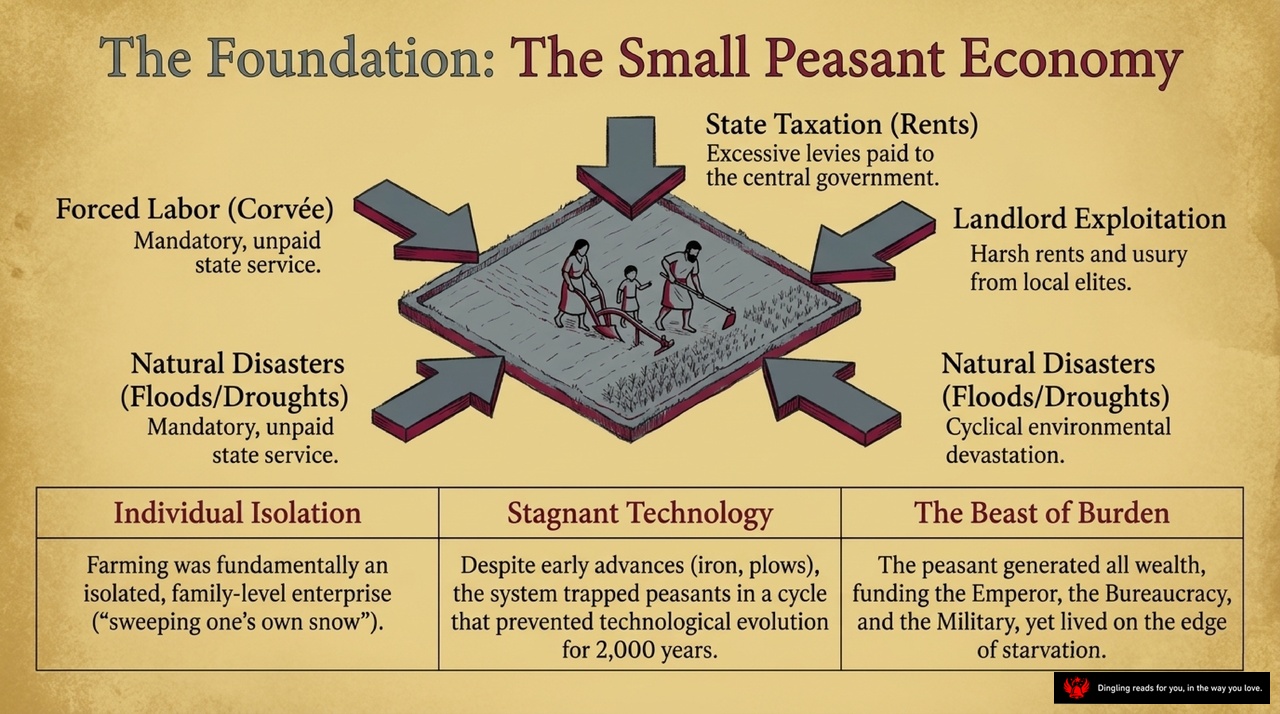
The foundation of China's two-thousand-year feudal system lay squarely in the countryside. For millennia, agriculture wasn't just an industry; it was the lifeblood of the entire state, with the survival of hundreds of thousands of peasant families and the treasury of the empire entirely dependent on the land.
Look at the tools of the trade. While iron plows eventually replaced wooden ones, and ox-drawn plowing boosted efficiency, the fundamental unit of production remained the small, individual family farm. This "small peasant economy" was defined by self-sufficiency. A typical household farmed a tiny plot, wove its own cloth, and raised its own food, rarely needing the market to survive. This system created a massive, silent majority that produced the wealth for the empire but owned almost nothing in return.
The problem was the land itself. While the Emperor claimed "all land under heaven belongs to the King," in reality, a fierce battle for land ownership raged between the state and the powerful landowners. Over time, wealthy elites and officials used their power to buy up vast tracts of land, squeezing the small farmers into debt or forcing them to become tenant farmers on the very land they once tilled.
The burden on these peasants was crushing. They didn't just pay taxes to the Emperor; they paid rent to their landlords, performed forced labor for the state, and borrowed money from usurious merchants at exorbitant rates. As the old saying goes, they often had to sell their future harvest just to survive the present. They worked from spring to winter without a day of rest, yet after paying their debts and taxes, they were left with nothing but bare survival. When a drought hit or a flood destroyed their crops, these desperate farmers had no safety net. They were trapped in a cycle of poverty, and when the pressure became too much, the silence of the land was about to be shattered.
Silent beneath the earth lies a force powerful enough to shatter any empire. For two millennia, the rhythm of Chinese history has been defined by these uprisings. When the system pushed the peasantry to the brink of starvation, when floods wiped out their harvests, or when corruption made survival impossible, the silence broke. We see this pattern again and again: the rebellion of Chen Sheng and Wu Guang that toppled the mighty Qin; the Green Peasant and Red Eyebrow armies that drowned Wang Mang's regime; the Yellow Turban Rebellion that shattered the Han; and the massive revolts that eventually ended the Sui, Tang, Song, Yuan, Ming, and Qing dynasties.
But it wasn't just the big wars. Every feudal era was punctuated by smaller, desperate rebellions. These people were not naturally violent; they were farmers who loved their land and hated fighting. They only took up arms when there was no other choice, when the state and the landlords had taken everything they owned.
How did scattered, unarmed farmers become a tidal wave that could drown an empire? Religion played a crucial role. The rulers used religion to control the masses, but the peasants used it to organize themselves. From the Heavenly Masters' Daoism in the Han Dynasty to the Maitreya teachings and the God Worshipping Society of the Taiping Heavenly Kingdom, these beliefs provided a framework for unity and a sense of hope. They promised a world where the dark would be replaced by light, where everyone would have land and food. This simple, pure dream of equality became the fuel for their struggle.
Their tactics were also uniquely effective. Lacking the heavy armor and training of the official armies, they used flexibility. They split into small groups to harass the enemy and then regrouped to fight major battles. This made them incredibly hard to defeat. Leaders like Shi Dakai and Li Xiucheng grew from humble farmers into brilliant generals, mastering the rhythm of war and understanding the needs of the people better than any elite commander ever could.
Yet, despite these incredible achievements, these rebellions almost always ended in failure. Why? The moment they captured a major city, their fate changed. Initially, they exploited the cracks within the ruling class, but once they took the center, the rulers united against them. The enemy forces consolidated, often even allying with foreign powers or local elites who had previously been suppressed. Furthermore, the peasants themselves lacked a clear plan for governing. Once they moved from the countryside to the city, the luxury and corruption of the capital often corrupted their leaders, turning them into the very thing they sought to destroy. Without a solid political vision and with their internal weaknesses exposed, the rebellions collapsed.
Ultimately, the fruits of these struggles were almost always stolen by the landlord class. The very people who rose up to fight the system often ended up becoming the new rulers, representing the interests of the landlords once again. However, these rebellions were not meaningless. They swept away corrupt regimes, cleared the path for social progress, and proved that the people's power was unstoppable. Even when the old order returned, the spark of resistance remained, eventually leading to the fall of foreign dynasties and paving the way for a new era.

Imagine a graph where the line stays flat for centuries, representing a society built on extreme tolerance and conservatism. For two thousand years, the peasantry endured unimaginable suffering, tied tightly to the land by the weight of drought, relentless tax collectors, and the constant threat of starvation. As long as survival was possible, they remained silent, absorbing the pressure with a stoic, almost broken resilience.
But then, the pressure hits a critical threshold—around 80%. This is the breaking point. When starvation makes survival impossible, the potential for violence doesn't just rise; it explodes into a vertical spike. This is what we call "System Shock." The peasants, once untethered from the land they were forced to till, transform overnight into massive, highly disciplined armies. History remembers them as the Yellow Turbans or Li Zicheng, leaders who rose from the ashes of despair.
Yet, this "Miracle Generation" isn't just about destruction; it's about a desperate, utopian vision. As they rebel, they invent primitive egalitarian ideals—screaming for "equal land, equal food." They try to counter systemic oppression with a dream of a fair world. But this revolution is a double-edged sword. It brings rapid mass mobilization, but it also creates a cycle where the old order eventually rebuilds itself. The graph eventually crashes back down, showing that while the people can break the system, the underlying logic of feudal oppression remains, waiting for the next time the pressure mounts too high.

When the nomadic horsemen broke through the Great Wall, a dark chapter unfolded in Chinese history, defined not just by war, but by betrayal. Figures like Shi Jingtang, who sold the strategically vital Yan and Yun Sixteen Prefectures to the Khitans for his own power, became the ultimate traitors. Their choice wasn't just about cowardice; it was a logical outcome of a corrupt feudal bureaucracy where personal greed always outweighed national survival.
But history also remembers those who stood firm. Amidst the chaos of the Jin invasion and the Manchu entry, heroes like Yue Fei and Shi Kefa rose up. Their strength didn't come from the emperor's orders, but from the people themselves. From the "Eight-Character Army" in Taihang Mountain to the citizens of Jiangyin holding out for eighty-one days, the true defense of the nation was rooted in the masses.
The tragedy of the feudal era is that even when the people rose to save the country, the ruling class often viewed them as bandits to be suppressed rather than allies. This disconnect ensured that while the people fought and died, the old, corrupt system remained intact, unable to truly protect its own land.
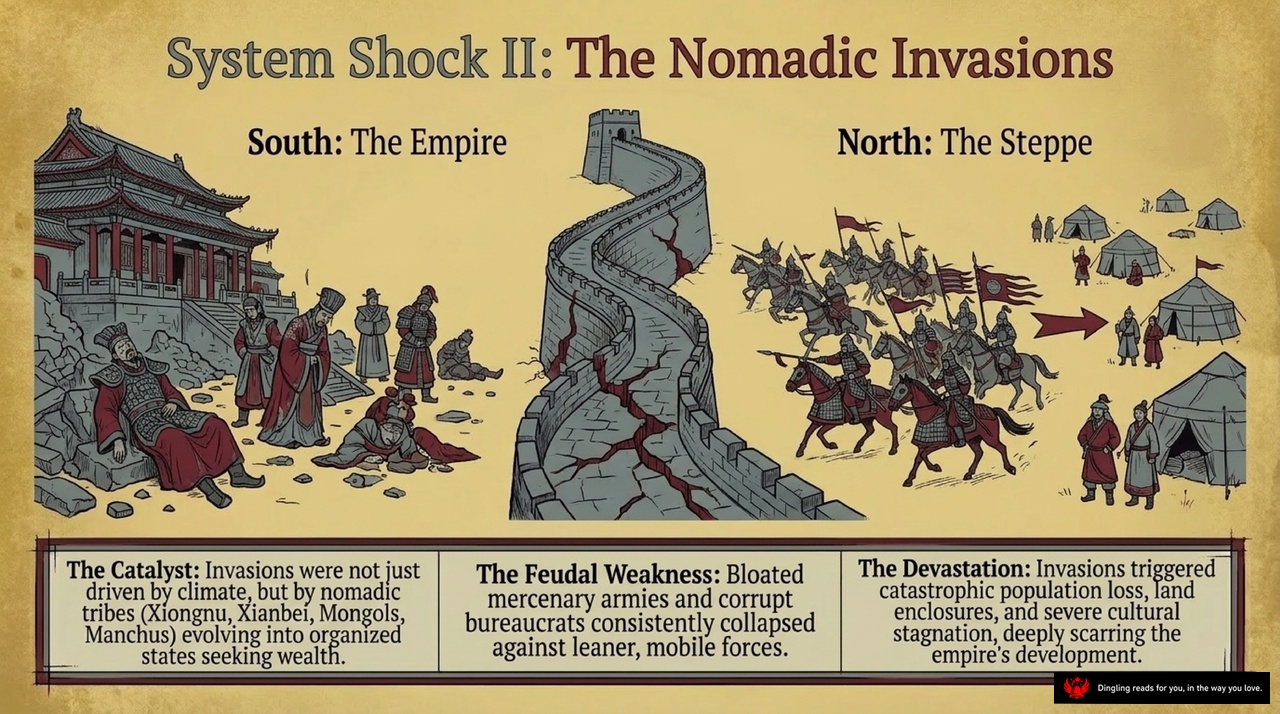
System Shock II: The Nomadic Invasions. Look at this divide. On the south, we see the crumbling Empire—corrupt bureaucrats, bloated mercenary armies, and a rigid feudal system that simply couldn't hold. On the north, the Steppe offers something far more dangerous: lean, mobile forces ready to strike. The image shows the Great Wall cracking under the pressure, a perfect metaphor for what was about to happen.
The catalyst wasn't just climate; it was evolution. Tribes like the Xiongnu, Xianbei, Mongols, and Manchus stopped being nomads and became organized states hunting for wealth. When these lean forces met the Empire's heavy, inefficient machinery, the result was catastrophic. The invasions triggered a population collapse, destroyed farmland, and froze cultural progress, leaving scars that lasted for centuries.
This wasn't a simple border skirmish. It was a clash of systems. The south was stuck in its own feudal weaknesses, unable to adapt. The north was agile and hungry. And as we'll see, these invasions didn't just change the map; they fundamentally reshaped the very soul of Chinese history.
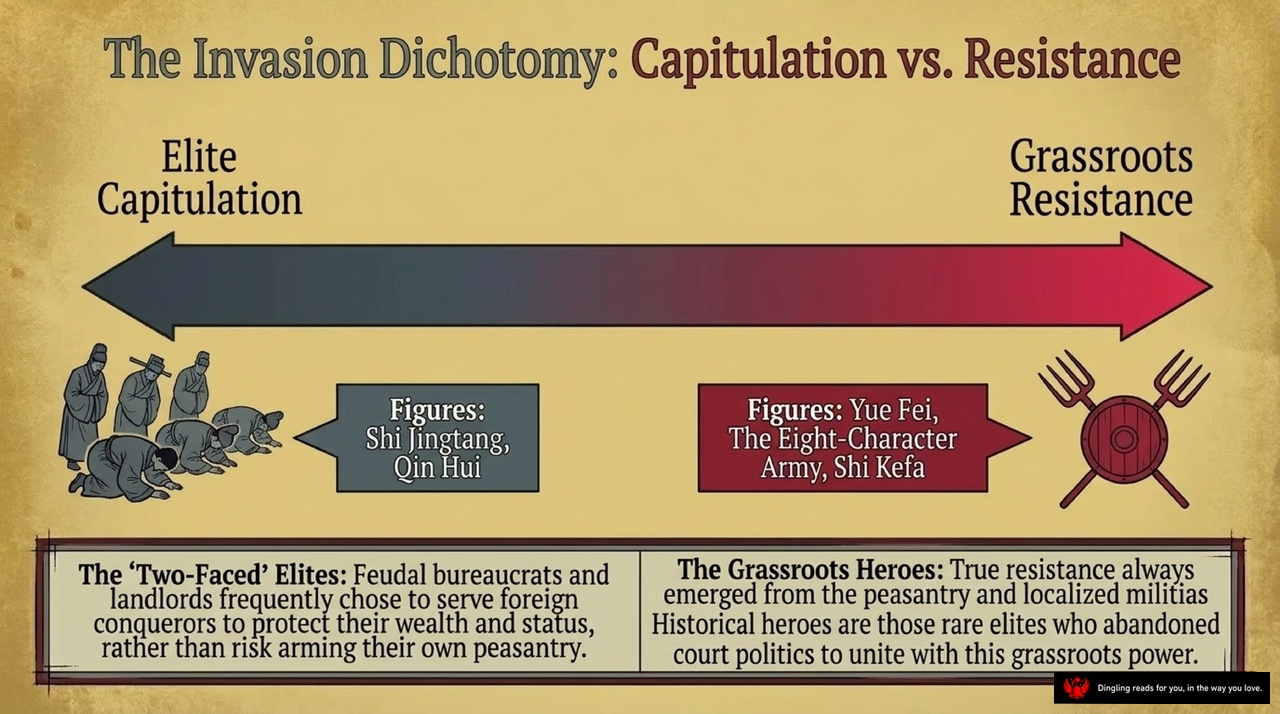
Today's slide breaks down the brutal "Invasion Dichotomy" that defined China's two millennia of feudal history: the stark choice between Elite Capitulation and Grassroots Resistance.
On the left, we see the path of "Elite Capitulation," represented by figures like Shi Jingtang and Qin Hui. These were feudal bureaucrats and landlords who, when faced with foreign conquerors, chose to serve them. Why? Because they feared arming their own peasantry more than they feared losing their wealth and status. They were the "two-faced" elites, protecting their privileges by betraying the very people who built the empire.
On the right stands the path of "Grassroots Resistance," symbolized by weapons and the spirits of heroes like Yue Fei, Shi Kefa, and the Eight-Character Army. True resistance didn't come from the corrupt court; it emerged from the peasantry and localized militias. The rare heroes who saved the nation were those elites brave enough to abandon court politics and unite with this grassroots power.
History teaches us a harsh lesson: when the ruling class chooses self-preservation over national survival, the people are left to fight alone. It was always the common folk, not the traitorous officials, who formed the real shield against invasion.
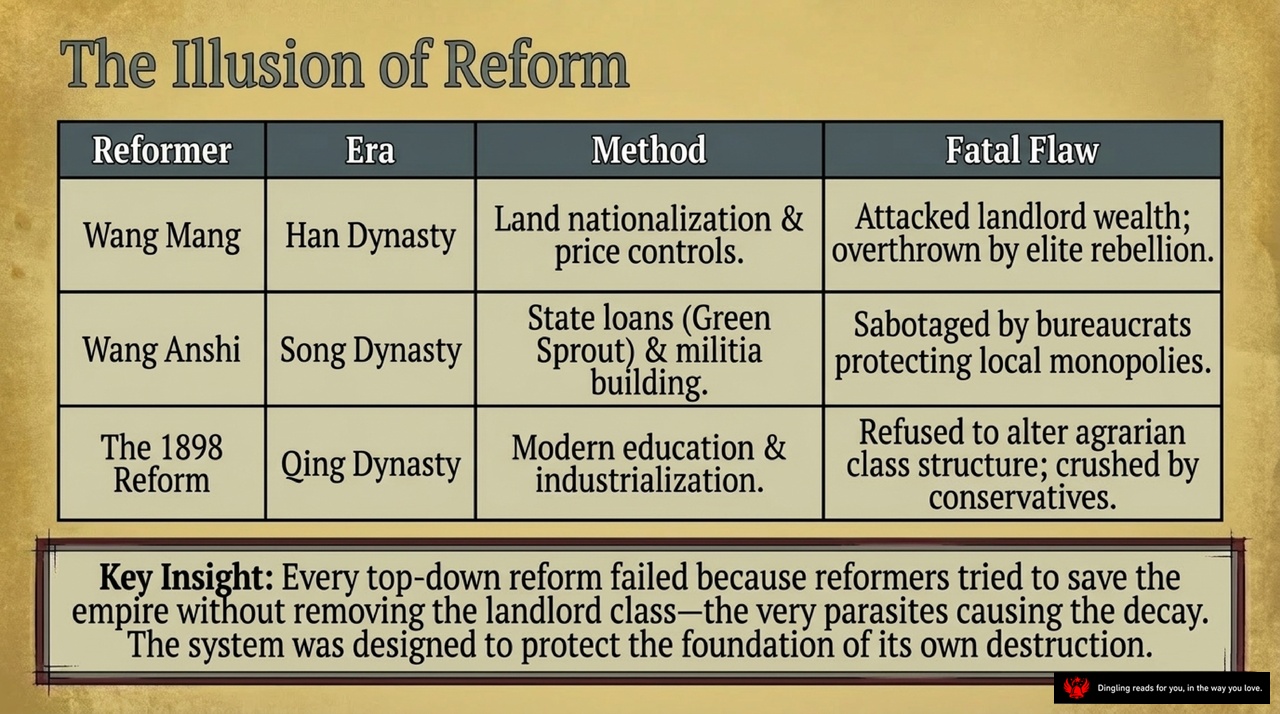
Top-down reform in imperial China often felt like a desperate patch on a sinking ship, yet it consistently failed. Look at the chart: Wang Mang tried to nationalize land and control prices in the Han Dynasty, only to be overthrown by elites protecting their own wealth. Centuries later, Wang Anshi in the Song Dynasty attempted state loans and militia building, but bureaucrats sabotaged him to protect local monopolies. Even the 1898 Reform in the Qing Dynasty, which introduced modern education and industrialization, was crushed because it refused to touch the agrarian class structure that conservatives relied on.
The fatal flaw in every case is clear: these reformers tried to save the empire without removing the landlord class—the very parasites causing the decay. They were designing a system to protect the foundation of its own destruction. As long as the ruling elite refused to share power or wealth with the masses, no amount of policy tweaks could prevent the collapse. True transformation required more than surface-level changes; it demanded a fundamental shift in who held the power, a lesson the history of these failed reforms tragically illustrates.
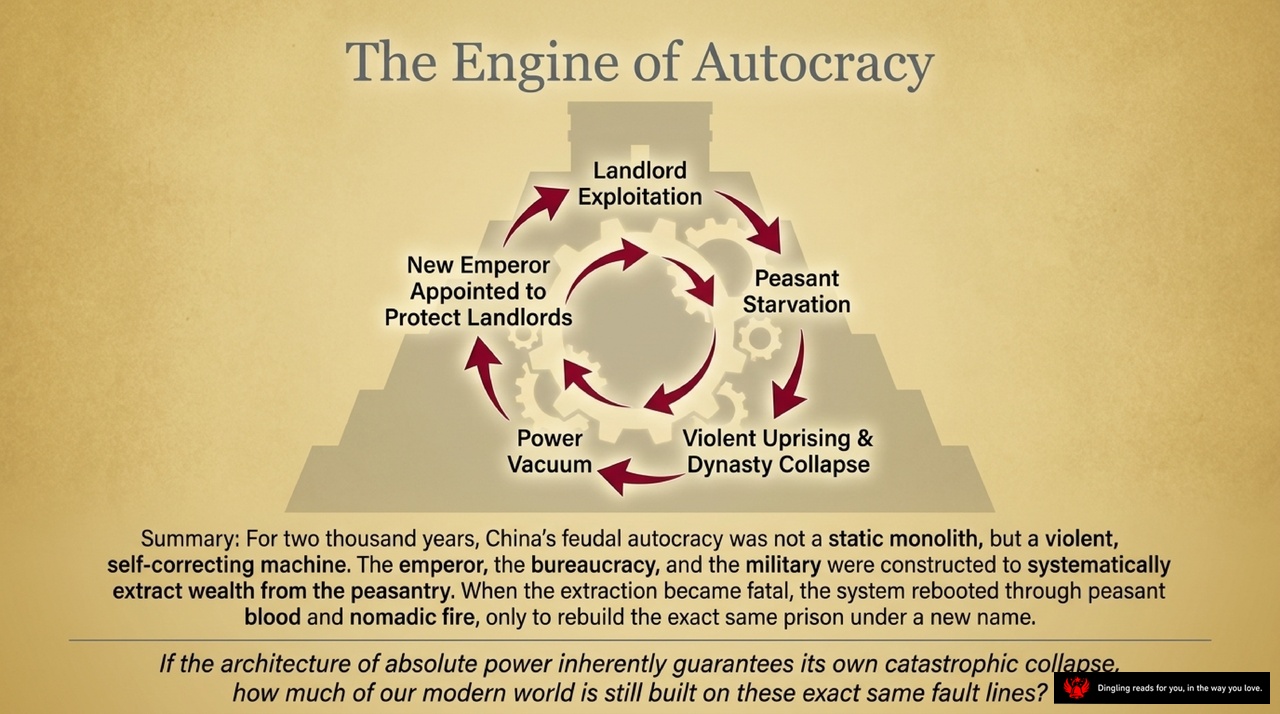
The slide before you reveals a terrifyingly simple truth: for two thousand years, China's feudal autocracy wasn't a static monument, but a violent, self-correcting machine. Look closely at that cycle. It starts with **Landlord Exploitation**, which inevitably leads to **Peasant Starvation**. When the pressure becomes unbearable, the result is a **Violent Uprising & Dynasty Collapse**. This creates a **Power Vacuum**, allowing a **New Emperor** to be appointed specifically to **Protect Landlords**, restarting the exact same loop.
This isn't just history; it's a system designed to systematically extract wealth from the peasantry until the extraction became fatal. When that happened, the system would reboot through peasant blood and nomadic fire, only to rebuild the exact same prison under a new name. The slide asks a chilling question that we must all consider: if the architecture of absolute power inherently guarantees its own catastrophic collapse, how much of our modern world is still built on these exact same fault lines?