
What is Science: Complete Chapter-by-Chapter Summary
Welcome to our book club session. Today, we're diving into a profound question: "What is Science?" as posed by the renowned scholar Wu Guosheng.
This book isn't just about formulas or lab results; it's a deep exploration into the philosophical origins of Western science and a fresh look at how we should re-evaluate traditional Chinese knowledge.
In our modern world, the word "science" is everywhere. But what does it really mean? Wu Guosheng guides us to realize that "science" is actually a Western concept. In Chinese history, the term evolved from a focus on practical skills—like military technology—to become a symbol of modernity and rationality. However, to truly understand its essence, we must look beyond our own cultural lens and travel back to the roots of Western thought.
The story begins in ancient Greece. Unlike the practical, experience-based knowledge of the East, Greek science was born from a desire for pure freedom. It wasn't about making things or solving immediate problems; it was about seeking absolute truth through reason. The Greeks believed that by understanding the eternal laws of the universe, the human soul could achieve true liberation. This pursuit of "episteme"—certain, universal knowledge—became the foundation of Western rational science.
Later, this Greek tradition met with Christianity, which added a new dimension: the will to act. This shift transformed science from merely observing nature to conquering it. The world became a machine to be understood and controlled, leading to the mathematical and experimental methods we recognize today.
So, as we turn the page, we will see how these ancient ideas shaped the modern world and why understanding their true origins is crucial for us today. Let's begin this journey.
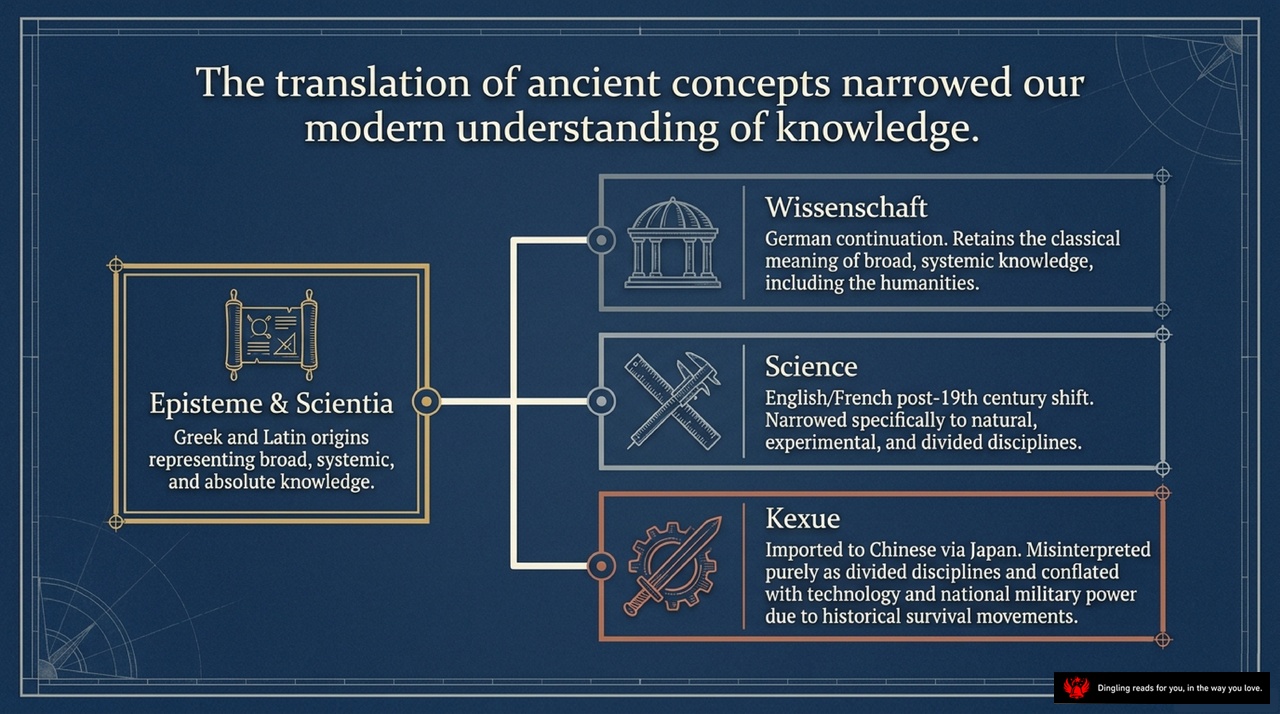
Have you ever wondered why the word "science" means something so different in China compared to Germany or the UK? The slide reveals a fascinating truth: translating ancient concepts has actually narrowed our modern understanding of knowledge.
Look at the left side: "Episteme & Scientia." These Greek and Latin roots originally represented broad, systemic, and absolute knowledge. It was about the entire tree of wisdom, including the humanities.
But as we move to the right, we see how different cultures split this concept. In Germany, the word "Wissenschaft" kept that classical, broad meaning. It still includes philosophy and the arts.
However, in English and French, the word shifted after the 19th century. "Science" narrowed down specifically to natural, experimental, and divided disciplines. It became just about physics and biology, leaving the humanities behind.
And in China? The concept of "Kexue" was imported via Japan. It was misunderstood purely as divided disciplines and later conflated with technology and military power due to historical survival needs. So, while the original idea was about comprehensive wisdom, our modern usage often limits it to just technical tools.

Science is born from a culture's foundational definition of humanity. To understand this, we must look at how the West and East fundamentally define what it means to be human.
On the left, we see the Western Ideal, rooted in a "Stranger Culture." Because Western societies were built on migration and trade, people often interacted with strangers. You couldn't rely on blood ties or family networks in these settings. So, the organizing principle became The Contract. This need for order among strangers demanded a specific type of person: one who is 'Free' and independent. To govern these strangers without relying on kinship, Western philosophy needed something absolute: eternal, internal certainty and logic. This is why the West developed Science as a pursuit of universal, unchanging truths.
On the right, we see the Eastern Ideal, rooted in a "Kinship Culture." In traditional agrarian societies, life was defined by the land and family. Your identity was tied to your bloodline and your place in the social hierarchy. The organizing principle here is Bloodlines and Agriculture. The Ideal Human isn't defined by independence, but by achieving 'Benevolence' through 'Ritual'. Since everyone is part of a known, interconnected web, there is no need for absolute, abstract logic. Instead, the philosophical focus rests on relational harmony and situational ethics. When you are governed by kinship networks, rigid, universal laws are unnecessary; what matters is your specific role and behavior within your family and community.
Ultimately, this slide shows that Science isn't just a collection of facts. It is a cultural artifact. It emerged because the West needed a way to find certainty among strangers, while the East found its order and meaning within the circle of family and ritual.

Greek rationalism pursued useless knowledge to guarantee human freedom. This counterintuitive idea lies at the heart of the Western scientific tradition. The slide outlines four key pillars: the goal, the paradox of utility, the method, and the foundation.
First, the goal. Greek rationalism sought to pursue the internal, unchanging "essence" of the world—what we call Ideas or Forms. Why? Because the Greek free man needed knowledge that was immune to the chaotic changes of human experience. By grasping these eternal truths, the soul could achieve true autonomy.
This leads to the Paradox of Utility. If knowledge serves a practical purpose, it becomes a "slave" to that utility. True knowledge must be practically useless to remain truly free. In the Greek view, science was not a tool for survival or profit; it was a luxury for the free mind, a way to escape the mundane.
The Method was deductive reasoning and logical proofs, exemplified by Euclidean geometry. Unlike the empirical approach we often see today, Greek science built entire systems from a few self-evident axioms, proving truths through pure logic rather than observation.
Finally, the Foundation: knowledge strictly for the sake of knowledge. This non-utilitarian spirit is what distinguished Greek science from the rest of the world. It wasn't about conquering nature or solving immediate problems; it was about the pure joy of understanding. This commitment to "useless" knowledge is actually what gave humanity its greatest freedom.

Look at this slide. It captures a fundamental divide: how two ancient civilizations looked up at the same night sky and saw completely different things.
On the left, we see Greek Astronomy. Their approach was rational and deductive. They weren't trying to predict political events or divine warnings. Instead, they were obsessed with solving a geometric puzzle. Their core objective was "saving the appearances"—using perfect, uniform circular motions to logically explain planetary movements. For them, the sky was a machine to be understood through reason and math.
On the right, the image shifts to Chinese Astronomy. Here, the paradigm is entirely different: political, ethical, and focused on natural history. Their goal wasn't to solve a mathematical equation, but to decode the heavens. They meticulously recorded eclipses, comets, and sunspots not as abstract data points, but as political astrology—warnings from Heaven requiring ethical correction. To them, the sky was a moral mirror reflecting the health of the empire.
So, while the Greeks sought universal truths through deduction, the Chinese sought moral order through observation. One was looking for the logic of the universe; the other was reading the judgment of the universe. This contrast highlights how deeply our scientific traditions are rooted in our cultural values.

Imagine the ancient Greek cosmos as a perfect, interconnected sphere where every object moved according to its own internal purpose, a universe governed by eternal "Forms." But then came Nominalism, a theological shift that shattered this harmonious order. Instead of intrinsic rules, it proposed that only God's absolute, unrestricted will mattered. The result? A fragmented universe. No longer a unified whole, reality became chaotic and uncertain, governed exclusively by external commands rather than internal logic. This transition from a teleological cosmos to a fragmented one didn't just change how we see the stars; it fundamentally altered the human experience of reality, replacing a predictable world with one where everything depends on the whims of a distant deity.

Welcome to the final chapter of our journey into the history of Chinese science. Today, we are asking a provocative question: Did ancient China actually have science?
For decades, the answer was a resounding "no." Scholars like Ren Hongjuan and Feng Youlan judged China by the Western standard of modern mathematical and experimental science, concluding that China had none. Even Joseph Needham, who famously asked why China didn't develop modern science despite its advanced knowledge, fell into this trap. He tried to find apples on a peach tree, forcing Chinese knowledge into a Western framework that simply didn't fit.
But what if we change the lens? What if we stop looking for "experimental science" and start looking for "natural history"?
This shift reveals a completely different picture. Ancient China didn't lack science; it lacked the specific Greek-Christian tradition of abstract, mathematical experimentation. Instead, it possessed a flourishing tradition of natural history—a deep, observational engagement with the world.
Think about ancient Chinese astronomy. It wasn't about calculating planetary orbits using complex equations. It was a meticulous record-keeping project. From the Han Dynasty to the 19th century, Chinese astronomers documented over 900 solar eclipses, thousands of stars, and phenomena like sunspots and auroras. They weren't trying to prove a universal law of gravity; they were faithfully documenting the heavens to understand their place within the cosmic order and to guide governance.
Look at geography and geology. Works like the *Shuijing Zhu* recorded over 1,200 rivers, while Xu Xiake's travels provided the world's earliest systematic study of karst landscapes. In medicine, the *Bencao Gangmu* cataloged nearly 2,000 herbs with detailed descriptions of their properties and uses. In agriculture, texts like the *Qimin Yaoshu* offered encyclopedic guides to cultivating plants and raising animals.
These weren't just random observations. They were systematic, organized by the traditional "Three Talents" of Heaven, Earth, and Humanity. This wasn't a failure to be "scientific" by Western standards; it was a sophisticated, holistic way of understanding the natural world.
So, when we ask if ancient China had science, the answer depends entirely on our definition. If we demand mathematical formulas and controlled experiments, the answer is no. But if we value the careful observation, classification, and recording of the natural world—the very essence of natural history—then ancient China was not only scientific; it was a powerhouse of natural knowledge. By adopting this perspective, we stop judging the past by our present standards and finally see the unique, vibrant scientific spirit that thrived in China for millennia.

Modern science didn't just describe the universe; it fundamentally rewired our understanding of it, transforming a living, breathing cosmos into a lifeless machine optimized for human manipulation. Look at this blueprint of the "Universal Clockwork." It illustrates a profound shift where the rich, qualitative diversity of life—its colors, textures, and meanings—was erased and replaced by cold, calculable quantities. This process, known as Mathematization, reduced the vibrant complexity of existence into simple numbers and force vectors, stripping the world of its soul to make it manageable.
But it went deeper than just numbers. We moved from Aristotle's concept of "places"—where objects naturally belong based on their essence—to Newton's absolute, empty, and infinite space. This Spatialization removed the world from its organic context, placing it on a rigid grid where nothing has a natural home unless we define it there. Finally, we arrived at Mechanization. The universe is no longer viewed as a living organism with its own internal logic, but as a dead machine driven solely by external forces, primed and waiting for us to experiment upon it. We built a clockwork universe not to understand life, but to control it.

The West has a rich, parallel legacy of encyclopedic natural history that runs alongside its famous mathematical tradition. It's important to understand that not all Western science is built on mathematical deduction or mechanical experiments. Natural history stands as an alternative, robust pillar in its own right.
This methodology is grounded in rigorous empirical observation, encyclopedic recording, and taxonomy. Think of giants like Pliny the Elder and Buffon, who spent their lives cataloging the world around them rather than just deriving formulas.
Underpinning this work is a deep philosophy: a genuine reverence for nature. These scholars treated the environment as a meaningful, living entity to be cataloged and understood, rather than a lifeless machine to be dismantled for parts. This approach honors the complexity of life itself, offering a different, yet equally vital, path to understanding our world.
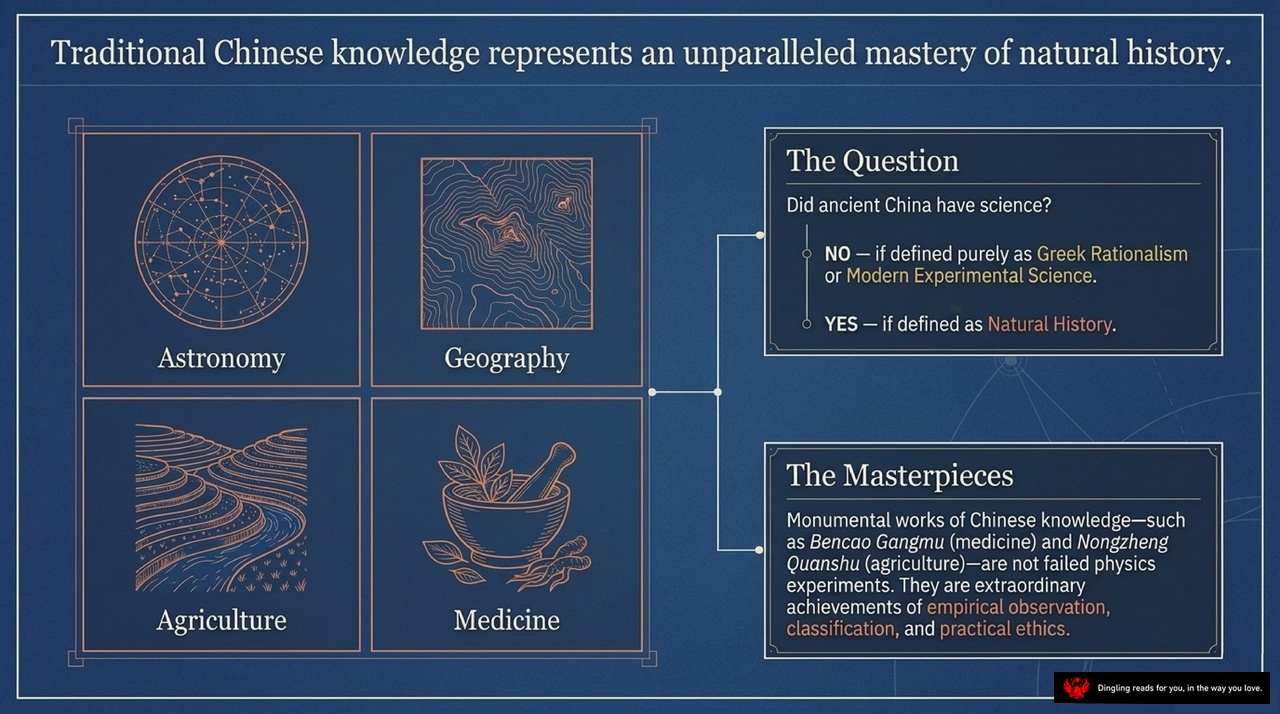
Today's slide asks a provocative question: Did ancient China actually have science? The answer depends entirely on how you define the term. If we strictly apply the Western standard of Greek rationalism or modern experimental science, the answer is no. But if we broaden our definition to include natural history, the answer is a resounding yes.
Look at the four pillars displayed here: Astronomy, Geography, Agriculture, and Medicine. These aren't failed physics experiments as some critics claim. Instead, they represent an unparalleled mastery of natural history. Take our star charts, for instance. Ancient Chinese astronomers didn't just guess; they meticulously recorded celestial events for millennia, creating a dataset so rich that modern astronomers still rely on it today. Similarly, in geography and agriculture, Chinese scholars moved beyond simple observation to develop sophisticated systems for understanding the land and its resources.
The masterpieces listed on the right, like the *Bencao Gangmu* and *Nongzheng Quanshu*, are monumental achievements. They are not theoretical abstractions but extraordinary feats of empirical observation, rigorous classification, and practical ethics. By shifting our lens from "science" as we know it today to "natural history," we unlock a different kind of scientific brilliance—one that was deeply rooted in the world, focused on cataloging reality, and dedicated to understanding the natural order in all its complexity.
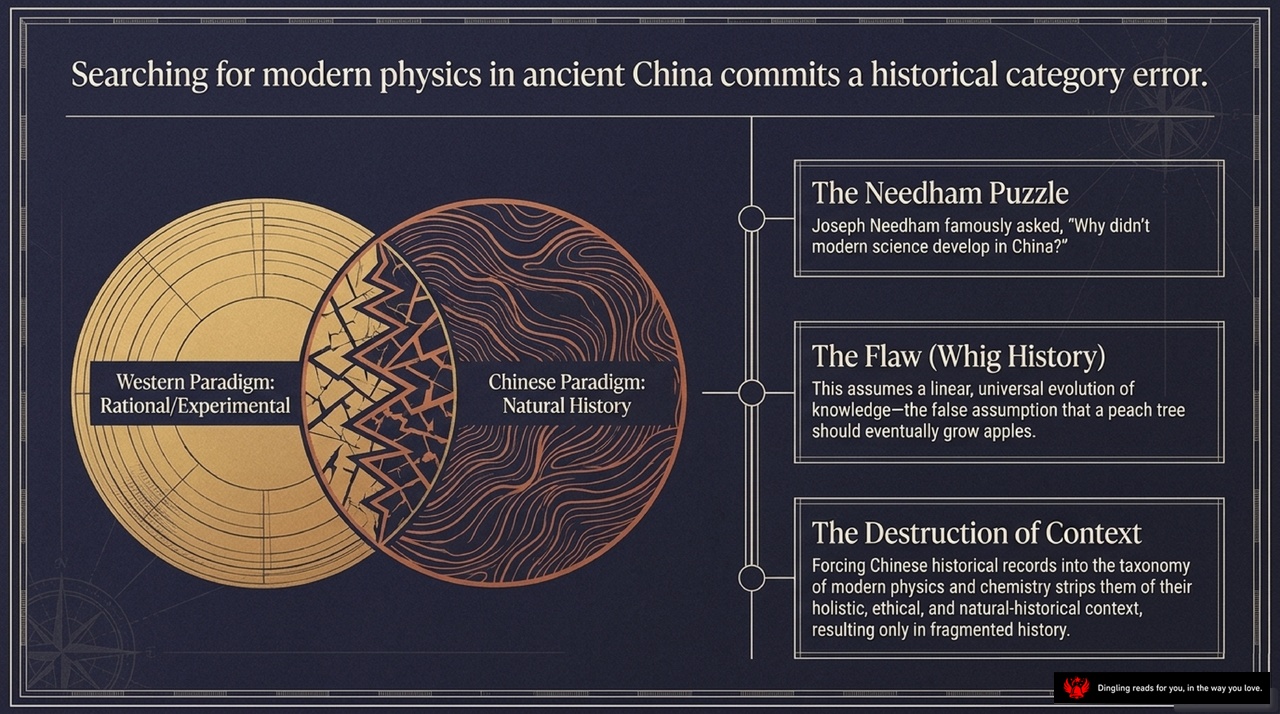
Searching for modern physics in ancient China commits a historical category error. This slide highlights a critical misunderstanding that has long plagued the study of Chinese science. At its heart lies the "Needham Puzzle": Joseph Needham's famous question, "Why didn't modern science develop in China?" This inquiry often stems from a flawed assumption known as "Whig History." This perspective wrongly assumes a linear, universal evolution of knowledge, operating under the false belief that a peach tree should eventually grow apples. It projects our current understanding of Western rational-experimental science back onto the past, expecting ancient China to have produced the same results simply because enough time had passed.
The image illustrates the fundamental mismatch between these two paradigms. On the left, we see the "Western Paradigm," defined as Rational and Experimental. This approach seeks universal laws through mathematics and controlled testing. On the right is the "Chinese Paradigm," characterized as Natural History. This tradition focuses on observing, recording, and classifying specific phenomena within their unique contexts, rather than stripping them away to find abstract, universal formulas. The jagged line where they overlap represents the destructive friction caused by forcing one onto the other.
This leads to the third point: The Destruction of Context. When we force Chinese historical records into the rigid taxonomy of modern physics and chemistry, we strip them of their holistic, ethical, and natural-historical context. We reduce rich, complex observations into fragmented data points that look like failed experiments. By doing so, we not only misunderstand the past but also lose the unique value of the Chinese tradition of natural history. True understanding requires us to stop looking for apples on a peach tree and instead appreciate the distinct fruit each tree offers.

Today's slide outlines a crucial insight: human knowledge doesn't exist in isolated boxes but flows across a continuous spectrum connecting action, observation, and deduction. Think of this as a single, evolving timeline rather than three separate categories.
On the far left, we see the Action-Based end, rooted in tacit knowledge. This is the realm of craftsmanship and practical skills—knowledge deeply embedded in the human body and immediate environment. It's the kind of wisdom you gain by doing, not just thinking.
Moving to the center is the Observation-Based spectrum, representing natural history. Here, knowledge comes from classification, encyclopedic recording, and a deep reverence for the living world. It focuses on harmony and the careful observation of life as it unfolds, without necessarily forcing it into rigid logical structures.
Finally, on the right, lies the Deduction-Based end, which embodies rational and experimental science. This is the domain of logic, mathematical prediction, and modern Western science. It prioritizes mechanical control, abstraction, and the discovery of universal laws that apply everywhere.
The key takeaway is that these aren't competing systems. Instead, they form a spectrum where our understanding of the world shifts depending on whether we are acting, observing, or deducing. True wisdom lies in recognizing where we stand on this spectrum and understanding how these modes of knowing complement one another.
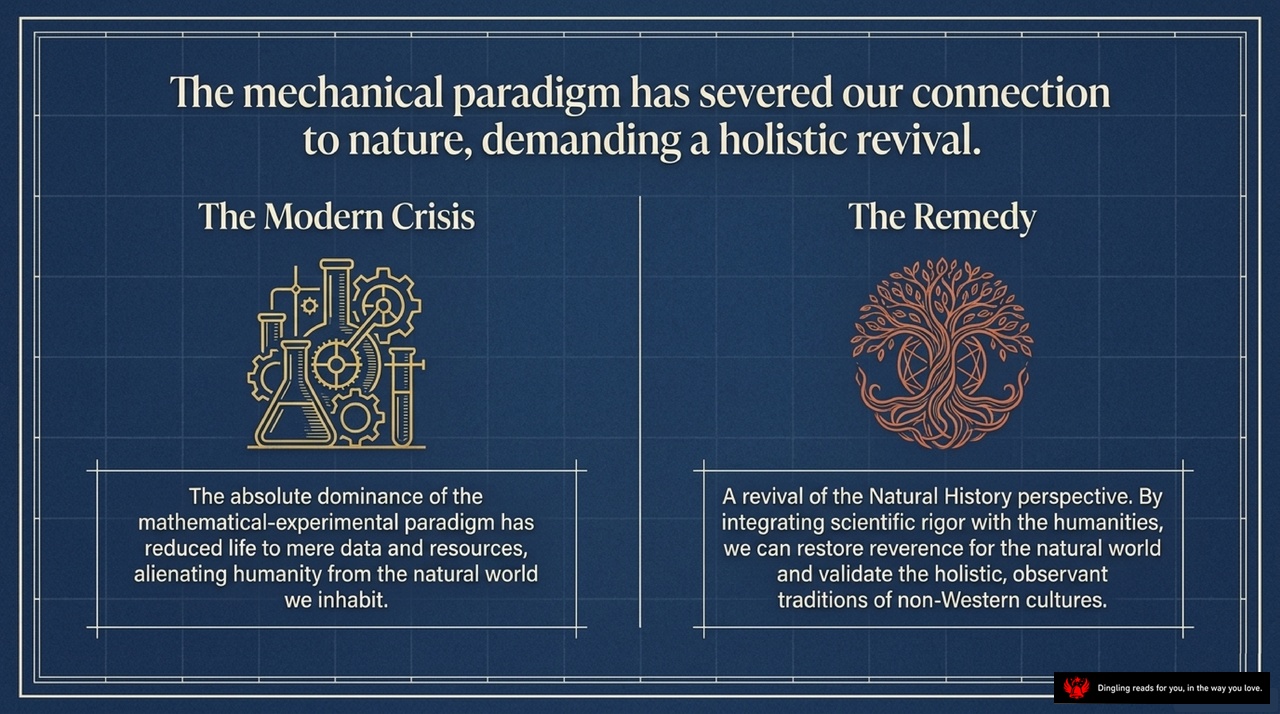
The mechanical paradigm has severed our connection to nature, demanding a holistic revival. On the left, we see the modern crisis: the absolute dominance of the mathematical-experimental paradigm has reduced life to mere data and resources, alienating humanity from the natural world we inhabit. This rigid, mechanical view treats nature as a machine to be dissected and controlled, stripping it of its intrinsic value and complexity.
But on the right lies the remedy: a revival of the Natural History perspective. By integrating scientific rigor with the humanities, we can restore reverence for the natural world and validate the holistic, observant traditions of non-Western cultures. Unlike the reductionist approach that focuses only on isolated variables, Natural History invites us to observe the interconnected web of life—the plants, animals, and ecosystems in their full context. It asks us to see the world not as a collection of parts, but as a living, breathing whole. This shift from mechanical analysis to holistic observation is essential for healing our fractured relationship with nature and finding a sustainable path forward.
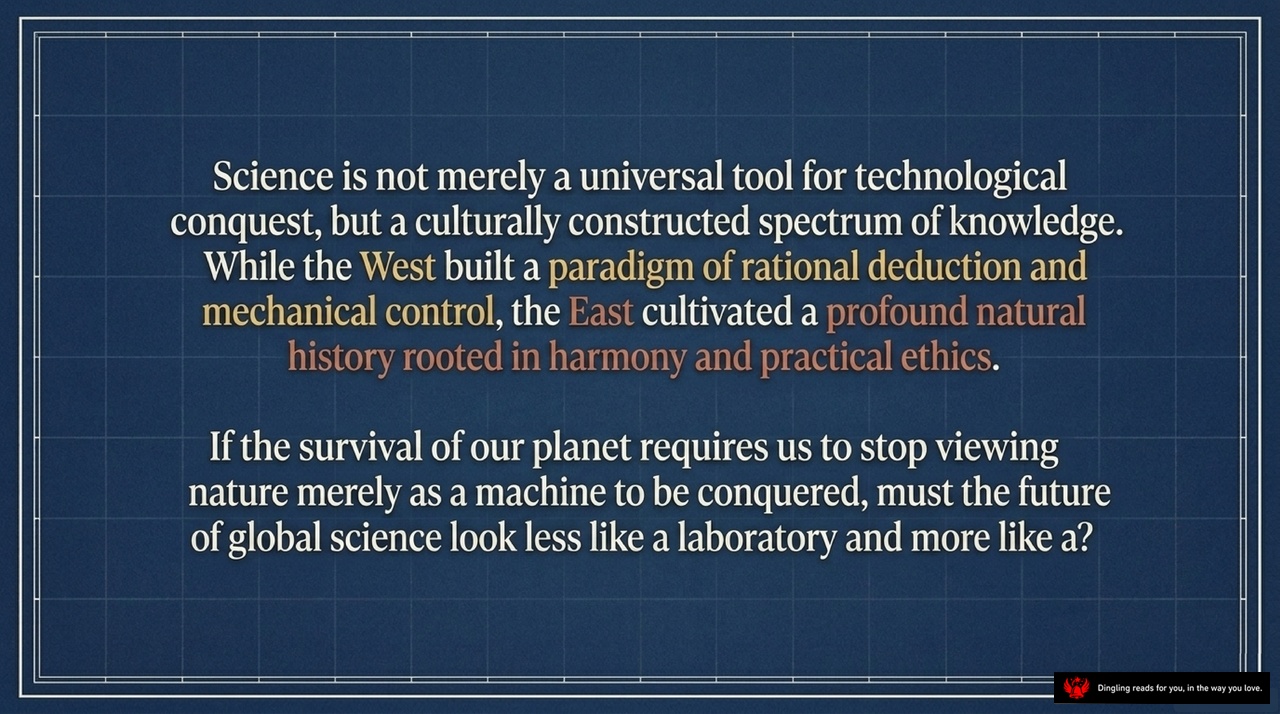
Science is not just a universal tool for technological conquest; it is a culturally constructed spectrum of knowledge. As the slide highlights, the West built a paradigm of rational deduction and mechanical control, while the East cultivated a profound natural history rooted in harmony and practical ethics. If the survival of our planet requires us to stop viewing nature merely as a machine to be conquered, must the future of global science look less like a laboratory and more like a garden?
This question challenges us to reconsider our relationship with the natural world. For centuries, Western science has prioritized control and efficiency, treating nature as a resource to be mastered through logic and experimentation. In contrast, Eastern traditions have long embraced a different approach, one that values observation, classification, and coexistence. This is the essence of natural history—a discipline that focuses on documenting the richness of life rather than dissecting its underlying mechanisms.
Think about it: when we look at a forest, do we see only timber and carbon sinks, or do we see a complex web of life, each species playing its part in a harmonious whole? The Western scientific tradition has been incredibly successful in advancing technology and solving practical problems, but it often comes at the cost of ecological balance and spiritual connection. By embracing the Eastern perspective of natural history, we might find a path forward that integrates both rigor and reverence, innovation and harmony.
The future of science may well lie in this synthesis—combining the analytical power of the West with the holistic wisdom of the East. Only by recognizing the intrinsic value of nature and learning to live in harmony with it can we hope to secure a sustainable future for all.