


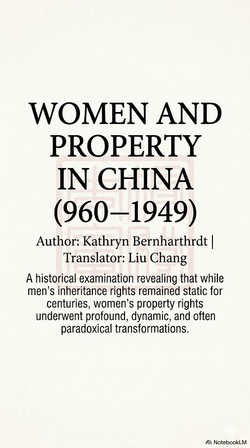
This book brilliantly proves that women did have property rights in Song China.
Your Review
This book brilliantly proves that women did have property rights in Song China.


This study finally proves women did have property rights.

Bernhardt proves that women's property rights were never fixed but constantly shaped by state priorities and local customs rather than simple gender equality.

Bernhardt brilliantly proves women did own property in Song China, shattering the old myth about total dependence.

This book is a must-read for anyone interested in Chinese legal history.

Bernhardt proves the Song half-share rule was misunderstood, applying only to heirless households and showing how state tax needs actually drove these legal changes.

Bernhardt effectively explains how the 1930s Civil Code promised equality but failed rural women due to loopholes favoring individual property rights over clan customs.

Slightly repetitive in places, still solid overall.

Bernhardt reveals that the 1930s Civil Code's promise of equality failed because it ignored deep-rooted patriarchal customs and family structures, allowing fathers to legally disinherit daughters through pre-death gifts, proving that formal legal equality without addressing underlying social and economic structures cannot achieve real-world equity for marginalized women who fell through the cracks of the code's rigid, individualistic framework.

The 1930s Civil Code promised equality but loopholes let fathers disinherit daughters legally.

Bernhardt proves the Song half-share rule was only for heirless families, correcting a major historical misunderstanding about women's rights.

Disappointed that formal equality in the 1930s code did not help many women in practice.

Bernhardt brilliantly dismantles the myth that Chinese women never owned property, showing how rights shifted with state needs.

This book shows how judges acted as intermediaries between strict laws and local customs, often bending rules to fit community values about chastity or lineage.

Interesting book that challenges common assumptions about women and property in traditional China.

Finally a history that proves women had property rights.

Interesting but frustrating. The 1930s Civil Code promised equality for daughters. Yet loopholes let fathers disinherit them legally using pre-death gifts.

This book proves that formal legal equality in the 1930s often failed real women due to loopholes and deep-rooted patriarchal customs.

Bernhardt's deep dive into court cases reveals how state priorities like tax revenue and labor stability drove changes in women's property rights across centuries, not just gender equality.

Bernhardt shows how Song laws were actually about tax revenue, not helping daughters, which changes how I view history.