Psychology Book Summaries & Key Insights

Psychology Total 132 books

The Warren Buffett Way summary and key insights by Robert G. Hagstrom
Loading…

The Warren Buffett Way

Robert G. Hagstrom

4.2870 learners

Robert G. Hagstrom’s *The Warren Buffett Way* demystifies the investment philosophy behind one of the world’s most successful investors, breaking down Buffett’s timeless strategies into actionable, accessible principles. Drawing on decades of Berkshire Hathaway’s annual reports, real-world investment cases, and insights from Buffett’s mentors—Benjamin Graham, Philip Fisher, and Charlie Munger—the book outlines 12 core rules spanning business quality, management integrity, financial health, and market valuation. It challenges modern finance’s efficient market hypothesis, emphasizing that rationality, patience, and a focus on intrinsic value over short-term price swings are the keys to long-term wealth. Hagstrom also explores the psychological traps that derail most investors, from loss aversion to herd mentality, and explains how Buffett avoids them. Whether you’re a novice investor or a seasoned professional, this book provides a framework to adapt Buffett’s wisdom to your own portfolio, rather than blindly copying his moves, helping you build a disciplined, profitable investment approach.
The Red Book summary and key insights by Carl Jung
Loading…

The Red Book

Carl Jung

3.9682 learners

In his midlife crisis, Carl Jung turned inward, documenting the vivid visions, dreams, and intense dialogues with his inner soul that would form *The Red Book*. Rejecting the early 20th century’s obsession with practicality and rationality, he delved into the "deep psyche"—a realm of collective unconscious wisdom that shattered his scientific certainty. Through haunting imagery like the 1913 flood vision (a premonition of WWI), encounters with archetypal figures such as the wise Philemon, the passionate Salome, and the transformative serpent, Jung confronts his shadow self, embraces life’s contradictions (light and dark, thought and emotion), and charts the path to individuation: the journey to become a whole, authentic self. More than a personal memoir, this foundational work of analytical psychology invites readers to confront their own inner depths, challenging the illusion of a perfect self and revealing that true redemption lies in integrating all parts of one’s being.

The Realm of Clarity summary and key insights by Qing Ze
Loading…

The Realm of Clarity

Qing Ze

3.41060 learners

For over 20 years, Qing Ze has navigated the brutal, high-stakes world of futures trading—from a reckless gambler who made $1 million overnight (and lost it all) to a seasoned master who turned pain and failure into profound wisdom. In *The Realm of Clarity*, he shares his journey from chasing quick riches to pursuing the "Dao" of trading, blending Eastern philosophy (Laozi, Confucianism) and Western thought (Kant’s transcendentalism) to build a groundbreaking investment philosophy: your theories, models, and assumptions define how you see the market. He breaks down his core "Trend + Structure" strategy, emphasizes non-negotiable risk management rules, and reveals why unshakable faith in your system is the key to beating the odds. Packed with real-world stories, hard-won lessons, and actionable insights, this book is a must-read for anyone looking to escape the cycle of losses and build a sustainable, profitable trading career.

The Molecule of More summary and key insights by Daniel Z. Lieberman;Michael E. Long
Loading…

The Molecule of More

Daniel Z. Lieberman;Michael E. Long

4.31239 learners

In *The Molecule of More*, neuroscientists Daniel Z. Lieberman and Michael E. Long demystify dopamine—once mislabeled the "pleasure molecule," but actually the brain’s relentless engine for "more." They break down how this single chemical drives everything from the inevitable fade of romantic passion (when thrilling new possibilities turn into routine) to destructive addictive behaviors, where the urge to want overrides the joy of liking. The book explores dopamine’s dual roles: fueling genius and creativity (linking it to both groundbreaking innovations and mental illness) while shaping political ideologies—liberal thinkers lean into its future-focused drive, conservatives prioritize present-focused stability. It also traces dopamine’s role in human migration, showing how a specific genetic variant helped our ancestors thrive in uncharted lands. Finally, Lieberman and Long argue that true happiness comes from balancing dopamine’s endless pursuit of tomorrow with the quiet joy of present-molecule-driven moments, like deep connection or hands-on creativity.

The Hero with a Thousand Faces summary and key insights by Joseph Campbell
Loading…

The Hero with a Thousand Faces

Joseph Campbell

4.2812 learners

Joseph Campbell’s seminal work, *The Hero with a Thousand Faces*, uncovers the universal “monomyth” structure woven into myths, fairy tales, religious texts, and epic stories across every global culture. By dissecting tales from Greek legends to Indigenous folklore, Campbell breaks down the hero’s timeless journey into a repeating cycle: the call to adventure, crossing the threshold into the unknown, facing trials alongside supernatural allies, achieving enlightenment or an ultimate boon, and returning to the ordinary world to share transformative wisdom. This groundbreaking analysis bridges ancient archetypes and modern life, showing readers how their own personal struggles, growth, and self-discovery mirror the heroic journeys of mythic figures. Campbell’s vivid storytelling and profound insights reveal that every individual holds the potential to be a hero, navigating life’s challenges to unlock purpose and contribute to the greater good.

The Conquest of Happiness summary and key insights by Bertrand Russell
Loading…

The Conquest of Happiness

Bertrand Russell

4.3658 learners

Bertrand Russell’s *The Conquest of Happiness* dismantles the myth that happiness is a rare gift for the fortunate. Drawing from his own journey—from a despairing childhood marked by suicidal thoughts to a joyful, purpose-filled adulthood—Russell unpacks the hidden psychological roots of modern unhappiness: crippling self-absorption (guilt, narcissism, grandeur), toxic competition, irrational jealousy, paralyzing fear, and the hollow pursuit of empty excitement. He argues that while systemic issues contribute, most misery stems from self-imposed mindsets and habits that drain our natural zest for life. Filled with relatable examples (overworked American businessmen, disillusioned intellectuals) and practical, actionable advice, the book shows readers how to break free: by cultivating broad, genuine interests outside themselves, building reciprocal loving relationships, balancing ambition with acceptance of life’s small frustrations, and finding fulfillment in constructive work. Russell’s warm, no-nonsense tone makes this timeless guide feel like a chat with a wise mentor, proving happiness is a skill anyone can learn.

The Burnout Society summary and key insights by Byung-Chul Han
Loading…

The Burnout Society

Byung-Chul Han

4.1814 learners

In The Burnout Society, philosopher Byung-Chul Han dissects the silent epidemic plaguing 21st-century life: burnout, depression, and chronic fatigue. Moving beyond the 20th-century immunological model—shaped by Cold War us-versus-them divisions—Han argues we’ve shifted to a meritocracy where relentless positivity and the mantra “you can do anything” drive self-exploitation far more insidious than external oppression. Unlike the disciplinary society of hospitals and prisons, today’s world rewards constant productivity, turning individuals into their own jailers and taskmasters. Han exposes how this hyper-activity erodes deep attention, the foundation of creativity and contemplation, replacing it with scattered “super attention” that mimics survival mode in the wild. He laments the loss of festive time—moments of unproductive joy and connection—and critiques how neoliberalism reduces life to mere survival and health obsession. Ultimately, Han calls for a return to contemplative rest, arguing that only by embracing stillness and rejecting the tyranny of endless productivity can we reclaim our humanity from the burnout crisis.

The Astonishing Hypothesis summary and key insights by Francis Crick
Loading…

The Astonishing Hypothesis

Francis Crick

4.5701 learners

In *The Astonishing Hypothesis*, Nobel Prize-winning scientist Francis Crick upends centuries of spiritual and philosophical belief by arguing that every facet of human experience—joy, sorrow, memory, free will, and consciousness itself—arises from the collective activity of billions of neurons and their associated molecules. Rejecting the idea of an independent soul, Crick frames consciousness as a solvable scientific problem, zeroing in on visual awareness as a practical starting point due to its vividness, controllable inputs, and feasibility for experimentation in humans and primates. Drawing on decades of neuroscience research, psychological experiments (such as visual illusions and attention studies), and analyses of brain-damaged patients, he explores how neural networks process visual information, the specialized roles of brain regions like the primary visual cortex and thalamus, and the search for the "neural correlates of consciousness." Crick’s work bridges abstract philosophy and hard science, challenging readers to rethink their understanding of self and laying the groundwork for modern consciousness studies.

Brain Repair summary and key insights by Yao Nailin
Loading…

Brain Repair

Yao Nailin

3.4919 learners

Brain Repair demystifies the intricate connection between brain science and mental health, turning cutting-edge research into actionable advice for everyday struggles and serious neurological conditions. Drawing on real-life anecdotes and rigorous studies, this book breaks down common issues like depression, anxiety, sleep disorders, and addiction, explaining their biological roots—from neurotransmitter imbalances to brain structure changes. It also explores lesser-known topics, including mental resilience, memory enhancement, and the surprising links between gut health, immunity, and brain function. Readers will learn evidence-based strategies to boost cognitive focus, manage procrastination, and nurture brain plasticity at every age. Whether you’re dealing with mild stress or curious about protecting your brain long-term, Brain Repair makes hard science relatable, empowering you to take control of your mental and neurological well-being.

The Art of Loving summary and key insights by Erich Fromm
Loading…

The Art of Loving

Erich Fromm

4.1459 learners

Erich Fromm’s *The Art of Loving* dismantles the pervasive myth that love is a fleeting, luck-dependent feeling, arguing instead that it is a teachable skill requiring intentional learning and practice. Drawing on psychoanalysis, philosophy, and social critique, Fromm explores humanity’s inherent struggle with loneliness and how mature love—rooted in creative giving, care, responsibility, respect, and understanding—offers the only genuine escape without sacrificing individual identity. He breaks down distinct forms of love, including brotherly love, maternal love, romantic love, self-love, and divine love, while exposing modern society’s alienating effects that reduce love to a transaction or fleeting passion. Fromm also outlines practical steps to cultivate love: embracing discipline, focus, patience, overcoming narcissism, and fostering rational faith, urging readers to prioritize love over material success to live a fulfilled, connected life.

Everything I Never Told You summary and key insights by Celeste Ng
Loading…

Everything I Never Told You

Celeste Ng

4.11307 learners

Set in 1970s small-town Ohio, *Everything I Never Told You* unfolds when Lydia Lee, the golden child of a mixed-race Chinese-American family, vanishes without a trace. Her disappearance cracks open the quiet tension simmering beneath the Lee household’s surface: Marilyn, Lydia’s white mother, has poured her unfulfilled medical school dreams into her daughter, pressuring her to excel in science and defy gender norms. James, her Chinese father, haunted by a lifetime of feeling like an outsider, pushes Lydia to fit in and make friends, desperate to spare her his own loneliness. As the family grapples with Lydia’s fate, secrets emerge—her hidden academic struggles, fake friendships, and the rift with her astronaut-obsessed brother, Nate, who’s desperate to escape their suffocating home. Through flashbacks and intimate perspectives, Celeste Ng lays bare the cost of unspoken expectations, the pain of being unseen, and how a family’s love can turn into a cage. In the aftermath of tragedy, the Lees confront their mistakes, learning to listen to each other and heal the wounds they’ve inflicted.

The Lucifer Effect summary and key insights by Philip Zimbardo
Loading…

The Lucifer Effect

Philip Zimbardo

4706 learners

In *The Lucifer Effect*, renowned psychologist Philip Zimbardo dismantles the myth of inherent "good" and "evil" by exploring how ordinary people can be pushed to commit unspeakable acts under the right circumstances. At the heart of the book is the groundbreaking Stanford Prison Experiment, where randomly assigned college students transformed into brutal guards and broken prisoners in just six days, revealing the overwhelming power of situational forces and systemic structures. Zimbardo connects this lab insight to real-world horrors—from the Abu Ghraib prison abuses to the Holocaust—unpacking psychological mechanisms like deindividuation, dehumanization, and moral disengagement that enable cruelty. He doesn’t stop at exposing darkness, though; he outlines practical strategies to resist harmful contexts, defines what makes a heroic act, and highlights everyday people who stood up against injustice, proving that while human nature is fragile, it’s also capable of extraordinary courage.

Unconventional summary and key insights by Bai Lu
Loading…

Unconventional

Bai Lu

31194 learners

Unconventional isn’t another generic self-help guide—it’s a no-nonsense playbook for building unshakable mental strength, mastering your deepest desires, and crafting a life on your own terms. Drawing on real-life anecdotes, timeless wisdom from thinkers like Seneca and Viktor Frankl, and actionable frameworks, author Bai Lu breaks down how to thrive in an uncertain world. You’ll learn to separate what you can control from what you can’t, reframe setbacks as growth fuel, and stop letting external chaos derail your focus. The book also dives into harnessing core desires (not suppressing them), identifying your unique strengths to stand out, turning knowledge into results through effective practice, and leveraging mindset models like compound growth and gray thinking. Plus, it shares practical strategies for building high-value relationships—from learning from relatable role models to connecting with industry leaders by offering genuine value. Whether you’re stuck in a career rut, struggling with decision-making, or craving more purpose, Unconventional gives you the tools to take charge and achieve lasting success.

The Feeling of Ascending to Heaven summary and key insights by Yue Xiaodong
Loading…

The Feeling of Ascending to Heaven

Yue Xiaodong

3.5481 learners

Drawing from real counseling sessions with Harvard students and international scholars, *The Feeling of Ascending to Heaven* offers raw, intimate stories of struggle and growth. From a small-town freshman crippled by insecurity to a student trapped by guilt over a sibling’s accident, a conflicted writer torn between family expectations and her dreams, and a trauma survivor stuck in childhood, each case unpacks universal psychological challenges—low self-esteem, unresolved grief, relationship crises, identity confusion, and ethical dilemmas. Dr. Yue Xiaodong walks readers through evidence-based techniques like cognitive restructuring, emotional catharsis, behavioral therapy, and transference management, showing how empathy, self-awareness, and targeted strategies can turn despair into self-transcendence. More than a collection of case studies, this book is a guide to navigating life’s hardest moments, helping readers recognize their own resilience and find paths to healing and growth.

The Sailor Who Fell from Grace with the Sea summary and key insights by Yukio Mishima
Loading…

The Sailor Who Fell from Grace with the Sea

Yukio Mishima

4.5463 learners

Set in post-WWII Yokohama, *The Sailor Who Fell from Grace with the Sea* follows 13-year-old Noboru Kuroda, a nihilistic boy who rejects the "fictions" of adult society—love, family, and stability. His world shifts when he meets Ryuji Tsukazaki, a brooding sailor who once dreamed of oceanic glory but loathes the land’s stagnation. Ryuji falls for Noboru’s widowed mother, Fusako, and abandons his life at sea to build a domestic future with her. Initially, Noboru sees Ryuji as a sacred figure, a bridge connecting the raw truth of the sea, his mother, and his own longing for unfiltered existence. But as Ryuji embraces the banality of land life—wearing tailored suits, managing Fusako’s shop, and playing the role of a father—Noboru views him as a traitor to the pure, uncompromising truth he once represented. Fueled by his extremist beliefs and a desire to preserve his vision of the world, Noboru and his nihilistic friends plot a brutal, irreversible judgment against the sailor who fell from grace.

Under the Skin summary and key insights by Michel Faber
Loading…

Under the Skin

Michel Faber

51207 learners

Disguised as a human with agonizing body modifications, Isserley cruises Scotland’s remote A9 highway, tasked with luring robust male hitchhikers to their deaths—her alien species values human flesh as a gourmet delicacy. For years, she’s executed her mission with cold precision, but as she interacts with her prey, a flicker of empathy begins to erode her resolve. When a privileged alien heir arrives to challenge the cruelty of the trade, Isserley is forced to confront the horrors of her work, the cost of her survival, and her own fractured identity. Michel Faber’s haunting, visceral novel blends tense road-trip suspense with profound introspection, exploring themes of alienation, morality, and the thin line between predator and prey. It’s a raw, unflinching portrait of a being caught between two worlds, fighting to hold onto her humanity while clinging to the only life she knows.

The Seven Madmen summary and key insights by Roberto Arlt
Loading…

The Seven Madmen

Roberto Arlt

4.31089 learners

Trapped in a cycle of grinding poverty, marital decay, and workplace ruin, Augusto Remo Erdosain—an Argentine clerk on the brink—stumbles into a twisted circle of outcasts and self-proclaimed visionaries in Roberto Arlt’s raw, unflinching classic. After stealing money to survive and facing exposure, Erdosain crosses paths with a delusional astrologer plotting a secret society built on lies, exploitation, and violent revolution. Alongside a cynical pimp, a vengeful cousin, and other fractured souls, he embraces a plan of kidnapping and murder to fund their chaotic quest to upend society. Blending gritty urban realism with existential despair, *The Seven Madmen* lays bare the desperation of those pushed to the margins, exploring how madness can become a twisted lifeline for those who’ve lost all hope of a normal life.

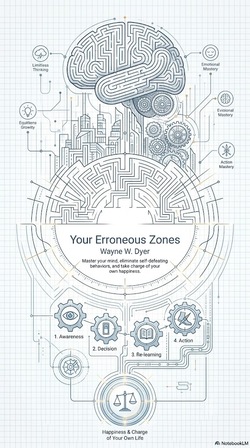
Your Erroneous Zones summary and key insights by Wayne W. Dyer
Loading…

Your Erroneous Zones

Wayne W. Dyer

4.51119 learners

Wayne W. Dyer’s *Your Erroneous Zones* is a timeless self-help classic that dismantles the self-defeating mindsets holding you back from true happiness and personal freedom. Dyer argues that many of our daily struggles—from constant anger and paralyzing guilt to relentless approval-seeking and chronic procrastination—stem from false, ingrained beliefs: that emotions are controlled by external events, that our worth depends on others’ opinions, or that we’re trapped by past labels. Through relatable real-life anecdotes and practical, actionable strategies, he guides readers to take full responsibility for their feelings, embrace the present moment, and reject rigid societal 'shoulds' that stifle authenticity. The book emphasizes that true fulfillment comes from self-acceptance, breaking free from psychological dependence, and choosing to live on your own terms rather than conforming to others’ expectations. Whether you’re stuck in cycles of worry, trapped in toxic relationships, or struggling to prioritize your own joy, this book offers a clear roadmap to rewrite your thought patterns and build a life rooted in confidence and inner peace.

Yan's Family Instructions summary and key insights by Yan Zhitui
Loading…

Yan's Family Instructions

Yan Zhitui

4.5877 learners

This transformative work redefines education by centering children’s untapped innate potential, challenging traditional knowledge-focused teaching models. It reveals the science behind the "absorbent mind"—a unique ability in infants and young children to unconsciously absorb language, cultural norms, and skills from their environment far beyond adult capacity. The book outlines critical developmental stages, emphasizing that the 0-6 age group is foundational for personality, intelligence, and social skill formation, far more impactful than later academic years. It introduces the concept of the "spiritual embryo," a human-only post-birth phase where children actively construct their mental world. Critiquing systems that prioritize exams over holistic growth, it advocates for child-led learning environments where adults act as guides rather than instructors, supporting natural independence, motor skill development, and social cohesion. By aligning education with biological and psychological laws, it offers a roadmap to nurture well-adjusted, capable individuals and build a more harmonious society.

The Absorbent Mind summary and key insights by Maria Montessori
Loading…

The Absorbent Mind

Maria Montessori

4.41282 learners

Maria Montessori’s *The Absorbent Mind* redefines childhood development with its groundbreaking focus on children’s innate, unconscious ability to absorb knowledge and shape their personalities from birth. Centered on the critical 0–6-year "spiritual embryo" stage, Montessori argues traditional education’s rote learning and adult-led instruction stifles this natural growth. She breaks down child development into distinct stages, explaining how the absorbent mind differs from adult learning: kids don’t just memorize—they integrate language, culture, and skills into their very being. The book outlines practical, child-centered approaches like prepared environments, mixed-age classrooms, and sensory training that honor this innate capacity. Montessori also frames nurturing the absorbent mind as more than raising capable kids; it’s the key to building a harmonious, peaceful world by unlocking the next generation’s full potential.