Psychology Book Summaries & Key Insights

Psychology Total 132 books

The Courage to Be Happy summary and key insights by Ichiro Kishimi;Fumitake Koga
Loading…

The Courage to Be Happy

Ichiro Kishimi;Fumitake Koga

4.2736 learners

In *The Courage to Be Happy*, Ichiro Kishimi continues the engaging dialogue between a skeptical young educator and a wise philosopher, unpacking Adlerian psychology’s transformative insights for happiness and growth. Frustrated by pushback against Adler’s ideas in his teaching, the youth challenges the philosopher to defend its validity, sparking deep dives into core concepts: teleology (rejecting the myth that past trauma defines the present), task separation, and the critical role of respect over praise or criticism in education. The book dismantles the fantasy of "destined love," framing love as an active, collaborative choice rather than a passive feeling, and emphasizes community connection over cutthroat competition. Packed with actionable advice for educators, professionals, and anyone seeking meaningful relationships, it teaches readers to embrace self-acceptance, take initiative in connections, and find the courage to choose happiness in every present moment.

Willpower summary and key insights by Roy F. Baumeister;John Tierney
Loading…

Willpower

Roy F. Baumeister;John Tierney

4794 learners

Written by renowned researchers Roy F. Baumeister and John Tierney, *Willpower* distills decades of scientific studies and real-world examples to demystify self-control. The book reveals that willpower is a finite, shared mental resource—every act of self-regulation, from resisting junk food to managing emotions, draws from the same internal "account." It explains core concepts like ego depletion, how glucose fuels cognitive discipline, and why decision fatigue leads to impulsive choices. Readers will learn actionable strategies: setting realistic goals to avoid burnout, using precommitment tactics to beat temptation, leveraging social accountability (such as AA’s 12-step program), and how parenting styles shape children’s self-control. It also addresses common pitfalls, like the "what-the-hell" effect that derails diets, and offers evidence-based fixes to build lasting self-discipline. Whether you aim to quit a habit, boost productivity, or improve relationships, *Willpower* turns intentional choices into automatic, sustainable habits.

Encountering Your Inner Self summary and key insights by Tiffany Chang
Loading…

Encountering Your Inner Self

Tiffany Chang

3.9991 learners

Meet Lila, a burnt-out NYC marketing manager trapped in a loveless marriage, toxic office dynamics, and a crippling sense of unworthiness. After an explosive fight with her husband, she flees to the Catskills, runs out of gas, and stumbles on a cabin where a wise elder poses a life-shaking question: “Who are you?” This sparks a transformative journey as Lila sheds the false identities she’s built her life on—job title, marital status, college credentials—and uncovers her true self: a core of love, joy, and peace buried under layers of physical habits, repressed emotions, overactive thoughts, and societal roles. Guided by the elder, she learns how energy vibrations shape her reality, how her subconscious drives repeated patterns, and how to heal childhood wounds trapped in her body. She discovers the difference between fleeting, external happiness and lasting, inner joy, and masters the art of surrendering to unchangeable facts while taking charge of her inner state. By the end, Lila emerges with clarity, resilience, and the tools to live authentically, free from the chains of others’ expectations.

You Can Heal Your Life summary and key insights by Louise L. Hay
Loading…

You Can Heal Your Life

Louise L. Hay

4.3895 learners

Louise L. Hay’s iconic guide *You Can Heal Your Life* unpacks how we lose touch with our innate, unshakable worth from childhood onward. We absorb limiting beliefs from critical parents, judgmental teachers, and societal pressures, internalizing self-doubt that manifests as anxiety, strained relationships, and even physical ailments. Hay uses relatable case studies—from patients trapped in self-defeating cycles to Winston Churchill’s journey through adversity—to illustrate how these toxic narratives warp our self-perception. She lays out actionable practices to reclaim your true self: practicing radical self-kindness, releasing old resentments, reframing negative thoughts, and embracing your inherent perfection. Whether navigating romantic relationships, finding purpose in work, or healing from past wounds, this book teaches you to rewrite your internal story, heal mind and body, and live a life rooted in self-love and authentic joy.

The Warren Buffett Portfolio summary and key insights by Robert G. Hagstrom
Loading…

The Warren Buffett Portfolio

Robert G. Hagstrom

4.2770 learners

Written by Robert G. Hagstrom, *The Warren Buffett Portfolio* breaks down the legendary investor’s counterintuitive concentrated investing strategy, a sharp alternative to underperforming mainstream approaches like active management and index investing. Unlike active funds that churn 80% of holdings yearly and rarely beat the S&P 500, or index funds that only deliver average returns, Buffett’s method focuses on selecting 5-10 high-quality, undervalued companies with long-term competitive advantages, then betting big and holding for years while ignoring short-term market volatility. The book dives into the logic behind this strategy: Benjamin Graham’s value investing principles, probabilistic thinking rooted in statistics, Charlie Munger’s latticework of mental models, and behavioral finance to avoid emotional traps like the “Market Mr.” It uses real-world wins (Coca-Cola, Wells Fargo) and stories from fellow greats like Keynes and Philip Fisher to prove its effectiveness, guiding readers on applying Buffett’s criteria and embracing long-term compounding to build lasting wealth.

Man's Search for Meaning summary and key insights by Viktor E. Frankl
Loading…

Man's Search for Meaning

Viktor E. Frankl

4951 learners

Based on Viktor E. Frankl’s firsthand experience surviving Auschwitz and other Nazi concentration camps, *Man’s Search for Meaning* blends harrowing personal memoir with groundbreaking psychological insight. Frankl documents the three stages of prisoners’ mental responses to camp life—terror, emotional numbness, and the fight to cling to purpose—and reveals how those anchored to a specific goal (reuniting with loved ones, finishing a manuscript, upholding moral values) were far more likely to survive. From this extreme "living laboratory," he developed logotherapy, a framework centered on humanity’s primary motivation: the pursuit of life’s meaning, not pleasure or instinctual drives. He explores how existential vacuum (modern society’s pervasive sense of meaningless) fuels psychological distress, and shares practical tools like paradoxical intention to break cycles of anxiety and neurosis. More than a story of suffering, this book is a timeless guide to finding purpose in adversity, empowering readers to reclaim control by identifying their unique "why."

The Undoing Project summary and key insights by Michael Lewis
Loading…

The Undoing Project

Michael Lewis

4.3953 learners

In *The Undoing Project*, Michael Lewis expands on the themes of his hit *Moneyball* to explore the revolutionary partnership between psychologists Daniel Kahneman and Amos Tversky. This dynamic pair shattered the long-held assumption that humans make rational decisions, uncovering the hidden cognitive biases that shape everything from baseball scouting and medical diagnoses to political predictions and financial choices. Through vivid storytelling, Lewis traces their journey from their early lives in Israel to their groundbreaking research, which introduced game-changing concepts like the representativeness heuristic, loss aversion, and prospect theory. Their work proved that our judgments rely on mental shortcuts rather than logical calculation, revolutionizing economics (earning Kahneman a Nobel Prize) and transforming fields from medicine to military strategy. Lewis also chronicles the deep, complex friendship that fueled their insights, offering a revealing look at why we make the choices we do—and how understanding our flaws can lead to better decisions.

The Paradox of Choice summary and key insights by Barry Schwartz
Loading…

The Paradox of Choice

Barry Schwartz

4.3700 learners

In *The Paradox of Choice*, Barry Schwartz exposes the hidden toll of America’s endless obsession with options. From supermarket shelves packed with 30,000+ products to overwhelming choices in healthcare, education, and careers, he reveals that surplus selection doesn’t boost happiness—it triggers decision paralysis, regret, and even depression. Through iconic experiments like the jam study (where 6 options drove 10x more purchases than 24), Schwartz breaks down why more choices often leave us less satisfied. He distinguishes between "maximizers" who chase the "best" option at the cost of joy, and "satisficers" who settle for "good enough" and thrive. The book also explores cognitive biases (anchoring, framing) and psychological traps (hedonic treadmill, social comparison) that amplify our struggles. Finally, Schwartz offers practical strategies to reclaim control: focus on high-impact choices, embrace satisficing, limit social comparisons, and use secondary decisions to simplify daily life. A must-read for anyone feeling overwhelmed by modern life’s endless choices.

Happier summary and key insights by Tal Ben-Shahar
Loading…

Happier

Tal Ben-Shahar

4.6526 learners

After winning Israel’s national squash championship at 16, Tal Ben-Shahar expected lifelong joy—only to feel empty hours later. That moment sparked his quest to redefine happiness, shattering the myth that success equals lasting fulfillment. In *Happier*, he argues true happiness isn’t fleeting pleasure or pain-free ease, but a sustained state blending present joy and long-term meaning. He breaks down four life patterns: the hedonist chasing instant gratification, the rat racer delaying joy for future success, the nihilist trapped in hopelessness, and the fulfilled person who balances today’s pleasure with tomorrow’s purpose. Packed with actionable tools—from the MPS model to find meaningful work, gratitude journaling, and "happiness catalysts" (small, joyful, purpose-driven acts)—the book guides readers to build lasting happiness habits, nurture unconditional relationships, and prioritize well-being over material gain. Ben-Shahar proves happiness isn’t a destination, but a daily practice anyone can master.

Why Family Hurts summary and key insights by Wu Zhihong
Loading…

Why Family Hurts

Wu Zhihong

4667 learners

Many of us carry unspoken wounds from family life, even when we can’t name them. *Why Family Hurts* dives deep into the hidden dynamics of Chinese family structures, using real-life case studies and psychological theories to unpack common pain points: the harmful myth of putting children above spousal relationships, the narcissistic roots of overindulgence, how parental anxiety gets passed onto kids, and the intergenerational cycles of trauma that repeat across families. Wu Zhihong breaks down why these patterns form—from unmet childhood needs to cultural norms—and offers actionable insights to break free. Whether you’re struggling with strained parent-child bonds, toxic in-law relationships, or repeating the same mistakes as your own parents, this book helps you recognize hidden hurts, reclaim your sense of self, and build healthier, more loving connections.

Blink summary and key insights by Malcolm Gladwell
Loading…

Blink

Malcolm Gladwell

4.81229 learners

In Malcolm Gladwell’s *Blink*, we dive into the hidden power of split-second decisions—the unconscious judgments we make in the blink of an eye that often outperform hours of deliberate analysis. Opening with the shocking story of the Getty Museum’s fake marble statue, where art experts’ gut reactions trumped months of scientific testing, Gladwell introduces the concept of 'thin-slicing': the ability to extract critical insights from tiny, focused snippets of information. He explores the adaptive unconscious, the brain’s fast, intuitive processor that operates below our awareness, drawing on experiments like Iowa’s card game study and John Gottman’s marriage prediction research to reveal how it shapes our choices. But Gladwell also warns of the pitfalls of rapid cognition: the 'Warren Harding Effect,' where surface biases skew judgments, and implicit prejudices that undermine fair decision-making. Through real-world examples—from orchestras using blind auditions to reduce gender bias to Chicago’s Cook County Hospital overhauling chest pain diagnoses—*Blink* teaches readers to recognize, refine, and harness their instant instincts, turning quick thinking into a reliable tool rather than a source of error.

Nudge summary and key insights by Richard H. Thaler;Cass R. Sunstein
Loading…

Nudge

Richard H. Thaler;Cass R. Sunstein

4.31279 learners

Co-authored by Nobel Prize-winning economist Richard H. Thaler and legal scholar Cass R. Sunstein, *Nudge* introduces the transformative concept of "libertarian paternalism"—a gentle, freedom-preserving approach to guiding people toward better decisions. The book breaks down how our brains rely on two thinking systems: a fast, intuitive one prone to cognitive biases (like anchoring, loss aversion, and status quo bias) and a slow, deliberate, rational one. These biases lead us to make suboptimal choices, from neglecting retirement savings to overspending on unnecessary fees. Thaler and Sunstein illustrate how small, strategic "nudges"—such as setting automatic 401(k) enrollment as the default, simplifying complex insurance plans, or using social norms to encourage eco-friendly habits—can help us avoid common pitfalls. Packed with real-world examples from finance, healthcare, education, and public policy, *Nudge* proves that thoughtful choice architecture can boost personal well-being and societal good while keeping full choice in our hands.

Weak Communication summary and key insights by Zou Zhendong
Loading…

Weak Communication

Zou Zhendong

3.6855 learners

Weak Communication upends traditional communication theory with a radical framework for understanding public opinion’s hidden rules. Unlike most guides that fixate on message delivery tactics, this book explores the *inverted nature* of the public sphere: where real-world power (money, status, authority) becomes a liability, and perceived weakness drives engagement. It introduces the groundbreaking "Weak Communication Hypothesis" and four core laws: the Weak Theorem (elites start at a disadvantage in public discourse), Emotional Law (emotion always outperforms logic), Light Rule (simple, playful content spreads fastest), and Sub-theory (slightly rebellious near-mainstream narratives dominate attention). Using relatable U.S.-centric examples—from Donald Trump’s 2016 underdog campaign to corporate CEOs facing backlash for tone-deaf disaster responses—it shows how politicians, business leaders, and everyday people can leverage these rules to win support, navigate crises, and build meaningful connections. It’s not just academic theory; it’s a practical playbook for mastering the unspoken logic of public attention.

Hooked summary and key insights by Nir Eyal
Loading…

Hooked

Nir Eyal

4.2891 learners

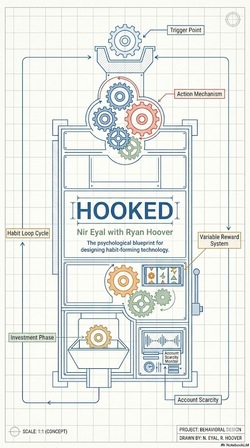
In *Hooked*, Ryan Hoover unpacks the neuroscience and psychology behind human habits, showing businesses how to turn casual users into loyal, repeat customers. Nearly half of our daily actions are unconscious habits rooted in the brain’s basal ganglia—and for companies, these habits unlock massive value: higher user lifetime value, pricing flexibility, faster viral growth, and unbreakable competitive barriers. The book’s core is the Hooked Model, a four-step framework—Triggers, Action, Variable Rewards, and Investment—that transforms "nice-to-have" products (like vitamins) into "can’t-live-without" solutions (like painkillers). Hoover uses real-world examples from Facebook, Twitter, and YouVersion to illustrate how to design products that tap into internal emotional triggers, simplify user actions, deliver unpredictable rewards, and build long-term user investment. He also addresses ethical considerations, guiding creators to build value-driven products instead of exploiting user weaknesses. Packed with actionable strategies, *Hooked* is a must-read for entrepreneurs, product designers, and marketers aiming to build lasting user loyalty.

Factfulness summary and key insights by Hans Rosling;Anna Rosling Rönnlund;Ola Rosling
Loading…

Factfulness

Hans Rosling;Anna Rosling Rönnlund;Ola Rosling

4.2688 learners

In Factfulness, Hans and Ola Rosling dismantle the 10 most common cognitive biases that distort our understanding of the world—from the binary 'us vs. them' split to the instinct to fixate on negative news. Using rigorous global data and on-the-ground stories, they debunk pervasive myths: the world isn’t divided into rich and poor extremes, but four income tiers where 75% of people live in the middle. They highlight underreported progress: extreme poverty has halved in 20 years, global life expectancy has risen to 73, and 88% of 1-year-olds are vaccinated. The book offers practical tools—like proportional thinking, multiple perspectives, and the 'possibilist' mindset—to help readers override instinctual biases, see the world as it truly is, and make more rational, effective decisions in work, life, and global engagement.

The Marshmallow Test summary and key insights by Walter Mischel
Loading…

The Marshmallow Test

Walter Mischel

4.41048 learners

Made famous by Walter Mischel’s landmark Stanford studies, *The Marshmallow Test* unpacks the science of self-control through playful, revealing experiments with young children. Starting with a simple choice—one marshmallow now or two later—the book explores the diverse strategies kids use to resist temptation: distraction, cognitive reframing, and even clever workarounds. Decades of longitudinal research link longer wait times to better academic performance, stronger emotional regulation, and healthier adult outcomes, while brain scans reveal the battle between the impulsive hot emotional system and the rational cool cognitive system. Crucially, Mischel dismantles the myth that self-control is innate; he shows it’s a learnable skill, shaped by trust, early attachment, and targeted strategies like “if-then” plans. The book also emphasizes balance, warning against both impulsivity and excessive delay, offering practical tools for people of all ages to build self-control and take charge of their lives.

How to Create a Mind summary and key insights by Ray Kurzweil
Loading…

How to Create a Mind

Ray Kurzweil

4.2920 learners

In How to Create a Mind, visionary Ray Kurzweil demystifies the human brain’s inner workings using iconic thought experiments—from Darwin’s evolutionary parallels to Einstein’s relativity insights—as a framework to unpack the neocortex’s core role as a hierarchical pattern-recognition machine. He breaks down how 300 million interconnected pattern recognizers drive memory, learning, creativity, and consciousness, drawing parallels between biological neural structures and cutting-edge AI technologies like hidden Markov models, neural networks, and evolutionary algorithms. Kurzweil addresses contentious debates: he defends the accelerating returns law against skeptics, argues that consciousness is an emergent property of complex systems, and explores the feasibility of building human-level artificial intelligence. He also shares practical tools like his dream-thinking method to unlock creativity, and paints a compelling vision of a future where human and non-biological intelligence merge to transcend biological limits and embrace the technological singularity.

The Emotion Machine summary and key insights by Marvin Minsky
Loading…

The Emotion Machine

Marvin Minsky

4.2943 learners

Forget the long-held belief that machines can never experience emotions like love—Marvin Minsky’s *The Emotion Machine* shatters this myth by redefining how we understand human emotions, consciousness, and intelligence. Minsky argues that emotions aren’t single, unbreakable states; instead, they’re dynamic combinations of mental resources activated or suppressed by the brain to adapt to specific situations. The book unpacks a six-layer model of mental activity, from instinctive reactions to self-aware reflection, and introduces the critic-selector framework that drives how we switch thinking modes when facing obstacles. It also explores consciousness as a "suitcase word" encompassing diverse mental processes, the multiple subpersonalities shaping our behavior across contexts, and core intelligence mechanisms like parallel analogy and credit assignment. By demystifying the mind’s hidden workings, this book deepens self-understanding and lays groundwork for AI that mimics human cognitive flexibility.

Don't Be a Normal Fool summary and key insights by Christopher Hsee
Loading…

Don't Be a Normal Fool

Christopher Hsee

3.5722 learners

Drawing on behavioral economics and real-world case studies, *Don't Be a Normal Fool* exposes the hidden cognitive biases that drive irrational decisions in finance, career, and daily life. Author Christopher Hsee breaks down core mental traps: mental accounting (how we categorize and spend money differently based on its source), transaction bias (fixating on deals over utility or percentages over actual savings), sunk cost fallacy (chasing lost investments), overconfidence (overestimating our abilities), and adaptive bias (misjudging long-term emotional impacts of events). Through relatable examples—from splurging windfalls to clinging to failing projects—Hsee explains how these biases skew judgment, then offers practical strategies to overcome them. Readers learn to recognize these traps, shift to rational decision-making, and optimize their choices to avoid common pitfalls that hinder financial stability and intentional living.

The Only Story summary and key insights by Julian Barnes
Loading…

The Only Story

Julian Barnes

4.6709 learners

Set in 1960s suburban England, *The Only Story* centers on 19-year-old Paul’s reckless, forbidden love affair with Susan, a married woman nearly three decades his senior. Defying the judgment of family, friends, and their tight-knit community, the pair find solace in each other—Paul escaping his suffocating, rule-bound upbringing, Susan fleeing a loveless, abusive marriage to Gordon. What begins as a passionate, rebellious refuge soon unravels as Susan spirals into alcoholism and crippling depression, her trauma and self-destruction testing their bond beyond repair. Decades later, Paul reflects on the chaos of that defining love, his lingering guilt, and the quiet, unassuming life he’s built selling cheese at a local market. Julian Barnes crafts a raw, intimate portrait of love as both salvation and ruin, exploring how unhealed pain can erode even the most intense connections, and how we carry the ghosts of our past long after they’ve faded.