History Book Summaries & Key Insights

History Total 180 books

1587, A Year of No Significance: The Ming Dynasty in Decline summary and key insights by Ray Huang
Loading…

1587, A Year of No Significance: The Ming Dynasty in Decline

Ray Huang

4.31311 learners

In 1587, a seemingly uneventful year in China’s Ming Dynasty, the cracks in the empire’s foundation began to widen irreparably. Ray Huang’s classic work uses this pivotal year to unpack the systemic failures that doomed the Ming, through the intertwined stories of key figures: Emperor Wanli, who retreated into passive defiance after losing a power struggle over heir selection; Grand Secretary Shen Shixing, a cautious mediator trapped between the emperor and rigid bureaucrats; Hai Rui, a morally inflexible official crushed by the system he tried to uphold; Qi Jiguang, a brilliant general undone by political alliances; and Li Zhi, a radical philosopher silenced for challenging Confucian orthodoxy. Huang reveals how the Ming’s overreliance on moral dogma instead of practical governance, its crippling civil-military divide, and its stagnant bureaucracy left no room for meaningful reform. Each character’s struggle exposes the empire’s fatal flaws, making 1587 not just a year in history, but a quiet turning point that sealed the Ming’s inevitable collapse.
The Death of Nian Gengyao summary and key insights by Zheng Xiaoyou
Loading…

The Death of Nian Gengyao

Zheng Xiaoyou

3.5603 learners

The Death of Nian Gengyao traces the dramatic rise and catastrophic fall of one of the Qing Dynasty’s most formidable generals. Born into a prominent official family, Nian Gengyao climbed the ranks rapidly, leveraging military prowess—most notably crushing the Qinghai rebellion—to become Emperor Yongzheng’s most trusted ally, earning lavish praise and unprecedented power. Yet his arrogance, overreach in appointing loyalists (the infamous “Nian Selection”), and failure to navigate the treacherous court politics triggered the emperor’s crippling paranoia. Drawing on court records, firsthand accounts, and the prescient essay “The Plight of Loyal Heroes” by Nian’s confidant Wang Jingqi, this book dissects the brutal clash between imperial authority and military ambition, laying bare the unforgiving nature of autocratic rule and the tragic fate of those who outshine their sovereign.

The Fiery Trial summary and key insights by Eric Foner
Loading…

The Fiery Trial

Eric Foner

4.41237 learners

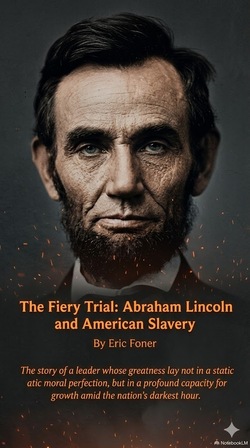
Eric Foner’s *The Fiery Trial* traces Abraham Lincoln’s evolution from a frontier boy with an instinctive hatred of slavery to the president who led America through its bloodiest conflict to dismantle the institution. Drawing on extensive primary sources, Foner reveals how Lincoln’s early experiences—witnessing slave auctions in Kentucky and New Orleans, living in free territories shaped by the Northwest Ordinance—laid the groundwork for his moral opposition. As a politician, Lincoln navigated 19th-century America’s treacherous political landscape, balancing anti-slavery convictions with the urgent need to preserve the Union. He moved from opposing slavery’s expansion as a Whig to joining the Republican Party, crafting strategies to secure border states, and eventually issuing the Emancipation Proclamation after the Battle of Antietam. Foner explores Lincoln’s compromises, like his early support for colonization, and his unwavering commitment to permanent abolition, culminating in his push for the Thirteenth Amendment. This definitive work illuminates the fiery trial that forged Lincoln’s legacy and redefined America’s promise of freedom.

Freedom From Fear summary and key insights by David M. Kennedy
Loading…

Freedom From Fear

David M. Kennedy

4982 learners

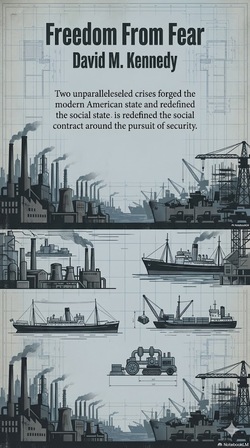
David M. Kennedy’s *Freedom From Fear* delivers a sweeping, immersive account of America’s defining journey through the Great Depression and World War II. Starting with the 1920s’ simmering tensions—Jim Crow’s racial oppression, rural poverty, urban cultural upheaval, and educational progress—the book traces how unregulated capitalism and global instability ignited the 1929 stock market crash. It dissects Herbert Hoover’s failed laissez-faire responses, then chronicles Franklin D. Roosevelt’s transformative New Deal: the 100 Days of urgent legislation, the rise of labor unions, the birth of the social safety net, and the political battles that exposed its limits. The narrative shifts to America’s reluctant pivot from isolationism to war, detailing the Lend-Lease Act, the Pearl Harbor attack, and the nation’s industrial mobilization that turned it into the Allies’ "arsenal of democracy." Kennedy explores how war resolved the Depression, sparked early civil rights gains, and redefined America’s global role, revealing how a nation conquered fear to reimagine its identity and future.

The Imperial Presidency summary and key insights by Arthur M. Schlesinger, Jr.
Loading…

The Imperial Presidency

Arthur M. Schlesinger, Jr.

4.31000 learners

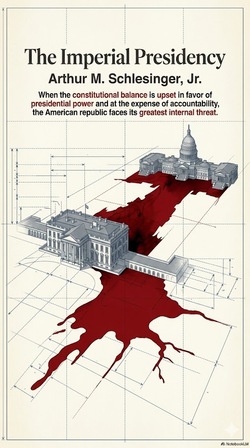
Arthur M. Schlesinger Jr.’s *The Imperial Presidency* traces the dramatic erosion of America’s constitutional checks and balances, from the Founding Fathers’ careful design of shared war and foreign policy powers to the unchecked expansion of presidential authority in the 20th century. Starting with the Framers’ debates over war powers and executive limits, Schlesinger chronicles pivotal moments: Lincoln’s emergency actions during the Civil War, Franklin Roosevelt’s wartime power grabs, Truman’s unauthorized Korean War intervention, and the extreme overreach of Johnson and Nixon in Vietnam—including secret bombings, illegal surveillance, and claims of unilateral war authority. He exposes how the “imperial presidency” emerged from Cold War crises, bureaucratic secrecy, and congressional complacency, threatening democratic accountability. A landmark work of political history, it argues for restoring constitutional balance by reasserting congressional oversight, curbing executive privilege, and prioritizing transparency in foreign policy.

The Metaphysical Club summary and key insights by Louis Menand
Loading…

The Metaphysical Club

Louis Menand

4.3663 learners

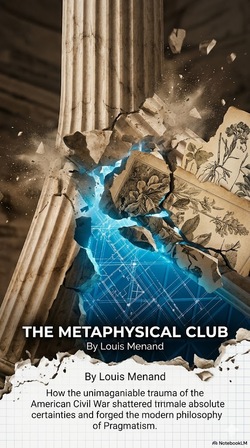
Louis Menand’s *The Metaphysical Club* chronicles the turbulent origins of American pragmatism, the philosophy that would shape the nation’s intellectual identity. Set against the Civil War and its aftermath, the book follows a circle of brilliant thinkers—Oliver Wendell Holmes Jr., William James, Charles Sanders Peirce, and John Dewey—who forged their ideas in battlefield trauma, scientific debate, and social upheaval. From Holmes’ brutal war experiences that birthed his legal realism, to James’ struggle to reconcile science and faith, to Peirce’s groundbreaking logical framework, and Dewey’s radical educational experiments, Menand reveals how these men gathered in 1870s Cambridge to form the Metaphysical Club. Their informal discussions rejected abstract metaphysics, prioritizing ideas’ real-world effects. This work unpacks how their collective thinking evolved into a philosophy that transformed American law, education, and notions of freedom, leaving an indelible mark on modern American life.

The Path Between the Seas summary and key insights by David McCullough
Loading…

The Path Between the Seas

David McCullough

4.2649 learners

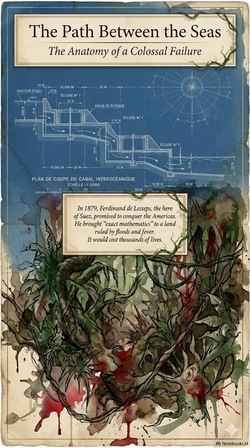
David McCullough’s *The Path Between the Seas* tells the sweeping, dramatic story of the Panama Canal—one of humanity’s greatest engineering feats. Spanning decades, it traces the ill-fated French attempt led by Ferdinand de Lesseps, whose hubris and disregard for Panama’s brutal climate and geology led to catastrophic failure, financial scandal, and thousands of lives lost to yellow fever. The narrative then shifts to America’s rise to the challenge, driven by Theodore Roosevelt’s unyielding commitment to sea power. Readers witness the political maneuvering that split Panama from Colombia, the groundbreaking work of William Gorgas to eradicate yellow fever, John Stevens’ transformative infrastructure overhauls, and George Goethals’ ironclad leadership that brought the project home ahead of schedule. McCullough weaves intimate personal stories with epic historical events, revealing the triumphs, tragedies, and relentless human grit that turned a 400-year-old dream into a reality reshaping global trade and U.S. geopolitical power.

Personal Memoirs of U. S. Grant — Volume 1 summary and key insights by Ulysses S. Grant
Loading…

Personal Memoirs of U. S. Grant — Volume 1

Ulysses S. Grant

4.41044 learners

Ulysses S. Grant’s *Personal Memoirs — Volume 1* delivers an unflinching, first-person narrative of his rise from a humble Ohio farm boy to the Union’s most critical Civil War general. Opening with his family’s colonial roots and grueling rural childhood, Grant details his reluctant enrollment at West Point, unremarkable cadet years, and service in the Mexican-American War—where he openly condemned the conflict as an unjust land grab. The memoir traces his post-war struggles: failed farming ventures, a stint in his father’s leather shop, and growing anxiety as sectional tensions ignited civil war. When the war erupted, Grant reclaimed his military calling, rising from a volunteer regimental colonel to a general whose bold strategies turned the tide in the West. Volume 1 culminates with the epic Siege of Vicksburg, a victory that split the Confederacy and cemented his legacy as a master of modern warfare. More than military history, it reveals Grant’s quiet resilience, strategic genius, and unvarnished honesty, offering a timeless window into 19th-century America and the making of a legendary leader.

Elon Musk: Tesla, SpaceX, and the Quest for a Fantastic Future summary and key insights by Ashlee Vance
Loading…

Elon Musk: Tesla, SpaceX, and the Quest for a Fantastic Future

Ashlee Vance

3.9781 learners

From a bookish, bullied kid in apartheid South Africa to the visionary entrepreneur reshaping space travel, electric vehicles, and clean energy, Ashlee Vance’s *Biography of Musk* traces Elon Musk’s relentless journey. Born into a family of pioneering aviators, Musk’s early years were defined by self-taught coding, a hunger for sci-fi, and an unshakable dream to reach America. After dropping out of Stanford just two days into his PhD, he launched Zip2— a digital mapping startup that sold for over $300 million—then co-founded PayPal, revolutionizing online payments. Undeterred by near-bankruptcy at SpaceX and Tesla, he used first-principles thinking to slash rocket launch costs, build game-changing electric cars, and pioneer solar energy subscriptions with SolarCity. This book lays bare the grit, genius, and unyielding ambition behind Musk’s quest to make humanity a multiplanetary species and transition the world to sustainable energy.

The Constitution of a Great Country summary and key insights by Su Li
Loading…

The Constitution of a Great Country

Su Li

3.71018 learners

This book challenges the Western-centric view of constitutions as static written documents, offering a groundbreaking exploration of China’s unique constitutional legacy forged over millennia. Instead of focusing on legal texts, it frames China’s constitution as a dynamic, evolving system of institutional integration centered on three interconnected layers: *Qijia* (village governance), *Zhiguo* (state administration), and *Pingtianxia* (multi-ethnic empire management). Drawing on historical practices—from primogeniture and the county system to the imperial examination and the Great Wall’s strategic role—it unpacks how these institutions emerged to address existential challenges like river floods, nomadic threats, and resource scarcity. Contrasting with social contract theory, it argues China’s constitution is rooted in functional pragmatism, designed to sustain a vast, multi-civilizational community. By bridging historical analysis and contemporary relevance, the book not only illuminates China’s governance logic but also invites a rethinking of constitutional studies globally, emphasizing that effective constitutions must adapt to a nation’s unique context.

Big History, Small World summary and key insights by Cynthia Stokes Brown
Loading…

Big History, Small World

Cynthia Stokes Brown

3.81271 learners

Spanning 13.8 billion years, *Big History, Small World* delivers a sweeping, interdisciplinary narrative that weaves cosmic origins, biological evolution, and human civilization into a single cohesive story. Starting with the Big Bang and the formation of stars and planets, it traces life’s emergence on Earth—from the first single-celled organisms to cyanobacteria that oxygenated the atmosphere. The book follows human evolution from early hominids like Lucy to the global spread of Homo sapiens, exploring pivotal shifts: the Agricultural Revolution, the rise of ancient civilizations, and the Industrial Revolution. It delves into globalization’s impacts, from interconnected supply chains to cultural fusion, and concludes with a forward-looking examination of 21st-century challenges: climate change, biotech ethics, and AI’s role in shaping our future. Framing humanity as both a product of cosmic chance and a steward of the planet, this book invites readers to see their place in history’s grand tapestry and how small choices ripple across time and space.

The Great Debate summary and key insights by Yuval Levin
Loading…

The Great Debate

Yuval Levin

3954 learners

Set against the roiling backdrop of late-18th-century transatlantic revolutions—from America’s fight for independence to France’s seismic upheaval—*The Great Debate* unpacks the defining clash between Edmund Burke and Thomas Paine, two titans whose ideas forged modern political thought. Burke, a pragmatic British statesman, championed traditional order, gradual reform, and the wisdom of collective historical experience, warning that radical revolution would unravel society’s organic bonds. Paine, a fiery radical and American independence icon, argued for natural rights, rational governance, and the right of people to overthrow tyrannical systems to build just, egalitarian societies. Their debate spanned core political tensions: justice vs. order, reason vs. convention, revolution vs. incremental change. More than a historical showdown, this clash laid the foundation for the modern left-right political spectrum, shaping debates over governance, equality, and societal change that resonate in contemporary policy fights.

The Information summary and key insights by James Gleick
Loading…

The Information

James Gleick

4.5479 learners

James Gleick’s The Information is a sweeping, engaging exploration of how information has shaped human civilization from ancient times to the digital age. Starting with early information carriers—from African talking drums that used redundancy to beat ambiguity to the first alphabet systems that rewrote human thought—the book traces the evolution of how we encode, transmit, and store knowledge. It delves into the origins of English dictionaries, the mechanical computing dreams of Charles Babbage and Ada Lovelace, and the telegraph revolution that erased time and space barriers. At its core, the book celebrates Claude Shannon’s groundbreaking 1948 information theory, which introduced the 'bit' as the universal unit of information and laid the groundwork for modern computing, communications, and even molecular biology. Gleick then expands into far-reaching impacts: from Norbert Wiener’s cybernetics to DNA’s genetic code, Richard Dawkins’ 'meme' concept, and quantum information’s challenge to physical laws. Finally, it confronts modern information overload, asking how we can reclaim meaning in a world drowning in data.

Light of Civilization summary and key insights by Wu Jun
Loading…

Light of Civilization

Wu Jun

3.31284 learners

Journey through the pivotal milestones of human civilization in *Light of Civilization*, a sweeping exploration of how ancient innovations and cross-cultural exchanges shaped the modern world. From the Rosetta Stone’s decoding that unlocked ancient Egypt’s secrets to the Sumerians’ invention of cuneiform and the wheel, the book traces foundational breakthroughs across continents. It delves into China’s imperial examination system and advanced agricultural techniques, Greece’s mathematical and scientific revolutions, Rome’s enduring legal legacy, and the global spread of porcelain. The narrative also covers the Renaissance’s artistic and scientific flourishing fueled by the Medici family, the Age of Discovery’s transformative voyages, and Isaac Newton’s groundbreaking work that laid the groundwork for modern science. By connecting these threads, the book reveals how civilizations’ triumphs, collaborations, and even failures have woven the fabric of human progress, offering a vivid portrait of our shared historical heritage.

A Short History of Nearly Everything summary and key insights by Bill Bryson
Loading…

A Short History of Nearly Everything

Bill Bryson

4.1614 learners

Bill Bryson’s *A Short History of Nearly Everything* transforms intimidating scientific concepts into a witty, approachable journey for every curious reader. Ditching dry textbook jargon, Bryson weaves together tales of cosmic origins, planetary formation, the rise of life on Earth, and the quirky, often overlooked stories of the scientists who unlocked these secrets. From the mind-bending physics of the Big Bang to the messy, miraculous process of evolution, he breaks down complex ideas—like quantum mechanics or plate tectonics—into relatable anecdotes and plainspoken explanations. Whether you’re a science novice or casual enthusiast, this book demystifies everything from subatomic particles to the vastness of the universe, proving science is a story of curiosity, failure, and awe that connects us all to the history of nearly everything.

Too Big to Fail summary and key insights by Andrew Ross Sorkin
Loading…

Too Big to Fail

Andrew Ross Sorkin

4.31320 learners

Andrew Ross Sorkin’s *Too Big to Fail* pulls back the curtain on the 2008 global financial crisis, delivering a gripping, minute-by-minute account of the high-stakes battles unfolding on Wall Street and in Washington. From Bear Stearns’ fire-sale collapse to Lehman Brothers’ historic bankruptcy, the book follows key players—Treasury Secretary Henry Paulson, Lehman CEO Dick Fuld, New York Fed President Timothy Geithner, and Goldman Sachs’ Lloyd Blankfein—as they scramble to contain a system on the brink of total meltdown. It exposes the infighting, tough choices, and moral dilemmas faced by bankers and policymakers: Paulson’s struggle between free-market principles and government intervention, Fuld’s desperate attempts to save his firm, and last-minute deals that saved Merrill Lynch and AIG while letting Lehman fall. With unprecedented access to private conversations and closed-door meetings, this definitive narrative reveals how close the U.S. economy came to collapse and the controversial measures that prevented it.

Alan Turing: The Enigma summary and key insights by Andrew Hodges
Loading…

Alan Turing: The Enigma

Andrew Hodges

4.51174 learners

Andrew Hodges’ *Alan Turing: The Enigma* delivers a definitive, intimate portrait of one of the 20th century’s most brilliant and tragic minds. From his rebellious childhood at Sherborne School, where his friendship with Christopher Morcom ignited his scientific curiosity, to his groundbreaking 1936 paper introducing the Turing Machine—laying the foundation for modern computing—this biography traces Turing’s extraordinary journey. It vividly recounts his pivotal WWII role designing the Bombe machine to crack Nazi Germany’s Enigma code, a feat that shortened the war and saved countless lives. Post-war, Turing pushed boundaries again, leading the ACE computer project and pioneering morphogenesis research, using math to explain biological pattern formation. Yet despite his immense contributions, Turing faced brutal persecution for his homosexuality: convicted of gross indecency in 1952, he was subjected to chemical castration, ultimately dying by cyanide poisoning in 1954. Hodges balances technical depth with emotional resonance, exploring the tension between Turing’s radical intellect and rigid societal norms, cementing his legacy as the father of computing and a symbol of intolerance’s cost.

A Study of History summary and key insights by Arnold J. Toynbee
Loading…

A Study of History

Arnold J. Toynbee

4.61112 learners

Arnold J. Toynbee’s landmark work *A Study of History* redefines how we analyze human progress by rejecting nation-states as the core historical unit, instead centering civilizations as the key to unlocking humanity’s collective story. Examining over 26 civilizations spanning thousands of years, Toynbee lays out a comprehensive framework for understanding their lifecycle: civilizations arise when societies respond to meaningful, balanced challenges with creative action; they grow when creative minorities guide communities toward internal self-determination, shifting focus from external conquest to spiritual and institutional refinement; they stagnate when trapped by over-specialized “mastery” of past challenges that stifles adaptability; and they decline when elites lose creativity, splitting societies into rulers, internal proletariats, and external barbarians. He further explores collapse’s aftermath—universal states, universal churches as “cocoons” for new civilizations, and heroic ages—and analyzes cross-civilization clashes and revivals. This magnum opus isn’t just a historical survey; it’s a provocative call to recognize repeating patterns and confront Western civilization’s fragile future.

Small Voice of History summary and key insights by Wang Di
Loading…

Small Voice of History

Wang Di

3.6600 learners

In *Small Voice of History*, renowned historian Wang Di weaves a compelling narrative of his academic journey and a critical reexamination of Chinese historical scholarship. From his childhood reading street-side comic books in Chengdu to his transformative PhD studies in the U.S., Wang traces how his experiences fueled his mission to center marginalized voices in history. The book champions microhistory as a vital framework to amplify stories of ordinary people—from a 16th-century Italian miller to 20th-century Sichuan salt merchants—challenging traditional grand narratives that overlook everyday lives. Wang engages with landmark works by scholars like Carlo Ginzburg, William T. Rowe, and Paul Cohen, unpacking their methodologies while advocating for cross-disciplinary and global perspectives in studying China’s past. Blending personal memoir with rigorous analysis, this volume invites readers to rethink how history is written and understood, emphasizing that the "small voices" of common people hold the key to a more nuanced, human-centered grasp of the past.

The Rings of Saturn summary and key insights by W.G. Sebald
Loading…

The Rings of Saturn

W.G. Sebald

4.5667 learners

Set against the windswept coast of Suffolk, W.G. Sebald’s *The Rings of Saturn* unfolds as a meandering, meditative walk through time, memory, and decay. As Sebald traverses desolate marshes, crumbling manors, and ghostly coastal towns, his journey weaves together fragments of forgotten history, literary ghosts, and intimate encounters. He delves into the life of Thomas Browne, whose skull was exhumed and reburied decades after death; Joseph Conrad’s formative years in Lowestoft, where he found his voice in English; and Edward FitzGerald’s reclusive life translating the Rubaiyat. Along the way, he confronts the collapse of herring populations, the scars of war and colonialism, and the quiet erosion of nature—from dying forests to abandoned radar stations. Blending travelogue, biography, and philosophical reflection, the book captures the haunting weight of time, where the past lingers in every ruin, every fading memory, and every stretch of desolate shore.