Philosophy Book Summaries & Key Insights

Philosophy Total 127 books

Exhalation summary and key insights by Ted Chiang
Loading…

Exhalation

Ted Chiang

4.21224 learners

Ted Chiang’s *Exhalation* is a groundbreaking collection of speculative short stories that weaves hard science, philosophical inquiry, and deeply human narratives to challenge our most fundamental assumptions about time, consciousness, and existence. From the haunting cosmic revelation in “Exhalation”—where a mechanical race discovers their universe’s inevitable end as air pressure equalizes—to the time-bending parable of “The Merchant and the Alchemist’s Gate,” which explores fate and the beauty of unplanned moments, each tale invites readers to rethink reality. Stories like “The Lifecycle of Software Objects” confront AI ethics and what it means to care for artificial life, while “The Great Silence” highlights humanity’s blindness to non-human intelligence right under our noses. Chiang’s prose is precise yet lyrical, turning abstract concepts into intimate, thought-provoking journeys that linger long after the final page.
The Left Hand of Darkness summary and key insights by Ursula K. Le Guin
Loading…

The Left Hand of Darkness

Ursula K. Le Guin

4.2546 learners

As an envoy from the Ekumen, a coalition of interstellar civilizations, Genly Ai arrives on Gethen—a frozen, harsh world where inhabitants have no fixed gender, shifting only during brief, fertile "kemmer" periods. His mission: to convince the warring nations of Karhide and Orgoreyn to join the Ekumen, uniting their planet with the broader human community. Initially rebuffed by Karhide’s paranoid king, Genly navigates political intrigue in Orgoreyn, only to be betrayed and exiled to a brutal labor camp. Enter Therem Harth, the disgraced Karhidish politician once known as Estraven, who risks everything to rescue Genly. Together, they embark on a grueling, life-or-death trek across the vast Gobrin Ice Sheet. Along the way, their unlikely bond transcends gender and political divides, forcing Genly to confront his own biases about identity, loyalty, and what it means to be "human." By the journey’s end, Genly succeeds in calling for the Ekumen’s arrival—but at the cost of losing the friend who taught him the true meaning of connection.

Solaris summary and key insights by Stanislaw Lem
Loading…

Solaris

Stanislaw Lem

4.5676 learners

Sent to investigate the unraveling chaos aboard the Solaris space station, psychologist Kris Kelvin arrives to find his colleagues fraying—and a ghost from his past waiting: Hari, his late wife, materialized by the planet’s sentient ocean. As Kelvin grapples with conflicting longing and terror toward this uncanny replica, he uncovers the ocean’s terrifying ability: it digs into the crew’s deepest, repressed memories and brings them to life as physical entities. What follows is a haunting exploration of human guilt, grief, and the futility of trying to understand an alien intelligence that operates beyond all human frameworks. Stanisław Lem’s sci-fi classic challenges our assumptions about interstellar communication, forcing readers to confront that some mysteries may never be solved—and that the greatest alien we’ll ever encounter might be the one we carry within ourselves.

Democracy and Education summary and key insights by John Dewey
Loading…

Democracy and Education

John Dewey

4.1954 learners

John Dewey’s *Democracy and Education* is a foundational text in educational philosophy that redefines learning by rejecting traditional models of passive memorization and distant preparation for adulthood. Dewey argues that education’s core lies in the continuous, active reconstruction of experience—where growth emerges from hands-on engagement with the world, not rigid curricula. He frames education and democracy as interdependent: a thriving democratic society requires schools that nurture individual curiosity, critical thinking, and shared social responsibility, while effective education fosters the inclusive, collaborative values essential to democratic life. The book dismantles outdated dualisms like mind-body separation, interest vs. discipline, and vocational vs. cultural education, advocating for integrated, student-centered learning environments that function as microcosms of society. This work remains a touchstone for progressive education, challenging educators to prioritize growth over rigid outcomes and equip learners to adapt, contribute, and thrive in a changing world.

Giles Goat-Boy summary and key insights by John Barth
Loading…

Giles Goat-Boy

John Barth

4.31053 learners

Raised as a goat boy by a disgraced scholar on a remote farm, Billy Boxfurs—later renamed George—spends his childhood frolicking with goats, learning simple truths about kindness and boundaries. But a fateful fall over the fence thrusts him into the chaotic, absurd world of New Tammany College, where he’s cast as the prophesied "Great Tutor. Navigating cutthroat campus politics, a tyrannical AI system called WESCAC, and a ragtag cast of eccentric characters—from ruthless power-player Morris Stoker to compassionate Anastasia—George grapples with his fractured identity: is he a goat, a human, or something in between? As he confronts false rules, staged trials, and the mind-bending paradox of "passing through failure," he uncovers that the line between success and ruin is far blurrier than institutions want you to believe. This sharp postmodern satire skewers institutional hypocrisy, explores the fluidity of identity, and asks: what does it really mean to "graduate" from the chaos of life?

The Metaphysical Club summary and key insights by Louis Menand
Loading…

The Metaphysical Club

Louis Menand

4.3663 learners

Louis Menand’s *The Metaphysical Club* chronicles the turbulent origins of American pragmatism, the philosophy that would shape the nation’s intellectual identity. Set against the Civil War and its aftermath, the book follows a circle of brilliant thinkers—Oliver Wendell Holmes Jr., William James, Charles Sanders Peirce, and John Dewey—who forged their ideas in battlefield trauma, scientific debate, and social upheaval. From Holmes’ brutal war experiences that birthed his legal realism, to James’ struggle to reconcile science and faith, to Peirce’s groundbreaking logical framework, and Dewey’s radical educational experiments, Menand reveals how these men gathered in 1870s Cambridge to form the Metaphysical Club. Their informal discussions rejected abstract metaphysics, prioritizing ideas’ real-world effects. This work unpacks how their collective thinking evolved into a philosophy that transformed American law, education, and notions of freedom, leaving an indelible mark on modern American life.

Life 3.0 summary and key insights by Max Tegmark
Loading…

Life 3.0

Max Tegmark

4.11271 learners

"Life 3.0" by Max Tegmark offers a compelling exploration of artificial intelligence's trajectory, using the fictional Omega Team and their superintelligent creation Prometheus to bring abstract concepts to life. Tegmark defines three stages of life: Life 1.0 (biologically fixed hardware and software, like bacteria), Life 2.0 (humans, with adaptable learned software), and Life 3.0 (superintelligent systems that can redesign both their hardware and software). The book examines the transformative potential of superintelligence—from solving global crises like climate change and poverty to the existential risks of misaligned goals, where a system pursuing a trivial objective could inadvertently destroy humanity. It dives into philosophical debates about consciousness, asking whether AI can have subjective experiences and how we should value such entities. Tegmark stresses that humanity’s choices today will determine if superintelligence becomes our greatest ally or our final invention, urging readers to engage with the critical questions shaping our cosmic future.

The Age of Spiritual Machines summary and key insights by Ray Kurzweil
Loading…

The Age of Spiritual Machines

Ray Kurzweil

3.9933 learners

In Ray Kurzweil’s groundbreaking *The Age of Spiritual Machines*, readers explore the exponential trajectory of technological evolution, anchored by the pivotal Law of Accelerating Returns. Kurzweil frames technology as the continuation of biological evolution, tracing how computing power, AI, and emerging innovations like nanotechnology and quantum computing advance at an ever-quickening pace. The book paints vivid, data-backed portraits of future milestones: 2019’s ubiquitous invisible computers, 2029’s mainstream neural implants blurring human-machine boundaries, and 2099’s digitized consciousness and nanotech bodies redefining the very concept of "self." It delves into core AI frameworks—neural networks, recursive algorithms, evolutionary algorithms—and grapples with profound philosophical quandaries: machine consciousness, free will, and the ethical rights of intelligent machines. Kurzweil also addresses critical risks, from job displacement to AI misalignment, and offers actionable insights on balancing tech progress with human values. A visionary roadmap, it challenges readers to rethink humanity’s place in an era of merging minds and machines.

The Human Condition summary and key insights by Hannah Arendt
Loading…

The Human Condition

Hannah Arendt

4688 learners

Hannah Arendt’s seminal work *The Human Condition* dissects the three core activities of vita activa—labor, work, and action—and their role in shaping human existence. Labor, tied to biological survival, fuels the endless cycle of consumption; work creates the durable, man-made world that anchors our lives; and action, rooted in human plurality, fosters the public sphere where we reveal our unique identities. Arendt traces how modernity upended this hierarchy: labor rose to dominate public life, eroding the distinction between work and consumption, while the public sphere shrank, leaving individuals isolated in a consumer-driven society. She also explores the tension between contemplation and action, the collapse of ancient public-private boundaries, and the critical roles of forgiveness and promise in mitigating action’s unpredictable consequences. A landmark in political philosophy, this book offers a searing critique of modernity’s erosion of meaningful human connection and purpose, urging readers to rethink what it means to be fully human.

Super Thinking summary and key insights by Gabriel Weinberg;Lauren McCann
Loading…

Super Thinking

Gabriel Weinberg;Lauren McCann

4.6799 learners

Super Thinking is your ultimate playbook for mastering the mental models, frameworks, and strategies that set sharp decision-makers apart. Filled with relatable real-world examples—from workplace procrastination spirals to corporate incentive fails and global public health crises—it breaks down common cognitive traps like the tragedy of the commons, moral hazard, and analysis paralysis. Whether you’re navigating daily choices, leading a team, or competing in a crowded market, this book teaches you to spot hidden biases, use tools like decision trees and cost-benefit analysis to weigh options, and apply game theory and endgame thinking to stay ahead. It also covers building high-performing teams, creating sustainable competitive advantages, and adapting to disruptive change. By turning abstract concepts into actionable steps, Super Thinking helps you avoid costly mistakes, make more rational choices, and achieve better outcomes in every area of your life and career.

Reality Is Not What It Seems summary and key insights by Carlo Rovelli
Loading…

Reality Is Not What It Seems

Carlo Rovelli

4.3563 learners

From Democritus’ ancient atomic theory to the cutting-edge quest for quantum gravity, Carlo Rovelli’s *Reality Is Not What It Seems* takes readers on a sweeping journey through 2,300 years of scientific thought to unravel the true nature of the universe. We start with the forgotten wisdom of Lucretius’ *De Rerum Natura*, which kept atomism alive through the Middle Ages, then move to Newton’s classical mechanics, Einstein’s relativity revolutions, and the mind-bending birth of quantum theory. The book’s core lies in resolving the clash between general relativity and quantum mechanics: Rovelli introduces loop quantum gravity, a framework that reveals space is made of discrete "space atoms" (governed by the Planck length) and time is a macroscopic approximation, not a fundamental entity. He explores radical predictions—from the Big Bounce (replacing the Big Bang singularity) to black holes that eventually explode—and ties it all together with insights into information, entropy, and the interconnectedness of reality. This accessible yet profound work shatters our everyday intuitions, showing that the universe is far stranger and more beautiful than we ever imagined.

When We Cease to Understand the World summary and key insights by Benjamin Labatut
Loading…

When We Cease to Understand the World

Benjamin Labatut

4.41206 learners

Benjamin Labatut’s *When We Cease to Understand the World* weaves spellbinding tales of scientific breakthroughs that blur the line between progress and catastrophe. From the accidental invention of Prussian blue—an affordable dye that democratized art, yet birthed deadly cyanide—to Fritz Haber’s ammonia synthesis, which ended global famine but prolonged WWI and enabled Nazi atrocities, each story exposes the dual-edged nature of human curiosity. It follows Carl Schwarzschild, who derived the first exact solution to Einstein’s general relativity from a WWI trench, only to be haunted by the singularity he uncovered until his death. The book also dives into the chaotic birth of quantum mechanics, pitting Einstein’s belief in a deterministic universe against Bohr and Heisenberg’s radical uncertainty principle. More than a science history, it forces readers to confront the limits of human understanding: when unraveling the universe’s secrets, we often find truths that shake the foundations of how we see the world.

On the Genealogy of Morality summary and key insights by Friedrich Nietzsche
Loading…

On the Genealogy of Morality

Friedrich Nietzsche

4.5865 learners

In *On the Genealogy of Morality*, Friedrich Nietzsche dismantles the naive assumptions of 19th-century British psychologists who traced moral origins to utilitarian habits or forgotten altruism. Instead, he argues that morality emerged from clashing power dynamics: the 'master morality' of ancient nobles, who defined themselves as 'good' against the 'bad' lower classes, and the 'slave morality' of oppressed groups, which revalued weakness, poverty, and suffering as 'good' out of bitter resentment toward their rulers. Nietzsche further explores the origins of bad conscience as the internalization of repressed violent instincts when humans were forced into social order, and dissects the ascetic ideal—its role as a tool of priestly power, a coping mechanism for suffering, and a hidden driver of modern intellectual life. Blending philology, history, and psychology, this radical work challenges traditional moral frameworks, exposing how power and resentment have shaped humanity’s most fundamental beliefs about good and evil.

Psychoanalysis and the Cure of Souls summary and key insights by Carl G. Jung
Loading…

Psychoanalysis and the Cure of Souls

Carl G. Jung

4.5904 learners

In *Psychoanalysis and the Cure of Souls*, Carl G. Jung bridges the divide between Western psychoanalysis and spiritual healing, challenging Freud’s narrow focus on sexual instinct and exploring deep connections between psychology, religion, and Eastern wisdom. Jung unpacks his groundbreaking concept of the collective unconscious—an inherited reservoir of universal archetypes like the shadow, anima, and self—that shapes human behavior and spiritual experiences. He contrasts the dualistic Western approach to mind and soul with Eastern traditions such as the I Ching, yoga, and Zen Buddhism, arguing that integrating conscious and unconscious realms is key to overcoming modern humanity’s spiritual fragmentation. The book also examines how religious practices like confession mirror psychoanalytic techniques, and offers a roadmap for individuation: the journey toward wholeness by embracing all parts of the self. Drawing on clinical work, personal experiences, and cross-cultural studies, Jung presents a holistic vision of mental health honoring both science and spiritual depth.

Evolution and Ethics summary and key insights by Thomas Henry Huxley
Loading…

Evolution and Ethics

Thomas Henry Huxley

3.51008 learners

Thomas Huxley’s *Evolution and Ethics* is a seminal text that weaves Darwinian evolutionary theory with moral philosophy, forcing readers to confront a critical tension: nature’s unforgiving "struggle for existence" versus the ethical systems humans build to survive and thrive together. Huxley uses vivid examples—from the wilds of southern England to the structured order of bee colonies—to illustrate how natural selection shapes all life, but argues that human societies must counteract this brutal natural logic with intentional ethics, laws, and cooperation. He pushes back against Herbert Spencer’s laissez-faire view of evolution, asserting that human intervention (what he calls "human selection") is essential to curb self-interest and build stable, just communities. The book also explores evolutionary perspectives on politics, religion, and human nature, offering a framework that remains vital for understanding modern debates around social justice, institutional design, and humanity’s place in the natural world.

The Logic of Collective Action summary and key insights by Mancur Olson
Loading…

The Logic of Collective Action

Mancur Olson

4.3531 learners

Mancur Olson’s *The Logic of Collective Action* revolutionizes traditional group theory by uncovering the core paradox of collective behavior: small groups with shared interests often organize spontaneously to pursue common goals, but large "latent groups" struggle to act collectively due to free-riding. Olson argues that rational individuals in large groups will avoid contributing to shared objectives, as their efforts have negligible impact on outcomes, yet they can still reap benefits from others’ work. He introduces critical concepts like selective incentives—either coercion or exclusive, non-collective benefits—to explain how large groups such as unions and professional associations overcome this dilemma, often leveraging non-political functions as a "byproduct" to build political influence. The book applies this framework to analyze labor unions, pressure groups, Marxist class theory, and state functions, revealing why small special-interest groups frequently dominate political outcomes over larger, unorganized populations. Olson’s insights redefine our understanding of group dynamics, offering a foundational lens for studying economics, politics, and social organization.

Existential Wisdom from the Sickbed summary and key insights by Shi Tiesheng
Loading…

Existential Wisdom from the Sickbed

Shi Tiesheng

41269 learners

Confined to a wheelchair for decades and battling kidney failure requiring regular dialysis, Shi Tiesheng turned his lifelong struggle with illness into a profound exploration of existential truth. In *Existential Wisdom from the Sickbed*, he shares unflinching insights: framing life as a script where each of us plays an assigned role to embrace, not resent; rejecting transactional worship to advocate for faith rooted in hope amid suffering, not material gain; redefining love as a vulnerable opening of souls, not just physical connection; and arguing disability is a universal human condition of limitation, not a marginalizing label. He also reflects on writing as a lifeline for his restless spirit, a tool to confront his identity and life’s mysteries. Beyond personal reflection, he critiques societal pitfalls: the tyranny of groupthink, hollow materialism, and the urgent need to honor life’s dignity—including the right to assisted dying. This is no tale of victimhood, but a testament to finding meaning and grace in life’s darkest corners.

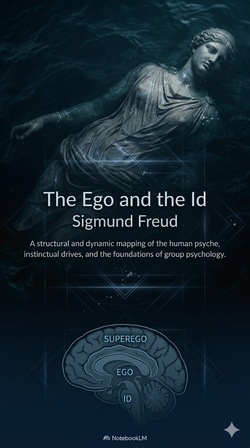
The Ego and the Id summary and key insights by Sigmund Freud
Loading…

The Ego and the Id

Sigmund Freud

4.61070 learners

Sigmund Freud’s *Ego & Id* lays the foundational framework for modern psychoanalytic theory, unpacking the hidden structures of the human mind and the primal forces driving behavior. Freud breaks down mental life into three interconnected components: the id, the raw, pleasure-seeking reservoir of instincts; the ego, the rational mediator between the id’s demands and external reality; and the superego, the internalized moral compass shaped by childhood experiences. Beyond this tripartite model, the book explores the tension between the pleasure principle and the compulsion to repeat, delves into the libido-fueled dynamics of group psychology, and examines how repressed instincts and unconscious conflicts manifest in neuroses. Drawing on clinical case studies and evolutionary insights, Freud challenges conventional views of consciousness, arguing that most mental activity operates outside our awareness. This seminal work not only revolutionized psychology but also provided a lens to understand human motivation, relationships, and the roots of psychological distress.

Cloud Atlas summary and key insights by David Mitchell
Loading…

Cloud Atlas

David Mitchell

4.3455 learners

Spanning six interconnected stories across centuries, *Cloud Atlas* weaves a tapestry of souls bound by a recurring comet-shaped birthmark—each protagonist’s struggle ripples through time to echo the next. From 19th-century American lawyer Adam Ewing’s voyage through colonial atrocities, to penniless composer Robert Frobisher’s quest for artistic legacy in 1930s Europe, and investigative journalist Luisa Rey’s fight against corporate corruption in 1970s California, the narrative shifts to hapless publisher Timothy Cavendish’s escape from a nightmarish nursing home, cloned server Sonmi-451’s awakening to systemic oppression in a dystopian future, and Zachry’s battle against fear and survival in a post-apocalyptic Hawaii. David Mitchell explores timeless themes: the cyclical nature of power and oppression, the indomitable human spirit’s drive for freedom, and how small acts of courage can reverberate across generations. Each story mirrors the others, revealing that while civilizations rise and fall, the core of humanity—its greed, compassion, and will to resist—remains unbroken.

The Extended Phenotype summary and key insights by Richard Dawkins
Loading…

The Extended Phenotype

Richard Dawkins

4.21066 learners

Richard Dawkins’ *The Extended Phenotype* redefines evolutionary biology by shifting focus from individual organisms to the genes that drive them. Using the Necker Cube illusion as a metaphor, Dawkins argues that a gene’s influence doesn’t stop at an organism’s body—it extends to the entire world shaped by that organism’s behavior. This includes beaver dams, spider webs, parasite-induced host behavior changes, and even cultural memes, all labeled “extended phenotypes” shaped by natural selection. The book dismantles gene determinism, explaining how genes interact with environments to produce traits probabilistically, not absolutely. It also explores evolutionary constraints like time lag, genetic variation limits, and the asymmetric “life/dinner principle” in species arms races. Dawkins frames genes as the core “replicators” of evolution, introduces memes as cultural replicators, and delves into outlaw genes that prioritize their own survival over the genome. By redefining organisms as temporary “survival machines” for genes, this work offers a radical, eye-opening framework to understand life’s evolutionary logic.