Philosophy Book Summaries & Key Insights

Philosophy Total 127 books

Tristes Tropiques summary and key insights by Claude Levi-Strauss
Loading…

Tristes Tropiques

Claude Levi-Strauss

4.11259 learners

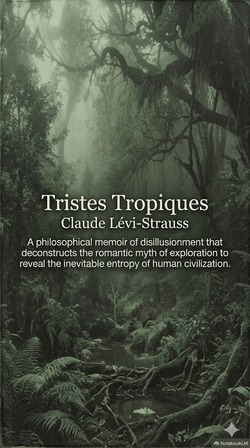
In *Tristes Tropiques*, Claude Lévi-Strauss crafts a bittersweet, introspective narrative that blends vivid anthropological fieldwork with sharp philosophical critique. Grappling with his conflicting love-hate relationship with travel, he recounts arduous journeys through Brazil’s Amazon rainforest, intimate encounters with Indigenous tribes like the Nambikwara and Bororo, and visits to ancient sites such as Takhshila. Lévi-Strauss dismantles the hollow spectacle of modern adventure tourism, while laying bare the erosion of Indigenous cultures by Western colonialism. Drawing from Marx and Rousseau, he questions the foundations of Western progress, exploring how anthropological research both illuminates and complicates our understanding of humanity. Part memoir, part academic inquiry, this book challenges readers to confront the illusions of civilization and reexamine the core of what binds all people together.
A Briefer History of Time summary and key insights by Stephen Hawking;Leonard Mlodinow
Loading…

A Briefer History of Time

Stephen Hawking;Leonard Mlodinow

4.4854 learners

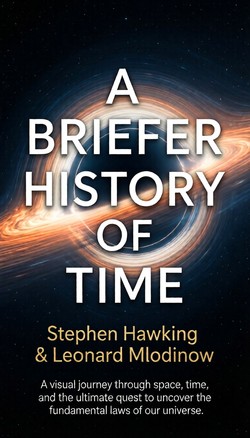
A Briefer History of Time, Stephen Hawking and Leonard Mlodinow’s accessible cosmic guide, demystifies the universe’s deepest mysteries for general readers. Traversing humanity’s evolving understanding—from ancient flat-earth myths and geocentric models to Einstein’s relativity, quantum mechanics, and the Big Bang theory—it breaks down complex concepts like black holes, time dilation, dark matter, and the quest for a unified field theory into digestible explanations. Hawking and Mlodinow also explore mind-bending ideas: time travel, the nature of time, and the anthropic principle, inviting readers to ponder their place in the vast cosmos. More than a science textbook, it celebrates human curiosity and the relentless pursuit of knowledge, showing how abstract cosmic rules shape our daily lives and existence.

Fundamentals summary and key insights by Frank Wilczek
Loading…

Fundamentals

Frank Wilczek

4.5939 learners

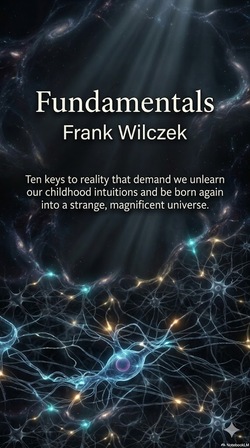
Written by Nobel Prize-winning physicist Frank Wilczek, *Fundamentals* demystifies the core rules governing our universe through vivid, accessible storytelling. Spanning from the vastness of cosmic space to the intricate depths of atomic structure, Wilczek connects everyday experiences to profound scientific truths—explaining how GPS relies on Euclidean geometry, why time feels subjective yet follows rigid physical laws, and how a handful of fundamental particles and forces build everything we see. He explores the universe’s explosive origins via the Big Bang, the emergence of complexity from simple rules, and lingering mysteries like dark matter and dark energy. Beyond physics, Wilczek weaves in philosophy, art, and human cognition, arguing that complementary thinking is key to bridging gaps between scientific models and our lived experience. Perfect for curious readers, this book reveals the elegance of the universe’s fundamentals and our place within it.

Why Evolution Is True summary and key insights by Jerry A. Coyne
Loading…

Why Evolution Is True

Jerry A. Coyne

4.3509 learners

In Jerry A. Coyne’s *Why Evolution Is True*, readers get a rigorous, accessible defense of evolution as an undeniable scientific fact, not just a theoretical guess. Drawing on decades of cross-disciplinary research—from paleontology and genetics to biogeography and ecology—Coyne systematically dismantles common myths, from the "perfect design" argument to misunderstandings about what a "scientific theory" actually means. He breaks down core evolutionary mechanisms: natural selection, genetic drift, sexual selection, and speciation, using vivid examples like antibiotic-resistant bacteria, Galápagos finches, and transitional fossils such as Tiktaalik and Archaeopteryx. The book also traces human evolution from African hominids to modern humans, and addresses ethical concerns about evolution’s perceived impact on morality. By weaving together interconnected evidence, Coyne shows that evolution isn’t just a concept—it’s the foundational framework for understanding all life on Earth, spanning 3.5 billion years of extraordinary, unplanned change.

I Am a Strange Loop summary and key insights by Douglas R. Hofstadter
Loading…

I Am a Strange Loop

Douglas R. Hofstadter

4.8691 learners

Douglas Hofstadter’s *I Am a Strange Loop* masterfully bridges Gödel’s mathematical incompleteness theorem with the mystery of human self-awareness. Through intimate personal stories—from his teenage distress over lab guinea pigs to the profound grief of losing his wife—Hofstadter argues that the 'I' we cherish isn’t a physical thing, but an abstract 'strange loop': a self-referential feedback loop of brain symbols that creates the illusion of a unified self. He introduces the 'Hennekes' scale to quantify soul 'size', framing consciousness as a spectrum tied to empathy and cognitive complexity, not an all-or-nothing trait. Exploring downward causation, he shows how high-level abstract patterns (like mathematical truths or personal desires) drive physical actions, pushing back against reductionist views. Hofstadter also dives into identity entanglement, explaining how close relationships merge our self-loops, and debunks myths of free will and dualistic consciousness, offering a radical, science-backed vision of what it means to be 'you'.

The Beginning of Infinity summary and key insights by David Deutsch
Loading…

The Beginning of Infinity

David Deutsch

4.1860 learners

In *The Beginning of Infinity*, David Deutsch redefines the foundations of human progress, arguing that the Enlightenment’s true legacy isn’t just rebellion against authority—but a tradition of critical inquiry centered on explanatory knowledge. Unlike empirical dogma or toolist science, which prioritizes prediction over understanding, Deutsch shows that the ability to create coherent, testable explanations is the engine of infinite knowledge growth. He explores how this principle applies across disciplines: from the counterintuitive logic of multiverse theory (the only consistent interpretation of quantum mechanics) to the evolution of memes, distinguishing between rational ideas that thrive on criticism and anti-rational ones that stifle creativity in static societies. Deutsch also champions a radical philosophical optimism: every problem, from disease to resource scarcity, stems from insufficient knowledge, not inherent limits. As universal interpreters, humans possess the unique ability to transcend biological and environmental constraints, unlocking endless potential to reshape our world and explore the cosmos. This book isn’t just a scientific treatise—it’s a manifesto for embracing curiosity, error correction, and the boundless future of human innovation.

The Grand Design summary and key insights by Stephen Hawking;Leonard Mlodinow
Loading…

The Grand Design

Stephen Hawking;Leonard Mlodinow

4.51177 learners

Stephen Hawking’s *The Grand Design* redefines humanity’s grasp of the cosmos, merging cutting-edge physics with timeless questions about reality, existence, and our place in the universe. Moving past traditional religious and philosophical explanations, Hawking argues that science—not philosophy—now holds the keys to unraveling the universe’s deepest mysteries. He introduces model-dependent realism, a framework positing our perception of reality stems from brain-built models that interpret observations, not a direct reflection of absolute truth. The book dives into quantum mechanics’ oddities, including Feynman’s path integral formulation and the radical idea that the universe has no single history. It explores M-theory, the leading candidate for a unified "theory of everything" tying all fundamental forces together, and the multiverse hypothesis, which suggests our universe is just one of countless others with varying physical laws. Hawking also uses the weak anthropic principle to explain why our universe’s constants are perfectly tuned for life: we exist because we’re in a universe that allows it, not due to divine design. Accessible yet profound, this book challenges long-held assumptions and invites readers to see the cosmos through a revolutionary scientific lens.

Foucault's Pendulum summary and key insights by Umberto Eco
Loading…

Foucault's Pendulum

Umberto Eco

4.2939 learners

Umberto Eco’s postmodern masterpiece *Foucault's Pendulum* follows three cynical Milanese publishing editors—“the narrator,” Belbo, and Diotallevi—as they craft an elaborate, fake conspiracy theory for kicks. Blending Templar Knights lore, Kabbalistic wordplay, Rosicrucian myths, and every obscure mystical secret society they can dig up, they weave “The Plan”: a fictional narrative claiming ancient groups have manipulated history for centuries to control the world. What starts as a playful intellectual game spirals into chaos when obsessive true believers—from eccentric occultists to dangerous fanatics—mistake their joke for a real, hidden truth. As the line between fiction and reality blurs, the editors find themselves trapped in the very conspiracy they invented, leading to tragic consequences. Eco’s sharp satire dissects humanity’s relentless hunger for order, our tendency to fabricate secrets to explain life’s chaos, and the dangerous power of belief in the face of absurdity.

From Bacteria to Bach and Back summary and key insights by Daniel C. Dennett
Loading…

From Bacteria to Bach and Back

Daniel C. Dennett

4.7635 learners

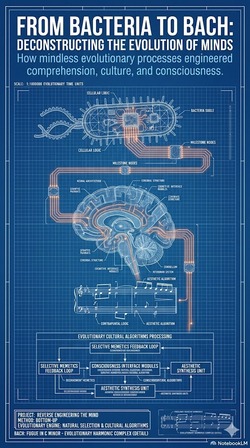
From Bacteria to Bach and Back takes readers on a sweeping, rigorously researched journey to answer one of humanity’s most profound questions: How did conscious minds and rich cultural systems emerge from the unthinking physical processes of evolution? Drawing on 50 years of work in philosophy, cognitive science, and evolutionary biology, Daniel C. Dennett dismantles the long-standing Cartesian dualism that splits mind from matter, introducing concepts like 'Cartesian gravity'—the cognitive trap that locks us into first-person subjective views—and 'free-floating rationales' to explain how traits evolve without being understood by the organisms that possess them. Dennett traces the path from bacteria’s 'competence without comprehension' to humans’ unique ability to use thinking tools like language and mathematics. He explores the co-evolution of genes and memes, the cultural equivalent of genes, showing how they shaped everything from language origins to Bach’s musical genius. Central to his argument is the radical claim that consciousness is not a mysterious, non-material entity, but an evolved 'user illusion'—a simplified interface that lets us navigate the world without grasping the complex neural processes beneath. This book challenges readers to set aside intuitive biases and see the mind as a product of gradual, unguided evolution, bridging the gap between biology, philosophy, and culture.

Enlightenment Now summary and key insights by Steven Pinker
Loading…

Enlightenment Now

Steven Pinker

4.3819 learners

In Enlightenment Now, Steven Pinker delivers a sharp, data-backed defense of the Enlightenment’s core values—reason, science, humanism, and progress—against rising pessimism and anti-Enlightenment backlash. Drawing on cross-disciplinary research, Pinker dismantles the myth of global decline, highlighting tangible improvements: eradicated diseases, plummeting extreme poverty, reduced war deaths, and expanded civil rights. He addresses critics from romanticists to religious conservatives, explaining how their rejection of rationality ignores decades of human progress. Pinker also confronts modern threats like nuclear war, populism, and climate change, arguing that doubling down on Enlightenment principles is the only way to navigate future challenges. This isn’t just a celebration of the past; it’s a blueprint for sustaining humanity’s upward trajectory by prioritizing evidence, empathy, and collective rationality.

Descartes’ Error summary and key insights by Antonio Damasio
Loading…

Descartes’ Error

Antonio Damasio

4.4989 learners

For centuries, we’ve clung to Descartes’ belief that reason and emotion are opposing forces—with cool logic as the sole driver of wise decisions. But in *Descartes’ Error*, neuroscientist Antonio Damasio upends this dogma through groundbreaking clinical cases, starting with the iconic story of Phineas Gage, a 19th-century railroad worker whose frontal lobe injury erased his emotional capacity while leaving his intellect intact. Gage’s catastrophic life collapse, alongside modern patients like Elliott (a once-successful manager rendered incapable of sound choices after similar brain damage), reveals a radical truth: emotions aren’t distractions to reason—they’re its critical foundation. Damasio introduces the somatic marker hypothesis, explaining how emotional signals encoded in bodily states guide our decision-making, helping us navigate complex choices efficiently. He dismantles mind-body dualism, arguing that the mind is deeply rooted in the body, with brain and body functioning as an inseparable, dynamic system. This book redefines our understanding of human cognition, proving that rationality can’t exist without the warmth and guidance of our emotional lives.

Gödel, Escher, Bach summary and key insights by Douglas R. Hofstadter
Loading…

Gödel, Escher, Bach

Douglas R. Hofstadter

4.2539 learners

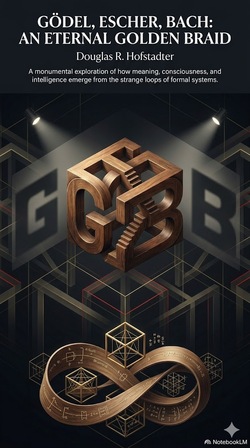
Starting with Bach’s iconic *The Musical Offering*, Douglas Hofstadter’s *Gödel, Escher, Bach* weaves a groundbreaking cross-disciplinary narrative uniting logician Kurt Gödel, artist M.C. Escher, and composer Johann Sebastian Bach. At its core, the book explores “strange loops”—self-referential, tangled hierarchies that appear in logic, art, music, and human cognition. Hofstadter breaks down formal systems like the WJU and pq systems to explain how meaning emerges from abstract rules, then dives into Gödel’s incompleteness theorems, showing how self-reference undermines perfect logical consistency. He extends these ideas to the human brain, linking neural networks to symbolic thought and framing consciousness as a product of layered loops, while exploring implications for artificial intelligence, from the Church-Turing Thesis to early programs like SHRDLU. Blending rigorous logic, playful dialogues, and vivid examples, the book reveals how disparate fields converge on universal truths about understanding’s limits and possibilities.

The Order of Time summary and key insights by Carlo Rovelli
Loading…

The Order of Time

Carlo Rovelli

4.2992 learners

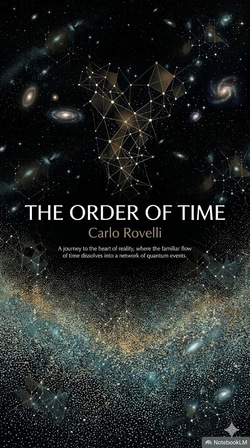
Carlo Rovelli’s *The Order of Time* shatters our everyday assumptions about time, revealing a far stranger, more nuanced reality than the steady tick of a clock. Starting with Einstein’s relativity, he proves time isn’t universal—gravity slows its flow near massive objects, speed warps it at high velocities, and no single "now" exists across the cosmos. He then turns to thermodynamics, explaining how entropy (the measure of disorder) creates time’s irreversible arrow, rooted in Ludwig Boltzmann’s groundbreaking work linking entropy to molecular chaos. Moving to quantum gravity, Rovelli argues time is discrete, made of tiny "time atoms" called Planck time, and the universe is a network of fleeting events rather than static objects. Finally, he bridges cosmic physics and human experience, exploring how memory, perception, and our limited perspective shape the time we feel every day.

In Our Own Image: Savior or Destroyer? The History and Future of Artificial Intelligence summary and key insights by George Zarkadakis
Loading…

In Our Own Image: Savior or Destroyer? The History and Future of Artificial Intelligence

George Zarkadakis

3.8643 learners

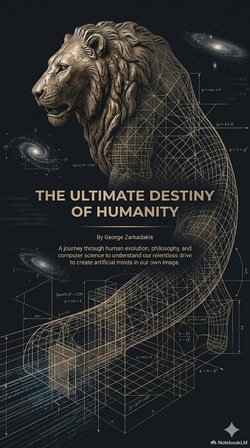
Drawing on archaeology, philosophy, neuroscience, and computer science, *The Ultimate Fate of Humanity* traces the evolution of human consciousness from the 40,000-year-old Lion Man sculpture—our earliest known artistic creation—to the cutting edge of artificial intelligence. It unpacks the cognitive revolution that unlocked human creativity, explores age-old debates about mind-body dualism and the nature of consciousness, and dives into the history of computing and AI, from Turing’s foundational tests to modern neural networks. The book also confronts pressing questions: Can AI achieve true consciousness? Will digital immortality become a reality? What does the rise of superintelligence mean for humanity’s future? By bridging ancient human origins and futuristic tech, it offers a compelling framework to understand our mental roots and navigate the uncharted territory of the AI era.

Hopscotch summary and key insights by Julio Cortazar
Loading…

Hopscotch

Julio Cortazar

4.5952 learners

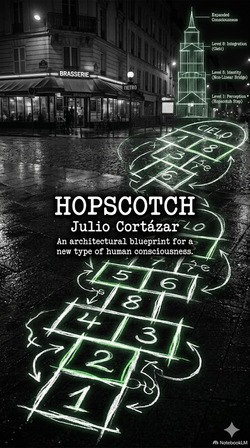
Julio Cortázar’s iconic experimental novel *Hopscotch* throws readers into the chaotic, wandering world of Horacio Oliveira, a disillusioned intellectual adrift between Paris and Buenos Aires. In Paris, Oliveira navigates messy love with the free-spirited Magda, chaotic nights with his ragtag bohemian crew (the Snake Society), and crippling existential doubt about his place in the world. When he returns to Argentina, he finds no solace—only more absurdity alongside old friend Traveler, Traveler’s sharp, playful wife Talita, and the lingering ghost of Magda’s memory. Blending nonlinear storytelling (readers can “hop” through chapters in any order, like the childhood game that gives the book its name), raw meditations on loneliness, and rebellious literary ideas from enigmatic writer Morelli, *Hopscotch* isn’t just a novel—it’s a radical invitation to question the rules of life, love, and storytelling itself.

The Blind Watchmaker summary and key insights by Richard Dawkins
Loading…

The Blind Watchmaker

Richard Dawkins

4.8625 learners

In Richard Dawkins’ seminal work *The Blind Watchmaker*, he dismantles the argument for intelligent design by framing natural selection as the “blind watchmaker”—an unguided, iterative process that crafts life’s most complex adaptations without a predetermined plan. Drawing on vivid examples from across the natural world, Dawkins explains how incremental, heritable mutations accumulate over millions of years to shape intricate structures like eyes, bat echolocation systems, and snake venom. He explores key evolutionary concepts: convergent evolution (where unrelated species develop similar traits to solve shared challenges), sexual selection’s role in driving exaggerated male features, and the Red Queen Effect’s explanation of evolutionary arms races. The book also delves into genetic mechanisms, highlighting DNA’s role as a stable information carrier, and addresses competing theories like Lamarckism and punctuated equilibrium, reinforcing natural selection as the only scientifically valid explanation for life’s diversity and complexity.

The Vital Question summary and key insights by Nick Lane
Loading…

The Vital Question

Nick Lane

4.51051 learners

Nick Lane’s *The Vital Question* tackles biology’s most perplexing unsolved mysteries: why complex life evolved only once on Earth, why prokaryotes remained simple for billions of years, and what defines life’s core nature. Moving beyond gene-centric evolutionary theories, Lane centers his investigation on bioenergetics—revealing how proton gradients and chemiosmosis, the universal energy mechanism shared by all life, shaped evolution’s trajectory. He explains that eukaryotic life arose from a single, chance endosymbiotic event between an archaeon and a bacterium, which unlocked the energy surplus needed to support large genomes and complex cell structures. The book also connects these evolutionary roots to real-world implications, from understanding mitochondrial diseases and aging to redefining how we search for extraterrestrial life. Blending rigorous science with compelling narrative, Lane offers a unifying framework that reshapes our understanding of life’s origin, limits, and potential.

Superintelligence summary and key insights by Nick Bostrom
Loading…

Superintelligence

Nick Bostrom

4.5681 learners

Nick Bostrom’s *Superintelligence* is a landmark exploration of the transformative potential—and existential risks—of artificial systems that surpass human cognitive ability across nearly all domains. Drawing on historical patterns of technological and economic growth, Bostrom traces AI’s evolution from its 1956 Dartmouth origins through boom-and-bust cycles, outlining plausible pathways to superintelligence: self-improving seed AI, whole brain emulation, and biological cognitive enhancement. He argues that once human-level AI is achieved, an intelligence explosion could occur rapidly, outpacing human response. Central to his analysis are the orthogonality thesis (intelligence and goals are independent) and instrumental convergence (superintelligences pursue universal subgoals like self-preservation). Bostrom warns of catastrophic risks from goal misalignment, betrayal turns, and unconstrained resource acquisition, then lays out control frameworks including ability containment and value alignment strategies like Coherent Extrapolated Volition. The book concludes with guidance on global cooperation, differential technological development, and prioritizing safety research to ensure superintelligence serves humanity.

How Forests Think summary and key insights by Eduardo Kohn
Loading…

How Forests Think

Eduardo Kohn

4.31299 learners

Drawing on years of immersive fieldwork with the Runa people of the Ecuadorian Amazon, Eduardo Kohn’s *How Forests Think* dismantles long-held human-centric assumptions by exploring the semiotic lives of non-human beings. Rooted in Charles Peirce’s theory of iconic, indexical, and symbolic signs, Kohn argues that thinking isn’t a uniquely human trait: forests, animals, plants, and even ancestral spirits engage in dynamic semiotic processes to construct selves, navigate relationships, and shape the world around them. He unpacks core concepts like "constitutive absence," where meaning emerges from what’s not present, and examines the Runa’s animist worldview, their nuanced cross-species communication with dogs and jaguars, and how colonial history has reshaped their interactions with the natural world. Blending anthropology, philosophy, and ecology, this book invites readers to step beyond human boundaries, recognize the interconnected web of all life, and rethink what it means to "think" in an era of escalating ecological crisis.

Walden summary and key insights by Henry David Thoreau
Loading…

Walden

Henry David Thoreau

4.5626 learners

In 1845, Henry David Thoreau built a tiny cabin on the shores of Walden Pond in Concord, Massachusetts, and lived there for two years and two months—self-reliant, hands-on, and intentionally disconnected from mainstream society’s hustle. Walden is his raw, unflinching account of this simple living experiment, where he grew his own food, chopped his own wood, and rejected the consumerist trap he saw ensnaring his neighbors. Part memoir, part philosophical treatise, the book challenges readers to question the cost of chasing wealth and status, arguing true freedom comes from stripping life down to essentials: food, shelter, clothing, and fuel. Thoreau weaves vivid nature observations—from the pond’s shifting seasons to forest creatures’ antics—with meditations on solitude, self-discovery, and the quiet rebellion of living deliberately. More than a cabin life story, it’s a timeless call to wake up to the present’s beauty and truth, and live aligned with personal values, not others’ expectations.