Philosophy Book Summaries & Key Insights

Philosophy Total 127 books

The Castle summary and key insights by Franz Kafka
Loading…

The Castle

Franz Kafka

4.1459 learners

K, a land surveyor, arrives uninvited at a remote village huddled beneath the imposing, unreachable Castle, only to find himself trapped in a labyrinth of bureaucratic absurdity. Tasked with a job the village insists it never requested, he navigates a world where rules shift without warning, officials are maddeningly unreachable, and villagers oscillate between suspicion and reluctant aid. His desperate quest to gain entry to the Castle—and thus validate his identity and purpose—leads him into tangled relationships: with Frieda, a former barmaid who becomes his fiancée; the Barnabas family, whose ties to the Castle are fraught with hidden trauma; and petty bureaucrats who toy with his fragile hopes. As K’s efforts to break through the Castle’s impenetrable barriers grow increasingly futile, Franz Kafka’s masterpiece lays bare the existential dread of an individual pitted against an indifferent, dehumanizing system, posing profound questions about identity, belonging, and the illusion of control.
The Principles of Psychology summary and key insights by William James
Loading…

The Principles of Psychology

William James

4.21163 learners

As a foundational text of modern psychology, William James’s *The Principles of Psychology* revolutionizes the field by rejecting the traditional atomist view of the mind as a collection of isolated mental bits. James introduces his groundbreaking concept of the 'stream of consciousness,' arguing that our thoughts are continuous, fluid, and inherently selective rather than fragmented. Drawing on neurophysiological experiments, case studies of split consciousness, and introspective analysis, he explores core topics: the brain’s role in mental activity, the physical basis of habit formation, the causal power of consciousness (debunking the 'conscious automaton' theory), and the proper methods for psychological research—including introspection, experimental studies, and comparative analysis. James frames psychology as a natural science focused on individual minds, addressing enduring questions about the mind-body relationship, the nature of unconscious states, and how we perceive and interact with the world. This work not only laid the groundwork for functionalism but also remains a provocative, accessible guide to understanding human thought and behavior.

The Evolution of Physics summary and key insights by Albert Einstein;Leopold Infeld
Loading…

The Evolution of Physics

Albert Einstein;Leopold Infeld

4.31025 learners

Co-authored by Albert Einstein and Leopold Infeld, *The Evolution of Physics* takes readers on a captivating, accessible journey through the most transformative shifts in physical thought. Starting with Aristotle’s intuitive, long-dominant views on motion, it traces how Galileo’s experimental rigor laid the groundwork for Newton’s classical mechanics—establishing laws that governed our understanding of the macro world for centuries. The book then explores the cracks in this "mechanical view": the rise of thermodynamics and electromagnetic theory, which challenged the idea that all phenomena could be reduced to particle interactions. It delves into the revolutionary concepts of fields, Einstein’s special and general relativity (redefining space, time, and gravity as curved spacetime), and the birth of quantum mechanics, which upended deterministic views with wave-particle duality and probability waves. More than a textbook, it focuses on the evolution of ideas, making complex physics approachable for anyone curious about how we’ve unlocked the universe’s secrets.

Liquid Modernity summary and key insights by Zygmunt Bauman
Loading…

Liquid Modernity

Zygmunt Bauman

4.2896 learners

Zygmunt Bauman’s *Liquid Modernity* redefines late modern life by contrasting our era of constant flux with the rigid, rule-bound "solid modernity" of Fordist factories, lifelong careers, and fixed social identities. Bauman frames liquid modernity as a world where every structure—jobs, relationships, even self-concepts—has melted into temporary, shifting states. He breaks down its core traits: everything operates on short-term cycles, power functions through speed and escape rather than control, individuals are forced into "involuntary nomadism" without stable anchors, and consumerism dominates as a tool for identity-building and anxiety relief. The book explores how capital’s relentless pursuit of mobility, fueled by digital technology, dismantled solid modernity’s foundations, leaving individuals grappling with precarious work, fragile communities, and pervasive uncertainty. Bauman also examines the crisis of critical theory in this new era, arguing it must shift from challenging state oppression to addressing the erosion of public space and the false freedom of consumer culture, offering a sharp, accessible analysis of life in a world where nothing stays fixed.

Reality and Virtuality summary and key insights by Jin Guantao
Loading…

Reality and Virtuality

Jin Guantao

3.6603 learners

Jin Guantao’s *Reality and Virtuality*—the second volume of his Authenticity Philosophy project—chronicles a decades-long intellectual evolution from systems theory to a groundbreaking framework for tackling today’s truth crisis. Born from 1980s Chinese philosophical debates and a later realization that systems evolution theory failed to account for the unique dynamics of life, society, and thought, this book redefines truth not as objective reality, but as a dynamic relationship between subject, control methods, and object. Guantao introduces the "arch model" to explain how scientific truth bridges empirical experience and mathematical symbols, with repeatable controlled experiments as the critical keystone. He breaks truth into three distinct domains—scientific, social, and personal—each governed by its own repeatability standards. The work confronts virtual worlds, arguing their experiences hold validity if rooted in repeatable control, and dissects AI’s inherent limits, showing it can never achieve true consciousness as it lacks subjective agency. As a methodological bridge in his trilogy, this book blends Chinese philosophical traditions with modern science, offering a path to rebuild a coherent sense of truth amid digital disruption and the growing rift between science and humanity.

An Essay on the Principle of Population summary and key insights by Thomas Robert Malthus
Loading…

An Essay on the Principle of Population

Thomas Robert Malthus

4.51010 learners

In the wake of the French Revolution and surging utopian ideals of human perfectibility, Thomas Robert Malthus’s *An Essay on the Principle of Population* offers a provocative, foundational analysis of a natural law governing human society. Malthus starts with two unshakable axioms: food is indispensable for human survival, and sexual desire between men and women is a constant, unchanging part of human nature. He argues that unchecked population grows exponentially (geometrically), while food production can only increase linearly (arithmetically)—a mismatch that creates unavoidable scarcity. To balance population and resources, humanity faces two types of "checks": preventive checks (delayed marriage due to fears of inability to support a family) and positive checks (poverty, disease, war, and vice). Malthus dismantles utopian visions from thinkers like William Godwin and Marquis de Condorcet, proving their idealized societies would collapse under unsustainable population pressure. He also critiques England’s Poor Laws, arguing they worsen poverty by encouraging reckless reproduction and eroding individual self-reliance. This seminal work redefined debates about social progress, economics, and human nature, remaining a cornerstone of social science discourse.

The Aims of Education summary and key insights by Alfred North Whitehead
Loading…

The Aims of Education

Alfred North Whitehead

4.2636 learners

In *The Aims of Education*, philosopher Alfred North Whitehead lays out a radical, timeless vision for transforming education by rejecting rote memorization and "inert ideas"—passively absorbed knowledge that stifles critical thinking. He argues the true goal of education is to cultivate well-rounded individuals who blend specialized expertise with cultural literacy, emphasizing that meaningful intellectual growth stems from active, self-directed learning between ages 16 and 30, rooted in early childhood nurturing. Whitehead introduces the core principle of educational rhythm, framing learning as a cycle of three interconnected stages: the romantic phase of exploratory discovery, the precision phase of focused skill-building, and the synthesis phase of integrating knowledge into practical wisdom. He also advocates for merging liberal and technical education, criticizing systems that silo disciplines, and redefines the university’s role as a space where imagination bridges abstract knowledge and real-world passion. Throughout, he challenges rigid curricula and standardized testing, urging educators to prioritize student-centered, adaptive learning that honors the organic development of the mind.

The Idea of a University summary and key insights by John Henry Newman
Loading…

The Idea of a University

John Henry Newman

4.3456 learners

In *The Idea of a University*, John Henry Newman delivers a timeless, rigorous defense of higher education’s true purpose. Rejecting the 19th-century utilitarian push for career-focused training, he argues a university’s core mission is to teach universal knowledge—an interconnected system where every discipline, including theology, holds an essential place. Newman warns that excluding theology fractures the integrity of knowledge, enabling other fields to overstep their bounds and make unsubstantiated claims about spiritual and moral truths. He champions "free education" as an end in itself, not a means to a job: this form of learning cultivates a disciplined, thoughtful mind capable of critical reasoning, holistic judgment, and navigating complex ideas beyond rote memorization. Newman also emphasizes the Catholic Church’s role in overseeing universities, not to stifle academic freedom, but to safeguard faith and ensure knowledge aligns with eternal truths, balancing secular inquiry with spiritual purpose. His work remains a foundational text for anyone debating higher education’s role in shaping whole, thoughtful individuals.

The Universe in a Nutshell summary and key insights by Stephen Hawking
Loading…

The Universe in a Nutshell

Stephen Hawking

4.4940 learners

Stephen Hawking’s *The Universe in a Nutshell* distills cutting-edge cosmic physics into an accessible, mind-expanding journey through the universe’s most profound mysteries. Starting with the collapse of classical physics and Einstein’s revolutionary theories of special and general relativity, Hawking unpacks how spacetime bends, time dilates, and gravity emerges as a geometric effect. He then introduces his groundbreaking no-boundary universe model, framing our cosmos as a finite yet edge-less realm shaped by quantum mechanics. The book delves into mind-bending topics like black holes, time travel paradoxes, the fate of the universe (from heat death to the big rip), and the radical membrane theory that reimagines spacetime as a high-dimensional 'brane.' Hawking also explores humanity’s future, from interstellar travel challenges to the Fermi Paradox and the search for extraterrestrial life. Blending rigorous science with witty, approachable prose, this book invites readers to grasp the universe’s complexities without sacrificing depth, making even the most abstract concepts feel tangible.

Thinking in Systems summary and key insights by Donella Meadows
Loading…

Thinking in Systems

Donella Meadows

4.5941 learners

In *Thinking in Systems*, Donella Meadows demystifies the hidden logic behind everything from ecosystems and economies to teams and daily habits. She breaks down systems into their core building blocks—elements, connections, and purpose—and unpacks their defining traits: wholeness, hierarchical nesting, adaptability, and dynamism. You’ll learn how stocks (accumulated resources) and flows (rates of change) drive system behavior, and how two key feedback loops—regulating (balancing) and reinforcing (amplifying)—shape everything from steady thermostat control to exponential debt growth. Meadows also exposes common system traps like the tragedy of the commons and goal erosion, and lays out 12 leverage points to shift systems for good, from tweaking parameters to redefining core values. More than a textbook, this guide teaches you to see beyond surface events, think holistically, and collaborate with systems instead of fighting them, so you can make smarter, more sustainable decisions.

Reaching the Brink of Life summary and key insights by Yang Jiang
Loading…

Reaching the Brink of Life

Yang Jiang

4.5678 learners

As Yang Jiang reflects on the twilight of her life, she delves into profound questions about life, death, and the essence of being human. Starting with her confusion about death—contrasting the dismissive views of urban intellectuals with the spiritual experiences of rural folks she encountered during her years in the countryside—she explores the existence of the soul, arguing it’s the invisible core that distinguishes the living from the dead. She unpacks the eternal struggle between the body’s desires and the innate moral conscience (what she calls "spiritual conscience"), drawing on daily examples, history, and Freud’s id-ego-superego theory. Further, she examines the tension between fate and free will, acknowledging life’s inherent injustices while emphasizing conscious choices can reshape one’s path. Framing suffering as a forge for the soul, she advocates lifelong self-cultivation through moral practice and introspection to transcend worldly desires. This intimate, thoughtful work invites readers to confront life’s hard truths and embark on their own journey of soul refinement.

Clear Joy In The Human Realm summary and key insights by Lin Qingxuan
Loading…

Clear Joy In The Human Realm

Lin Qingxuan

4648 learners

Clear Joy In The Human Realm, a heartfelt collection of essays by Lin Qingxuan, invites readers to slow down and uncover the quiet, unfiltered joy hidden in life’s simplest moments. Drawing from warm childhood memories, timeless Buddhist parables, and everyday observations, Lin contrasts the chaos of modern consumerism with the peace of mindful living. He shares stories of savoring his mother’s sweet potato cakes, releasing trapped birds to feel a surge of compassion, and finding clarity in temple bells or wild cherry blooms. Through these tales, Lin teaches that true happiness isn’t found in material wealth or grand gestures, but in nurturing a soft, open heart, embracing life’s impermanence, and spotting the divine in the ordinary. The book also delves into Buddhist principles like charity, inner purity, and how our minds shape the world we see, offering practical wisdom to navigate life’s messy, beautiful journey with grace.

What Technology Wants summary and key insights by Kevin Kelly
Loading…

What Technology Wants

Kevin Kelly

4.3454 learners

In *What Technology Wants*, visionary Wired co-founder Kevin Kelly upends our rigid views of tech as cold tools or looming threats. Drawing from decades of hands-on experience—from living off-grid to building early online communities—he argues technology is not a human invention to control, but a living, evolving "technium"—the 7th kingdom of life, extending 4 billion years of cosmic evolution. Kelly unpacks how exotropy (the force of order against entropy) drives tech’s inevitable trajectory: convergent evolution mirrors biological patterns, with key inventions emerging independently across cultures. He explores tech’s dual nature—its ability to expand human freedom and potential, yet risk eroding connection and autonomy. Using the Amish’s deliberate tech selection as a model, he offers a roadmap for co-evolving with tech: not rejecting it, but choosing mindfully to align its growth with human values, turning the "infinite game" of tech evolution into a partnership that enriches both humanity and the cosmos.

Conversations with God summary and key insights by Neale Donald Walsch
Loading…

Conversations with God

Neale Donald Walsch

4.31057 learners

In 1992, Neale Donald Walsch hit rock bottom—his relationships shattered, career stalled, health failing—so he poured his rage and despair into a letter to God. What followed was a three-year, unscripted dialogue that redefined his understanding of the divine, life, and himself. This collection of intimate conversations dismantles rigid, traditional views of God as a distant judge, revealing a playful, loving presence that exists in every moment, every emotion, and every being. Walsch explores universal questions: the nature of suffering (it’s a choice of resistance, not a given), the illusion of separation (all souls are one), the truth of reincarnation (a voluntary soul growth journey), and how our thoughts and words create our reality. He also challenges societal norms, warning of the danger of out-of-control technology without spiritual balance, and calls for a shift to a unified, shared-resource civilization. Ultimately, these conversations are a roadmap to awakening—reminding readers that they are divine beings, capable of creating a life of joy, unity, and purpose by reconnecting with their true selves and the universal love at the core of all existence.

Siddhartha summary and key insights by Hermann Hesse
Loading…

Siddhartha

Hermann Hesse

4.3423 learners

First a lifeline to a young Paulo Coelho trapped in a psychiatric ward in 1967, Hermann Hesse’s *Siddhartha* became an anthem for disillusioned Western youth of the 1960s. This timeless novel traces the spiritual odyssey of a privileged Brahmin son who rejects his predetermined life, joins ascetic Samanas, seeks wisdom from the Buddha, and plunges into worldly pleasures—wealth, passion, greed—only to find profound emptiness. After hitting rock bottom, a single sacred syllable, "Om," pulls him back from despair, leading him to a river where he learns to listen deeply, embrace the present moment, and merge with the unity of all life. Hesse crafted this tale through his own struggle with spiritual doubt, creating a protagonist who mirrors every seeker’s journey to find truth not in doctrines, but in the raw, lived experience of being.

The Tibetan Book of Living and Dying summary and key insights by Sogyal Rinpoche
Loading…

The Tibetan Book of Living and Dying

Sogyal Rinpoche

41154 learners

Drawing from his lifelong Tibetan Buddhist training and intimate encounters with death, Sogyal Rinpoche’s *The Tibetan Book of Living and Dying* bridges Eastern wisdom and Western cultural gaps around mortality. Unlike the West’s tendency to deny or fear death, Rinpoche unpacks the core Tibetan concept of bardos—transitional states spanning life, death, and rebirth—revealing how each moment holds potential for liberation. He guides readers through practices to uncover rigpa, the pure, unchanging nature of the mind, including meditation, compassion cultivation, and the phowa technique for conscious transition at death. The book also offers practical, heartfelt advice for caring for the dying, processing grief, and embracing impermanence to live more fully. By reframing death not as an end but as a gateway, Rinpoche empowers readers to let go of fear, awaken to their true selves, and find profound peace in both life and death.

Philosophical Investigations summary and key insights by Ludwig Wittgenstein
Loading…

Philosophical Investigations

Ludwig Wittgenstein

4.5677 learners

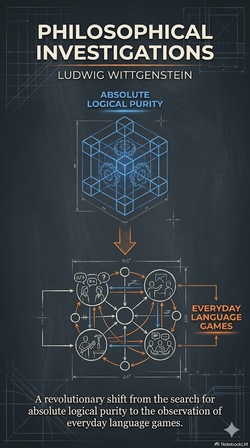
Ludwig Wittgenstein’s *Philosophical Investigations* upends traditional theories of language and meaning, rejecting his own earlier "picture theory" to argue that words gain significance not by corresponding to abstract entities, but through their use in everyday "language games"—interwoven acts of speech and action tied to specific life forms. Using vivid examples like Augustine’s account of language learning, the builder-assistant dialogue, and the duck-rabbit illusion, Wittgenstein dismantles the myth of a universal language essence. He introduces "family resemblance" to explain how concepts like "game" lack a shared core, linking instead through overlapping similarities. The work debunks private language, showing meaning depends on shared rules and public context. Ultimately, Wittgenstein frames philosophy not as a theory-building discipline, but as a "therapy" to dissolve confusion caused by linguistic misuse, guiding readers back to concrete, everyday word uses that give language its true purpose.

The Consolation of Philosophy summary and key insights by Ancius Boethius
Loading…

The Consolation of Philosophy

Ancius Boethius

4.3470 learners

Written by Boethius while imprisoned and facing execution, *The Consolation of Philosophy* is a timeless dialogue between the disgraced statesman and the personified Lady Philosophy. As Boethius wallows in despair over his unjust fall from power, Lady Philosophy arrives to dismantle his obsession with fleeting worldly goods—wealth, fame, and political status. She guides him through rigorous reasoning and poetic allegory to uncover that true happiness lies not in external fortunes, but in the pursuit of universal goodness rooted in divine wisdom. The text explores core philosophical questions: the illusion of fate vs. the order of divine providence, the inherent powerlessness of evil, the unshakable reward of virtue, and how human free will coexists with God’s omniscience. More than a philosophical treatise, it is a profound comfort for anyone grappling with adversity, reminding readers that inner virtue and connection to eternal truth are the only unshakable sources of peace.

Childhood's End   summary and key insights by Arthur C. Clarke
Loading…

Childhood's End

Arthur C. Clarke

4.6611 learners

Arthur C. Clarke’s *Childhood’s End* unfolds a haunting, visionary tale of cosmic intervention and humanity’s ultimate destiny. When massive alien ships hover over Earth, their enigmatic leader Karellen ushers in a global utopia—erasing war, poverty, and disease, but at the cost of human autonomy and space exploration. While most embrace the peace, rebels like the Freedom League fight to reclaim human control, and curious figures like Secretary Stormgren risk everything to uncover Karellen’s true form. Decades later, as humanity settles into stagnant comfort, a new generation of children begins awakening to extraordinary mental powers, revealing the aliens’ hidden purpose: to guide humanity toward a metamorphosis into the Overmind, a transcendent, collective cosmic consciousness. Clarke masterfully explores themes of free will, evolution, and humanity’s place in the universe, challenging readers to question what it means to be 'human' when faced with a fate greater than individual existence.

A Canticle for Leibowitz summary and key insights by Walter M. Miller Jr
Loading…

A Canticle for Leibowitz

Walter M. Miller Jr

4.6533 learners

Spanning over a millennium, *A Canticle for Leibowitz* traces humanity’s struggle to recover from repeated nuclear apocalypses, centered on a desert monastery dedicated to preserving the remnants of lost scientific knowledge. It begins with novice Francis Gerard, who stumbles on the relics of Saint Leibowitz—a 20th-century scientist turned monk who saved critical documents before civilization collapsed into the 'Great Simplification,' an era where knowledge was deemed heresy. As centuries pass, the monastery becomes a beacon of hope: scholars like Thaddeus Pfardentrot clash with monks over the purpose of preserved wisdom, while war and political greed threaten to ignite another cataclysm. Finally, as nuclear war looms again, a small group of monks launches an interstellar mission to carry humanity’s combined legacy of faith and science to a new home, breaking the cycle of self-destruction. Walter M. Miller Jr.’s masterpiece explores the fragile balance between religious devotion and rational inquiry, asking whether humanity can ever learn from its repeated mistakes.