Technology Book Summaries & Key Insights

Technology Total 104 books

The Beauty of Mathematics summary and key insights by Wu Jun
Loading…

The Beauty of Mathematics

Wu Jun

4.31125 learners

Ever wondered how your favorite search engine nails your query, or how voice recognition understands your speech? The Beauty of Mathematics demystifies the hidden math powering these everyday technologies. Written by Wu Jun, this book breaks down complex concepts—from statistical language models and hidden Markov models to information entropy and Boolean algebra—and shows how they transformed natural language processing, web search, and AI from lab experiments to real-world tools. It also shares fascinating stories of pioneers like Fred Jelinek, who revolutionized speech recognition by ditching rule-based methods for statistics, and Amit Singhal, Google’s master of simple, efficient algorithms. Whether you’re a tech enthusiast, student, or professional, this book reveals math isn’t just abstract formulas—it’s the backbone of the digital world you rely on daily.
Complexity summary and key insights by Mitchell Waldrop
Loading…

Complexity

Mitchell Waldrop

4.4571 learners

Mitchell Waldrop’s *Complexity* traces the explosive birth of a revolutionary scientific field, following a ragtag group of cross-disciplinary thinkers who challenged the rigid, reductionist paradigms of 20th-century science. At the heart of the story is Brian Arthur, a rebellious economist who upended mainstream economics with his theory of increasing returns—showing how small initial advantages can lock in market dominance, defying the traditional focus on equilibrium. The book then chronicles the creation of the Santa Fe Institute (SFI), where Nobel laureates, physicists, biologists, and economists gathered to study complex systems: dynamic, adaptive networks where order emerges spontaneously from chaos. From the artificial stock market model that explained bubbles and crashes to Stuart Kauffman’s NK landscapes and Per Bak’s sandpile theory of self-organized criticality, *Complexity* reveals how these thinkers uncovered universal rules governing everything from ecosystems to economies, redefining our understanding of how the world works.

The Inevitable summary and key insights by Kevin Kelly
Loading…

The Inevitable

Kevin Kelly

4.11019 learners

In The Inevitable, tech visionary Kevin Kelly outlines 12 irreversible technological trends shaping the next 30 years of human civilization. Rejecting utopian and dystopian extremes, he introduces "Protopia"—a state of continuous, incremental progress where small daily improvements bring new challenges yet collectively build a better world. Kelly explores how artificial intelligence will evolve into a distributed, ubiquitous force that augments human capabilities rather than replacing them. He breaks down shifting value systems: from ownership to access-driven sharing economies, static content to fluid, remixable digital media, and passive reading to interactive screen-based learning. The book also covers emerging phenomena like the quantified self, attention economy, and the rise of "Holos"—a global superorganism formed by interconnected humans, machines, and data. Urging readers to embrace being "perpetual novices," Kelly argues that adapting to constant change and actively participating in technological evolution is the only path to thriving in the coming era.

The Evolution of Physics summary and key insights by Albert Einstein;Leopold Infeld
Loading…

The Evolution of Physics

Albert Einstein;Leopold Infeld

4.31025 learners

Co-authored by Albert Einstein and Leopold Infeld, *The Evolution of Physics* takes readers on a captivating, accessible journey through the most transformative shifts in physical thought. Starting with Aristotle’s intuitive, long-dominant views on motion, it traces how Galileo’s experimental rigor laid the groundwork for Newton’s classical mechanics—establishing laws that governed our understanding of the macro world for centuries. The book then explores the cracks in this "mechanical view": the rise of thermodynamics and electromagnetic theory, which challenged the idea that all phenomena could be reduced to particle interactions. It delves into the revolutionary concepts of fields, Einstein’s special and general relativity (redefining space, time, and gravity as curved spacetime), and the birth of quantum mechanics, which upended deterministic views with wave-particle duality and probability waves. More than a textbook, it focuses on the evolution of ideas, making complex physics approachable for anyone curious about how we’ve unlocked the universe’s secrets.

The Demon-Haunted World summary and key insights by Carl Sagan
Loading…

The Demon-Haunted World

Carl Sagan

4.7961 learners

In his seminal work *The Demon-Haunted World*, Carl Sagan delivers a passionate defense of scientific thinking against the rising tide of pseudoscience, superstition, and irrationality plaguing modern society. Drawing on vivid examples—from alien abduction myths and crop circle hoaxes to faith healing scams and UFO conspiracy theories—Sagan dissects how cognitive biases, media sensationalism, and widespread scientific illiteracy allow false claims to thrive. He breaks down the core tenets of science: its self-correcting nature, reliance on falsifiability, and commitment to evidence-based inquiry, contrasting these with pseudoscience’s evasion of criticism and rejection of empirical testing. Sagan also explores the fragile, often misunderstood relationship between science and religion, arguing for mutual respect rather than conflict, and emphasizes the urgent need for improved science education to nurture critical thinking from childhood. More than a critique of irrationality, this book is a practical guide to equipping readers with the tools to distinguish fact from fiction, empowering them to navigate a world flooded with misinformation with clarity and reason.

The Universe in a Nutshell summary and key insights by Stephen Hawking
Loading…

The Universe in a Nutshell

Stephen Hawking

4.4940 learners

Stephen Hawking’s *The Universe in a Nutshell* distills cutting-edge cosmic physics into an accessible, mind-expanding journey through the universe’s most profound mysteries. Starting with the collapse of classical physics and Einstein’s revolutionary theories of special and general relativity, Hawking unpacks how spacetime bends, time dilates, and gravity emerges as a geometric effect. He then introduces his groundbreaking no-boundary universe model, framing our cosmos as a finite yet edge-less realm shaped by quantum mechanics. The book delves into mind-bending topics like black holes, time travel paradoxes, the fate of the universe (from heat death to the big rip), and the radical membrane theory that reimagines spacetime as a high-dimensional 'brane.' Hawking also explores humanity’s future, from interstellar travel challenges to the Fermi Paradox and the search for extraterrestrial life. Blending rigorous science with witty, approachable prose, this book invites readers to grasp the universe’s complexities without sacrificing depth, making even the most abstract concepts feel tangible.

How Google Works summary and key insights by Eric Schmidt;Jonathan Rosenberg
Loading…

How Google Works

Eric Schmidt;Jonathan Rosenberg

4.2807 learners

Authored by former Google CEO Eric Schmidt and top executives Jonathan Rosenberg and Alan Eagle, *How Google Works* pulls back the curtain on the tech giant’s groundbreaking strategies for building a thriving, innovation-driven organization. Drawing on decades of hands-on experience, the book breaks down Google’s core principles: prioritizing creative elite talent over rigid hierarchies, fostering a culture of transparency and 'don’t be evil' ethics, and leaning into technical insights rather than conventional market research. Real-world anecdotes—like the weekend fix that birthed the billion-dollar AdWords platform, the 20% time policy that spawned Gmail, and the OKR system that aligns teams around bold goals—illustrate how these practices fuel sustained growth. It also covers Google’s data-driven decision-making, flat organizational structure, and strategies for navigating digital disruption, offering actionable advice for leaders and entrepreneurs looking to adapt their own companies to the fast-paced 21st-century business landscape.

Hackers and Painters summary and key insights by Paul Graham
Loading…

Hackers and Painters

Paul Graham

4.2468 learners

In *Hackers and Painters*, Paul Graham redefines hackers not as malicious intruders, but as creators—artists of code who share the same drive to build meaningful work as painters, writers, and architects. Drawing from his own experiences as a high school nerd, he unpacks why intelligent students are ostracized: they prioritize intellectual curiosity over the performative popularity games that dominate American secondary schools. Graham then dives into taboo speech, urging readers to question societal norms and think freely. He shares firsthand insights from co-founding Viaweb, the first SaaS e-commerce platform, explaining how small, agile teams leverage cutting-edge languages like Lisp to outpace corporate competitors. The book also breaks down wealth creation, arguing that startups are the fastest path to building value by solving real problems, and introduces Bayesian filtering as a smarter solution to spam. Finally, Graham distills universal design principles, showing how elegance, simplicity, and user-centricity apply across tech, art, and engineering. A must-read for programmers, entrepreneurs, and anyone who thinks differently about building and innovation.

Deep summary and key insights by James Nestor
Loading…

Deep

James Nestor

3.5783 learners

Journalist James Nestor takes readers on an immersive journey into the world of freediving, starting with his eye-opening coverage of the 2011 World Freediving Championships in Greece. Witnessing athletes push human limits to dive 300 feet—where lungs compress to the size of baseballs—ignites his obsession, leading him to explore the science, history, and spiritual connections of underwater exploration. He delves into the mammalian dive reflex, a genetic instinct that slows heart rate and redirects blood flow to vital organs, and documents his own transformative dives, from shallow encounters with fish to deep, awe-inspiring interactions with sperm whales. Nestor also uncovers the fading tradition of Japan’s ama divers, women who’ve freedived for 2,500 years in harmony with the ocean, and explores cutting-edge research on abyssal zone life and the iron-sulfur world hypothesis, which suggests life originated in deep-sea hydrothermal vents. Blending personal narrative, scientific inquiry, and cultural reflection, *Deep* redefines humanity’s ancient bond with the ocean and challenges readers to rethink our relationship with the natural world.

The Global History of Science and Technology summary and key insights by Jun Wu
Loading…

The Global History of Science and Technology

Jun Wu

3.41039 learners

Spanning from humanity’s first stone tools to cutting-edge gene editing and quantum communication, *The Global History of Science and Technology* traces how technological breakthroughs have shaped every era of human civilization. Starting with the 1.76-million-year-old Acheulean handaxe and controlled fire use that let early humans expand beyond Africa, it moves through agricultural revolutions, the rise of metallurgy, and the birth of systematic scientific methods in ancient Greece and the Islamic Golden Age. The book highlights pivotal moments like the Industrial Revolution’s steam engines, Einstein’s relativity, the atomic age, and the digital revolution’s computers and internet. It also explores emerging technologies—CRISPR, quantum communication, artificial photosynthesis—and their ethical implications. More than a timeline, it connects tech advancements to social shifts, from early settlement to modern globalization, showing how science has always been intertwined with human survival, progress, and ambition.

On The Top of Tides summary and key insights by Wu Jun
Loading…

On The Top of Tides

Wu Jun

3959 learners

"On The Top of Tides" takes readers on a riveting journey through the rise, collapse, and reinvention of iconic tech giants—from AT&T’s century-long fall from grace to IBM’s dramatic turnaround, Apple’s revolutionary comebacks, and Microsoft’s enduring dominance. Beyond these gripping narratives, it unpacks the foundational rules shaping the tech industry: Moore’s Law, the Andy-Beer Theorem, and the winner-take-all market dynamics that define success in the digital age. It also delves into Silicon Valley’s unique ecosystem, exploring how venture capital, Stanford University’s innovation hub, and a culture of risk-taking fuel breakthroughs. Blending real-world case studies with actionable insights, this book offers invaluable lessons for entrepreneurs, business leaders, and tech enthusiasts on navigating disruptions, adapting to market shifts, and building sustainable, future-ready enterprises.

The History of Science summary and key insights by Wu Guosheng
Loading…

The History of Science

Wu Guosheng

4.4535 learners

Spanning millions of years, The History of Science chronicles humanity’s awe-inspiring journey from primitive toolmaking and celestial observations to cutting-edge quantum physics and genetic engineering. It starts with the scientific sparks in ancient civilizations—Egyptian solar calendars, Mesopotamian 60-进制 math, and China’s Four Great Inventions—then moves to the Greek rational revolution, where thinkers like Aristotle and Archimedes laid Western science’s foundational framework. The book navigates the medieval era by highlighting Arab scholars’ critical role in preserving and advancing classical knowledge, then dives into the Scientific Revolution: Copernicus’s heliocentrism, Galileo’s experimental breakthroughs, and Newton’s universal laws. It covers 19th-century milestones like Darwin’s evolution and Mendel’s genetics, 20th-century revolutions in relativity and quantum mechanics, and the rise of high-tech fields like nuclear energy, aerospace, and the internet. Finally, it explores modern debates over scientific unity and time’s role in the universe, offering a comprehensive look at how science has shaped civilizations and humanity’s understanding of the world.

What Technology Wants summary and key insights by Kevin Kelly
Loading…

What Technology Wants

Kevin Kelly

4.3454 learners

In *What Technology Wants*, visionary Wired co-founder Kevin Kelly upends our rigid views of tech as cold tools or looming threats. Drawing from decades of hands-on experience—from living off-grid to building early online communities—he argues technology is not a human invention to control, but a living, evolving "technium"—the 7th kingdom of life, extending 4 billion years of cosmic evolution. Kelly unpacks how exotropy (the force of order against entropy) drives tech’s inevitable trajectory: convergent evolution mirrors biological patterns, with key inventions emerging independently across cultures. He explores tech’s dual nature—its ability to expand human freedom and potential, yet risk eroding connection and autonomy. Using the Amish’s deliberate tech selection as a model, he offers a roadmap for co-evolving with tech: not rejecting it, but choosing mindfully to align its growth with human values, turning the "infinite game" of tech evolution into a partnership that enriches both humanity and the cosmos.

The Martian summary and key insights by Andy Weir
Loading…

The Martian

Andy Weir

3.8694 learners

When astronaut Mark Watney is left for dead after a catastrophic sandstorm cuts short NASA’s Ares 3 mission to Mars, he finds himself stranded alone on the red planet with limited supplies and no way to contact Earth. Armed with his background as a botanist and mechanical engineer, Watney refuses to surrender: he repurposes mission equipment, cultivates potatoes using Martian soil and human waste, and improvises life-saving solutions to overcome oxygen, water, and food shortages. Back on Earth, a sharp-eyed NASA analyst spots signs of Watney’s survival, sparking a global effort to bring him home. As Watney undertakes a perilous 3,200-kilometer journey to the Ares 4 landing site, NASA engineers race against time to modify rescue vehicles, while the Hermes crew defies orders to turn their return trip into a daring rescue mission. A gripping tale of ingenuity, resilience, and international collaboration, *The Martian* proves that even in the harshest environments, human resourcefulness can beat the odds.

Hacking Growth summary and key insights by Sean Ellis;Morgan Brown
Loading…

Hacking Growth

Sean Ellis;Morgan Brown

4.3638 learners

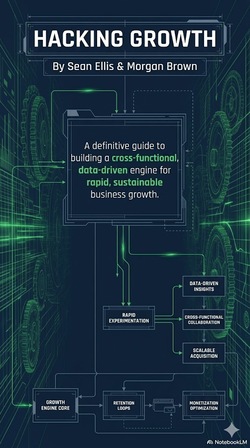
Hacking Growth, the definitive playbook for scaling businesses in the digital era, outlines a systematic, data-driven framework to achieve explosive, sustainable growth without draining marketing budgets. Co-created by growth hacking pioneer Sean Ellis and Morgan Brown, this methodology centers on cross-functional teams that break down silos between engineering, marketing, and data teams to run rapid, iterative experiments. Covering every stage of the user lifecycle—acquisition, activation, retention, and monetization—the book uses real-world case studies from Dropbox, Hotmail, Airbnb, and more to show how to identify your product’s 'aha moment', set a North Star Metric to align teams, and build a repeatable growth engine. It also addresses common pitfalls like growth stagnation, offering strategies to keep innovating and adapting to market shifts. Whether you’re a startup founder or corporate leader, this book turns growth from a lucky break into a predictable, scalable process.

Makers summary and key insights by Chris Anderson
Loading…

Makers

Chris Anderson

4.2574 learners

In *Makers*, Chris Anderson explores how the global Maker Movement is sparking the Third Industrial Revolution, bridging digital innovation with physical manufacturing to democratize creation. Drawing on personal stories—like his grandfather’s struggle to commercialize an automatic sprinkler system in the 1940s—and historical parallels to Manchester’s first industrial boom, Anderson shows how modern tools (3D printers, laser cutters, open-source platforms) have erased the high barriers to entry that once kept inventors from scaling their ideas. He highlights game-changing models: crowdfunding platforms like Kickstarter that fund projects without traditional capital, open-source communities like DIY Drones that turn hobbyists into industry leaders, and companies like 3D Robotics and Local Motors that blend community collaboration with agile manufacturing. Anderson also breaks down the 'physical long tail' effect, where niche, custom products thrive alongside mass-produced goods, and argues that this shift is reviving local manufacturing, creating high-skill jobs, and redefining how we design, build, and sell physical products in the 21st century.

Who Says Elephants Can't Dance? summary and key insights by Louis V. Gerstner
Loading…

Who Says Elephants Can't Dance?

Louis V. Gerstner

4.3979 learners

In 1993, IBM teetered on the edge of collapse—crippled by plummeting profits, bloated bureaucracy, and widespread calls to split the once-dominant tech giant. Enter Lou Gerstner, a non-tech CEO with a proven track record of reviving struggling corporations. Rejecting the prevailing wisdom to break IBM into smaller niche units, Gerstner launched a radical overhaul: slashing $89 billion in costs, cutting 35,000 jobs, dismantling rigid hierarchical systems, and refocusing the company on client needs instead of internal power struggles. This unflinching memoir chronicles his high-stakes journey, from tense negotiations to take the top job, to bold decisions like aggressive mainframe price cuts and unifying IBM’s fragmented brand under a single ad agency. Gerstner’s no-nonsense approach proved that even the largest, most entrenched organizations can adapt, turning IBM from a dying "elephant" into a nimble, industry-leading powerhouse once again.

Spin summary and key insights by Robert Charles Wilson
Loading…

Spin

Robert Charles Wilson

4657 learners

In Robert Charles Wilson’s *The Spin*, a cataclysmic event called the October Incident wraps Earth in a mysterious time barrier—cutting us off from the stars, warping temporal flow, and setting our planet on a 40-to-50-year countdown to destruction. Follow childhood friends Taylor, Jason, and Diane as Jason uncovers the truth: the barrier slows Earth’s time to shield us from deadly cosmic radiation, while the outside universe ages billions of years. As global chaos erupts, Jason leads a desperate Mars terraforming mission, sending life to the red planet to secure humanity’s future. When Martian envoy Vanowen arrives with advanced biotech and warnings of their own impending time barrier, the trio navigates political betrayal, personal sacrifice, and the ultimate choice: stay to face Earth’s end, or flee through the Great Arch to an uncharted New World. A gripping tale of survival, friendship, and humanity’s relentless drive to outrun extinction.

Seveneves summary and key insights by Neal Stephenson
Loading…

Seveneves

Neal Stephenson

4.2598 learners

When the moon shatters into seven massive chunks without warning, humanity faces an existential crisis: the resulting 'Hard Rain' of lunar debris will bombard Earth for centuries, rendering the planet uninhabitable. Neal Stephenson’s *Seveneves* unfolds as a sweeping sci-fi epic spanning 5,000 years, tracking humanity’s desperate fight to survive. The story begins with the launch of the Cloud Ark, a space station-turned-refuge that becomes a hub for engineers, scientists, and survivors grappling with political infighting, technical failures, and the high stakes of preserving civilization. As factions split over whether to stay near Earth or flee to Mars, a daring mission to retrieve a giant ice comet holds the key to sustaining the ark. Centuries later, the narrative shifts to a rebuilt Earth, where seven distinct human races—descended from the last surviving women, the 'Seven Eves'—navigate new conflicts, hidden civilizations, and the challenge of reuniting fragmented humanity. Blending hard science, political drama, and deep character exploration, *Seveneves* offers a gripping look at resilience, innovation, and the future of humanity in the cosmos.

A Fire Upon The Deep summary and key insights by Vernor Vinge
Loading…

A Fire Upon The Deep

Vernor Vinge

4.41300 learners

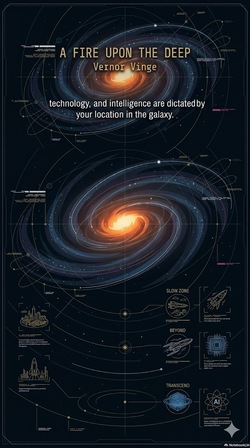
Set in Vernor Vinge’s iconic Zones of Thought universe—where cosmic regions dictate technological and cognitive limits—*A Fire Upon The Deep* unfolds a high-stakes interstellar saga. When the Straumli Realm awakens a galaxy-devouring entity known as the Blight, a group of human children flees to the Tines World, a planet inhabited by intelligent symbiotic creatures. Librarian Ravna Bergsndotter, driven by a thirst for adventure, joins a rescue mission alongside the sentient ship trees Blue Pod and Emerald Stem, and Pham Nuwen, a flawed envoy reconstructed by transcendent beings. As they navigate interstellar threats and the Tines’ brutal civil war, the crew must race against time to stop the Blight from consuming the entire galaxy. Vinge masterfully weaves complex worldbuilding, political intrigue, and heartfelt character dynamics, culminating in a climactic battle that reshapes the very fabric of the Zones, leaving both humans and Tines to forge a new future in a permanently altered cosmos.