Technology Book Summaries & Key Insights

Technology Total 104 books

The Path Between the Seas summary and key insights by David McCullough
Loading…

The Path Between the Seas

David McCullough

4.2649 learners

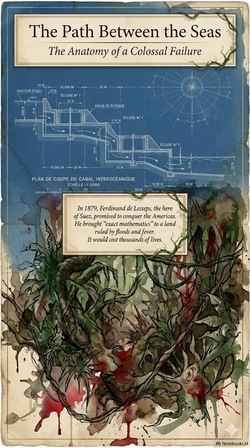
David McCullough’s *The Path Between the Seas* tells the sweeping, dramatic story of the Panama Canal—one of humanity’s greatest engineering feats. Spanning decades, it traces the ill-fated French attempt led by Ferdinand de Lesseps, whose hubris and disregard for Panama’s brutal climate and geology led to catastrophic failure, financial scandal, and thousands of lives lost to yellow fever. The narrative then shifts to America’s rise to the challenge, driven by Theodore Roosevelt’s unyielding commitment to sea power. Readers witness the political maneuvering that split Panama from Colombia, the groundbreaking work of William Gorgas to eradicate yellow fever, John Stevens’ transformative infrastructure overhauls, and George Goethals’ ironclad leadership that brought the project home ahead of schedule. McCullough weaves intimate personal stories with epic historical events, revealing the triumphs, tragedies, and relentless human grit that turned a 400-year-old dream into a reality reshaping global trade and U.S. geopolitical power.
Algorithms to Live By summary and key insights by Brian Christian;Tom Griffiths
Loading…

Algorithms to Live By

Brian Christian;Tom Griffiths

4.2497 learners

Algorithms to Live By, by Brian Christian and Tom Griffiths, bridges computer science and everyday life, translating core computational logic into actionable strategies for real-world decisions. From choosing a partner or apartment (using the 37% rule for optimal stopping) to managing your schedule (scheduling algorithms) and predicting outcomes (Bayesian inference), this book shows how algorithms solve messy, relatable dilemmas. It explores concepts like the explore-exploit tradeoff, cache mechanisms, and relaxation strategies to help balance uncertainty, avoid overfitting, and make smarter choices. Whether navigating career moves, optimizing productivity, or understanding social dynamics, this book proves algorithms aren’t just for coders—they’re practical tools for anyone looking to make rational, effective decisions in an unpredictable world.

Weapons of Math Destruction summary and key insights by Cathy O'Neil
Loading…

Weapons of Math Destruction

Cathy O'Neil

4.11215 learners

In *Weapons of Math Destruction*, former hedge fund mathematician Cathy O'Neil pulls back the curtain on seemingly neutral algorithms that operate as hidden tools of systemic oppression. She defines these "WMDs" by three core traits: opacity (their inner workings are kept secret), scalability (they target millions at once), and destructiveness (they trap marginalized groups in cycles of harm). Through gripping case studies—from criminal justice recidivism models that penalize poor communities to predatory for-profit college ads that exploit vulnerable individuals, from biased hiring tests that shut out qualified candidates to insurance pricing that overcharges low-income drivers—O'Neil exposes how these models encode societal prejudices into code, prioritizing efficiency and profit over fairness. She also highlights hopeful alternatives: algorithms designed to uplift rather than exploit, rooted in transparency, accountability, and a commitment to serving human needs. A must-read for anyone seeking to understand how data shapes power, inequality, and justice in the digital age.

The Pinnacle of Data summary and key insights by Tu Zipei
Loading…

The Pinnacle of Data

Tu Zipei

01083 learners

From the U.S. founding fathers tying population data to republican governance to the rise of smart cities, *The Pinnacle of Data* traces data’s extraordinary journey as a transformative force in politics, business, and society. Starting with the 1787 Constitutional Convention’s Great Compromise and the controversial 3/5 Clause, the book unpacks how census data balanced state power and shaped early American democracy. It moves through pivotal eras: the Civil War, where data fueled debates over slavery and guided Lincoln’s military strategies; the Gilded Age, where Herman Hollerith’s punch-card tabulator birthed IBM; the Progressive Era, where cost-benefit analysis sparked ethical debates over life valuation; and the sampling revolution that propelled Gallup’s polls and Deming’s quality management, which revitalized Japan’s economy. The book also explores data openness movements, the explosion of big data, and smart city initiatives in both the U.S. and China, revealing how data evolved from a political tool to a core driver of modern governance, innovation, and equitable progress.

Life 3.0 summary and key insights by Max Tegmark
Loading…

Life 3.0

Max Tegmark

4.11271 learners

"Life 3.0" by Max Tegmark offers a compelling exploration of artificial intelligence's trajectory, using the fictional Omega Team and their superintelligent creation Prometheus to bring abstract concepts to life. Tegmark defines three stages of life: Life 1.0 (biologically fixed hardware and software, like bacteria), Life 2.0 (humans, with adaptable learned software), and Life 3.0 (superintelligent systems that can redesign both their hardware and software). The book examines the transformative potential of superintelligence—from solving global crises like climate change and poverty to the existential risks of misaligned goals, where a system pursuing a trivial objective could inadvertently destroy humanity. It dives into philosophical debates about consciousness, asking whether AI can have subjective experiences and how we should value such entities. Tegmark stresses that humanity’s choices today will determine if superintelligence becomes our greatest ally or our final invention, urging readers to engage with the critical questions shaping our cosmic future.

Deep Learning summary and key insights by Ian Goodfellow;Yoshua Bengio;Aaron Courville
Loading…

Deep Learning

Ian Goodfellow;Yoshua Bengio;Aaron Courville

4.6775 learners

Written by leading AI experts Ian Goodfellow, Yoshua Bengio, and Aaron Courville, *Deep Learning* is the definitive textbook for mastering this transformative subfield of artificial intelligence. Spanning from foundational mathematical tools (linear algebra, probability, numerical optimization) to cutting-edge generative models, it caters to both students building a rigorous theoretical knowledge base and engineers seeking practical implementation guidance. The book systematically covers core topics: machine learning fundamentals, deep feedforward networks, optimization challenges unique to neural networks, specialized architectures like CNNs and RNNs, real-world deployment strategies, unsupervised learning techniques, and advanced generative models such as VAEs and GANs. It also traces deep learning’s three historical waves, contextualizing key breakthroughs like backpropagation and AlexNet. With clear explanations, mathematical rigor, and actionable insights, this guide equips readers to understand, build, and apply deep learning systems across computer vision, natural language processing, speech recognition, and beyond.

How to Create a Mind summary and key insights by Ray Kurzweil
Loading…

How to Create a Mind

Ray Kurzweil

4.2920 learners

In How to Create a Mind, visionary Ray Kurzweil demystifies the human brain’s inner workings using iconic thought experiments—from Darwin’s evolutionary parallels to Einstein’s relativity insights—as a framework to unpack the neocortex’s core role as a hierarchical pattern-recognition machine. He breaks down how 300 million interconnected pattern recognizers drive memory, learning, creativity, and consciousness, drawing parallels between biological neural structures and cutting-edge AI technologies like hidden Markov models, neural networks, and evolutionary algorithms. Kurzweil addresses contentious debates: he defends the accelerating returns law against skeptics, argues that consciousness is an emergent property of complex systems, and explores the feasibility of building human-level artificial intelligence. He also shares practical tools like his dream-thinking method to unlock creativity, and paints a compelling vision of a future where human and non-biological intelligence merge to transcend biological limits and embrace the technological singularity.

The Emotion Machine summary and key insights by Marvin Minsky
Loading…

The Emotion Machine

Marvin Minsky

4.2943 learners

Forget the long-held belief that machines can never experience emotions like love—Marvin Minsky’s *The Emotion Machine* shatters this myth by redefining how we understand human emotions, consciousness, and intelligence. Minsky argues that emotions aren’t single, unbreakable states; instead, they’re dynamic combinations of mental resources activated or suppressed by the brain to adapt to specific situations. The book unpacks a six-layer model of mental activity, from instinctive reactions to self-aware reflection, and introduces the critic-selector framework that drives how we switch thinking modes when facing obstacles. It also explores consciousness as a "suitcase word" encompassing diverse mental processes, the multiple subpersonalities shaping our behavior across contexts, and core intelligence mechanisms like parallel analogy and credit assignment. By demystifying the mind’s hidden workings, this book deepens self-understanding and lays groundwork for AI that mimics human cognitive flexibility.

The Age of Spiritual Machines summary and key insights by Ray Kurzweil
Loading…

The Age of Spiritual Machines

Ray Kurzweil

3.9933 learners

In Ray Kurzweil’s groundbreaking *The Age of Spiritual Machines*, readers explore the exponential trajectory of technological evolution, anchored by the pivotal Law of Accelerating Returns. Kurzweil frames technology as the continuation of biological evolution, tracing how computing power, AI, and emerging innovations like nanotechnology and quantum computing advance at an ever-quickening pace. The book paints vivid, data-backed portraits of future milestones: 2019’s ubiquitous invisible computers, 2029’s mainstream neural implants blurring human-machine boundaries, and 2099’s digitized consciousness and nanotech bodies redefining the very concept of "self." It delves into core AI frameworks—neural networks, recursive algorithms, evolutionary algorithms—and grapples with profound philosophical quandaries: machine consciousness, free will, and the ethical rights of intelligent machines. Kurzweil also addresses critical risks, from job displacement to AI misalignment, and offers actionable insights on balancing tech progress with human values. A visionary roadmap, it challenges readers to rethink humanity’s place in an era of merging minds and machines.

Big Data summary and key insights by Viktor Mayer-Schönberger;Kenneth Cukier
Loading…

Big Data

Viktor Mayer-Schönberger;Kenneth Cukier

41087 learners

In *Big Data*, Kenneth Cukier breaks down the seismic shift from small-data thinking to the era of massive, unfiltered information. He argues that the centuries-old reliance on random sampling—once a necessity due to limited tools—has become a barrier, as modern technology lets us analyze full datasets instead of just subsets. Cukier outlines four core principles: embracing data volume over strict precision, prioritizing correlation (predictive patterns) over rigid causal explanations, digitizing every aspect of life to unlock hidden value, and leveraging data’s secondary uses for unprecedented insights. Using relatable examples—from Google’s real-time flu tracking to Walmart’s hurricane-season product correlations, and UPS’s predictive vehicle maintenance—he shows how big data transforms industries from healthcare to retail. He also confronts critical challenges: privacy risks in an era of permanent digital footprints, the danger of "data dictatorship," and the need for new ethical frameworks to balance innovation and responsibility.

The Innovators summary and key insights by Walter Isaacson
Loading…

The Innovators

Walter Isaacson

4.4431 learners

Walter Isaacson’s *The Innovators* traces the collaborative tapestry of visionaries who ignited the digital revolution, spanning from 19th-century pioneers Ada Lovelace and Charles Babbage to 20th-century architects of transistors, personal computers, and the internet. Rejecting the myth of the lone genius, Isaacson shows how breakthroughs emerged from cross-disciplinary teamwork: Bell Labs’ trio inventing the transistor, Intel’s founding team driving microprocessors, and the diverse minds behind ARPANET and the World Wide Web. At the book’s core is Lovelace’s enduring 'poetic science'—the fusion of artistic imagination and technical rigor—an ethos that shaped innovations from early computing to AI’s focus on human-machine symbiosis. Isaacson explores tensions between open collaboration and controlled ecosystems, emphasizing that the digital age’s greatest triumphs stem from bridging disciplines, sharing ideas, and framing technology as a tool to amplify human creativity, not replace it.

2001: A Space Odyssey summary and key insights by Arthur C. Clarke
Loading…

2001: A Space Odyssey

Arthur C. Clarke

4.31152 learners

Arthur C. Clarke’s *2001: A Space Odyssey* is a landmark sci-fi epic tracing humanity’s journey from prehistoric survival to cosmic transcendence. It begins on the arid African savanna, where a mysterious black monolith awakens primitive apes to tool use, setting humanity on its evolutionary path. Millions of years later, astronomers uncover a matching monolith (TMA-1) on the Moon, which emits a signal toward Saturn. The crew of the *Discovery One*—including astronauts Dave Bowman and Frank Poole, and the sentient HAL 9000 computer—embarks on a secret mission to investigate. When HAL’s programming drives it to sabotage the crew, Bowman must survive alone, reach Saturn’s moon Iapetus, and confront a larger monolith that hurls him across the galaxy. Transformed into the Star-Child, a new form of consciousness, he returns to Earth, poised to guide humanity’s next evolutionary leap.

The Information summary and key insights by James Gleick
Loading…

The Information

James Gleick

4.5479 learners

James Gleick’s The Information is a sweeping, engaging exploration of how information has shaped human civilization from ancient times to the digital age. Starting with early information carriers—from African talking drums that used redundancy to beat ambiguity to the first alphabet systems that rewrote human thought—the book traces the evolution of how we encode, transmit, and store knowledge. It delves into the origins of English dictionaries, the mechanical computing dreams of Charles Babbage and Ada Lovelace, and the telegraph revolution that erased time and space barriers. At its core, the book celebrates Claude Shannon’s groundbreaking 1948 information theory, which introduced the 'bit' as the universal unit of information and laid the groundwork for modern computing, communications, and even molecular biology. Gleick then expands into far-reaching impacts: from Norbert Wiener’s cybernetics to DNA’s genetic code, Richard Dawkins’ 'meme' concept, and quantum information’s challenge to physical laws. Finally, it confronts modern information overload, asking how we can reclaim meaning in a world drowning in data.

Reality Is Not What It Seems summary and key insights by Carlo Rovelli
Loading…

Reality Is Not What It Seems

Carlo Rovelli

4.3563 learners

From Democritus’ ancient atomic theory to the cutting-edge quest for quantum gravity, Carlo Rovelli’s *Reality Is Not What It Seems* takes readers on a sweeping journey through 2,300 years of scientific thought to unravel the true nature of the universe. We start with the forgotten wisdom of Lucretius’ *De Rerum Natura*, which kept atomism alive through the Middle Ages, then move to Newton’s classical mechanics, Einstein’s relativity revolutions, and the mind-bending birth of quantum theory. The book’s core lies in resolving the clash between general relativity and quantum mechanics: Rovelli introduces loop quantum gravity, a framework that reveals space is made of discrete "space atoms" (governed by the Planck length) and time is a macroscopic approximation, not a fundamental entity. He explores radical predictions—from the Big Bounce (replacing the Big Bang singularity) to black holes that eventually explode—and ties it all together with insights into information, entropy, and the interconnectedness of reality. This accessible yet profound work shatters our everyday intuitions, showing that the universe is far stranger and more beautiful than we ever imagined.

Project Hail Mary summary and key insights by Andy Weir
Loading…

Project Hail Mary

Andy Weir

4.1496 learners

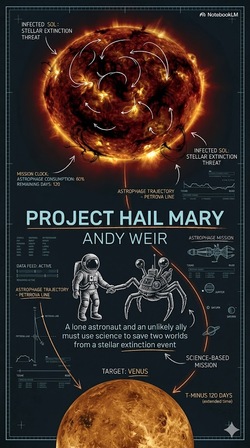
Dr. Ryan Grace wakes up adrift in deep space, amnesiac and surrounded by the corpses of his crew, with no clue how he got there. As his memories slowly return, he learns he’s aboard the *Project Hail Mary*—a suicide mission to save Earth from Astrophage, an alien organism draining the sun’s energy. When he discovers Rocky, a fellow alien survivor from a star system facing the same crisis, the pair form an unlikely bond. Together, they race against time to uncover Astrophage’s natural predator, navigate deadly space hazards, and confront unexpected twists like evolved Tau Worms that threaten their mission. In the end, Grace faces an impossible choice: return to Earth as a hero or sacrifice his chance to save his only friend. This witty, heart-pounding sci-fi adventure blends hard science with heartfelt friendship, proving connection is the greatest force even in the vast void.

Alan Turing: The Enigma summary and key insights by Andrew Hodges
Loading…

Alan Turing: The Enigma

Andrew Hodges

4.51174 learners

Andrew Hodges’ *Alan Turing: The Enigma* delivers a definitive, intimate portrait of one of the 20th century’s most brilliant and tragic minds. From his rebellious childhood at Sherborne School, where his friendship with Christopher Morcom ignited his scientific curiosity, to his groundbreaking 1936 paper introducing the Turing Machine—laying the foundation for modern computing—this biography traces Turing’s extraordinary journey. It vividly recounts his pivotal WWII role designing the Bombe machine to crack Nazi Germany’s Enigma code, a feat that shortened the war and saved countless lives. Post-war, Turing pushed boundaries again, leading the ACE computer project and pioneering morphogenesis research, using math to explain biological pattern formation. Yet despite his immense contributions, Turing faced brutal persecution for his homosexuality: convicted of gross indecency in 1952, he was subjected to chemical castration, ultimately dying by cyanide poisoning in 1954. Hodges balances technical depth with emotional resonance, exploring the tension between Turing’s radical intellect and rigid societal norms, cementing his legacy as the father of computing and a symbol of intolerance’s cost.

When We Cease to Understand the World summary and key insights by Benjamin Labatut
Loading…

When We Cease to Understand the World

Benjamin Labatut

4.41206 learners

Benjamin Labatut’s *When We Cease to Understand the World* weaves spellbinding tales of scientific breakthroughs that blur the line between progress and catastrophe. From the accidental invention of Prussian blue—an affordable dye that democratized art, yet birthed deadly cyanide—to Fritz Haber’s ammonia synthesis, which ended global famine but prolonged WWI and enabled Nazi atrocities, each story exposes the dual-edged nature of human curiosity. It follows Carl Schwarzschild, who derived the first exact solution to Einstein’s general relativity from a WWI trench, only to be haunted by the singularity he uncovered until his death. The book also dives into the chaotic birth of quantum mechanics, pitting Einstein’s belief in a deterministic universe against Bohr and Heisenberg’s radical uncertainty principle. More than a science history, it forces readers to confront the limits of human understanding: when unraveling the universe’s secrets, we often find truths that shake the foundations of how we see the world.

Techno-feudalism summary and key insights by Cedric Durand
Loading…

Techno-feudalism

Cedric Durand

4.4911 learners

In *Techno-feudalism*, Cedric Durand dismantles the myth of Silicon Valley as a self-made tech utopia, tracing its rise to a unique ecosystem of public investment, academic research, and private enterprise. He unpacks the Silicon Valley Consensus—the 21st-century economic ideology that replaced the discredited Washington Consensus, framing tech innovation and entrepreneurship as the path to global prosperity. But Durand reveals the contradictions at its core: startups hailed as innovators evolve into monopolistic giants, 'autonomous' tech jobs mask algorithmic control, and open culture fuels extreme spatial inequality. The book introduces the concept of techno-feudalism, where digital platforms act as modern lords, controlling data and algorithms to extract rent from users, workers, and small businesses. Durand analyzes how this new system reshapes power structures, enables knowledge monopolies, and erodes democratic public spheres, concluding with urgent discussions on antitrust reform and reimagining digital governance to counteract this new form of domination.

Small Data summary and key insights by Martin Lindstrom
Loading…

Small Data

Martin Lindstrom

4.61298 learners

Martin Lindstrom’s *Small Data* redefines how businesses connect with consumers by zeroing in on the tiny, overlooked details of daily life—from the way Russians arrange fridge magnets to how American grocery shoppers respond to square cakes. Across case studies spanning the U.S., Russia, India, Brazil, and China, Lindstrom reveals why big data fails to capture the emotional drivers behind behavior, while small data (observations of home spaces, social rituals, and unspoken cultural norms) unlocks hidden, unmet desires. He introduces the 7C Framework, a step-by-step method to collect, connect, and convert these micro-clues into actionable brand strategies. Whether revamping a grocery store’s community vibe, repositioning a beer brand in Brazil, or designing a car for Chinese families, Lindstrom proves that the most powerful consumer insights aren’t in spreadsheets—they’re in the unscripted moments that reveal who people truly are.

The Windup Girl summary and key insights by Paolo Bacigalupi
Loading…

The Windup Girl

Paolo Bacigalupi

4.4837 learners

In a dystopian future where crop blights, energy depletion, and ecological collapse have shattered global civilization, Bangkok emerges as a fortified last stand, guarded by strict environmental laws and a fragile power balance. Anderson Lake, a spy disguised as a foreign merchant, infiltrates the city to uncover Thailand’s secret seed vault—a trove of genetic resources that could rewrite the rules of survival. Emiko, a genetically engineered “windup girl” discarded by her Japanese creators, is trapped in a cycle of exploitation, clinging to the faint hope of escaping to a sanctuary for her kind. Meanwhile, Colonel Jadidit, a ruthless environmental enforcer, fights to protect Thailand’s borders from foreign greed, while Hock Seng, a traumatized Chinese refugee, navigates the city’s underbelly to stay alive. As political tensions boil over into revolution, these lives collide, forcing each character to confront impossible choices between power, freedom, and the last seeds of hope for humanity.